Mark 1:1 — The Beginning of the Gospel of Jesus Christ, the Son of God

August 16, 2011

The seemingly innocuous opening line of the Gospel of Mark is actually a broadside against the Roman Empire, or any empire. It is a loaded sentence.

Many think that Mark’s Gospel was written in the context of the city of Rome, perhaps to Roman Christians. Whatever the case, it was certainly written within the context of the Roman Empire. This context highlights the opening sentence of the Gospel.

To what “beginning” does Mark refer? Literarily, it is the beginning of the document and the sentence may function as a title; if not to the whole document, at least to the opening fifteen verses. But does it only have a literary function? I think it is theologically pregnant.

“Beginning” may call us to the beginning of the new creation as the first Greek word in the sentence reminds us of Genesis 1:1. The good news is that new creation has begun.  “Beginning” may point us to the beginning of the ministry of Jesus which inaugurates the new creation; it is the beginning of the in-breaking of the kingdom of God. The good news (gospel) both belongs to Jesus and is about Jesus.

More than this, Mark’s language makes a claim that contrasts with the claims of the Empire.We know that the birthday of Augustus Caesar (under whom Jesus was born) was proclaimed as “good news”  (gospel, euangelion) in the Empire. For example, a calendar inscription reads: “The birthday of the god was for the world the beginning of the joyful messages (gospel, JMH) which have gone forth because of him” (TDNT 2:724).

Further, just as Jesus is called “son of God” in Mark’s opening line, coins in the Roman world were sometimes inscribed with the Emperor’s name followed by the designation “son of God” (theou huios). The coins of Tiberius Caesar are a good example of this.

Mark begins his Gospel with an astounding claim. Jesus is the good news, not the Emperor. Jesus is the Son of God, not the Emperor. In effect, Jesus is Lord, not the Emperor.

The new era of peace, good news and justice did not begin with Augustus. Rather, it begins with Jesus. He is the servant of Isaiah who brings good news to Jerusalem and ultimately to the whole world. Mark tells the story of the Lord who rules through self-sacrificial service–the suffering servant of Isaiah–in contrast to the ruling coercive power of the Roman Caesar.

Mark calls us to believe this “gospel” (Mark 1:15)–the good news of the kingdom of God–rather than the proclamations of the empire….whether Roman or otherwise. The story of Jesus is the story of a different kind of kingdom.

Americana might hear this opening title as well as a judgment on the “good news” of the American dream and the American experiment. When Christians buy into a kind of civil religion where American values compete with the good news of Jesus we need to read the Gospel of Mark again.

My Sunday morning Bible class at Woodmont Hills (Nashville, TN) began a study of Mark this past Sunday. Hopefully, I will have some time to occasionally blog my thoughts on our reading of the text.


Summer Travels Now Complete

August 15, 2011

It has been a whirlwind summer but a satisfying one.  Only now have I been able to make time to offer a summary. In later posts I hope to tell more about each of our trips.

It began teaching a course on the historical geography of Israel which climaxed in a two-week tour of Israel where archeological, topographical and historical sites were emphasized.

Jennifer, Lacey and I then went on an almost three-week teaching tour in Singapore, Malaysia, and Australia (Brisbane). Jennifer and Lacey taught children while I led some discussions among adults.

After Lipscomb’s Summer Celebration, Jennifer and I participated in the VBS of the Pitman Church of Christ in NJ. We always enjoy visiting that congregation whose long time minister is Dan Cooper…and more on that later.

Saturday we returned from Guatemala where we participated in one of the surgical weeks of Health Talents International at Clinica Ezell. Jennifer served as a nurse and I served as Chaplain.

We are grateful to be safe, healthy and home.  And we are grateful for new friends, renewal of friendship with old friends, and the opportunity to serve in the Kingdom this summer.

I plan to say more in the future, but now I must prepare for the coming semester which begins next week.


Osama bin Laden

May 2, 2011

“Got him!” The headlines fill our papers, newsrooms and social media. Osama bin Laden, the mastermind of 9-11 is dead.

What should I do? Dance? Party? Shout “U-S-A” over and over?

What should I feel? Pride? Joy? Satisfaction? Patriotic? Gratitude?

I have mixed feelings. “Justice has been done,” says our President. Maybe so. One function of government is to execute jusice. God uses governments for that purpose though not everything nations do is necessarily just.

On the other hand, the celebration, joy and partying that litters our television screens from around the nation disturb me. I could understand if peace had arrived, if the war was over. That would be something to celebrate. But that is not what happened.

In Ezekiel, God spoke into the evil of the world with justice, but yet also said “I take no pleasure in the death of the wicked” (33:11).

Joy is not what I feel. I feel sad that the cycle of violence continues, and it will continue as violence breeds violence. I don’t feel like celebrating.

I feel like praying….

  • praying for all combatants in this conflict, this nation’s military as well as others.
  • praying for the victims of 9-11 as they re-live their loss today
  • praying for the enemies of this nation
  • praying for the family of Osama
  • praying for this nation
  • praying for peace
  • praying

May 21, 2011…Who Knew?

April 21, 2011

They do.  Jesus didn’t.

Yes, that is correct.  They know.  They have published it on billboards, the intenet and other media sources. Judgment Day is May 21, 2011, and the end of the world will follow on October 21,2011.

But Jesus didn’t know.

How do they know?  They looked it up in the Bible and calculated it.   Here’s how.

1.  The seven days of Genesis 7:4 are 7000 years because one day with the Lord is like a 1000 years.

Did Jesus know that?

2.  This was said to Noah in 4990. Minus 7000, and you get 2011.

Did Jesus know that?

But enough of the calculation. You can read it for yourself if you like. My point is quite simple.

Jesus had all the data available to him that is available to them. They read the Bible and conclude May 21, 2001 is the day!  Jesus, however, knew the same data and said “I don’t know” (cf. Mark 13:32).

Who do you believe?  I think I’ll go with Jesus.


McGary Asks for Forgiveness

March 22, 2011

Several days ago I posted a paragraph by Austin McGary (1846-1928) whose language astonished (and saddened) many of you. In fairness to brother McGary, I want to note his apology in the May 31, 1923 Gospel Advocate. Here he apologizes for what he wrote in the Gospel Outlook which he published from 1903-1905 after he was dismissed from the Firm Foundation.  He wrote (“A Sincere Apology,” GA 65 [31 May 1923] 529):

Brother Boles and Brother McQuiddy have both written me concerning some very improper and unchristianlike things I said about Brother D. Lipscomb in the Gospel Outlook many years ago. I sincerely and deeply and penitently regret having said these things, and I unfeignedly and feelingly beg all of Brother Lipscomb’s friends and the brotherhood in general to forgive me. It will be a lifelong regret with me that I did not apologize to Brother Lipscomb before he died for saying these things about him.

J. C. McQuiddy (1858-1924), editor of the Advocate, responded:

I most heartily commend this Christian apology, and would be glad to see many others follow the good example set by Brother McGary. Many apologies are needed just now, and those who should make them would be better for the making.

While it is not best to grieve over spilt milk, I would have been very glad for David Lipscomb to have read such an apology during his life, for I am sure he would have rejoiced to have received it and would have freely forgiven Brother McGary. We must forgive if we expect to be forgiven. This is a lesson that not only needs to be learned, but also one which should be practiced.

Terry Gardner noted this quotation in “Lipscomb, McGary and Forgiveness,” GA 145 (1 April 2003) 26 as well as in his lecture on McGary at the 2009 Freed-Hardeman Lectureship (available on I-Tunes).


Woe to Imperialism

March 21, 2011

Yesterday my Bible class at Woodmont Hills encountered the prophet Habakkuk’s condemnation of imperialism in chapter 2:6-20. In the wake of the United States’ entrance into another war (making it three current ones), I was struck with how relevant the prophet is. [My handouts for this class on Habakkuk are available here.]

The section is headed by a rhetorical question:  “Will not all of them [the nations] taunt him [Babylon] with ridicule and scorn?” And what will they say? This is where the prophet inserts his “woes” against imperialism in 2:6b-20.

There are five woes.

  • Woe to those who gain wealth by theft, extortion and plunder, that is, woe to any nation that gains wealth through injustice. The nation that lives by plunder will die by plunder; as they do unto others, so it will be done to them (2:6b-8)
  • Woe to those who erect monumental structures with such pride that they think they can escape ruin themselves even while they cause the ruin of others. The very buildings they erect will cry out against them (2:9-11).
  • Woe to those who build their empire by violence and injustice. They exhaust themselves in nation-building but it is all in vain (2:12-13); though nations exalt themselves in pride, they “imagine a vain thing” (Psalm 2:1).
  • Woe to those who humiliate, abuse and shame their neighbors as well as violently attack human beings as well as the ecosystems of creation (when the trees of Lebanon are cut down the animals lose their habitat; 2:15-17).
  • Woe to those who substitute another god for the true God, whether it be an idol made of gold and silver or gold and silver itself (2:18-19).

But there are two also doxological affirmations.

  • “For the earth will be filled with the knowledge of the glory of the Yahweh as the waters cover the sea” (2:14)–empires will not reign forever, but one day the natons will know Yahweh when violence and injustice will cease and the shalom of Yahweh will cover the earth.
  • “The Yahweh is in his holy temple; let all the earth be silent before him” (2:20)–even Babylon must be silent before the God of all the earth, and when in the presence of Yahweh’s holiness, we all must cover our mouths, prostrate our bodies, and humble ourselves before Yahweh.

Woe to Empires but glory to Yahweh. Yahweh wins, the nations don’t. But praise be to God, when Yahweh wins, the nations will come to know the glory of Yahweh.


McGary on Rebaptism: Reason to Divide

March 15, 2011

In 1898, Willam K. Homan in the Texas Christian Courier noted how relationships between the Gospel Advocate and Firm Foundation were deteriorating. This elicited a strong comment from Austin McGary, the editor of the Firm Foundation. I find this particular comment quite revealing as it parallels the instrumental music and missionary society controversies with the rebaptism controversy.  It is, it seems, worth a divison.

“We cheerfully admit that neither the society nor the organ has anything to do with this vile attack upon us by the Advocate combine. But the trouble between us is traceable to the very same presumptuous spirit that brings the society and organ into the work and worship of the church. Bros. Lipscomb and Harding and their wicked confederates in this attack upon us claim to speak where the Bible speaks and to be silent where the Bible is silent. But, like Homan and his confederates in advocating the society and organ, they speak where the Bible does not speak, and are silent where the Bible does speak, in their defense of Baptist baptism. And, besides pursuing the very same presumptuous course that the society and organ advocates do, these brethren are tenfold more palpably culpable in their effort to defend their practice of receiving Baptists on their baptism, because, in holding to this practice, they prove that they are wilfully going beyond the authority of the Lord, because they have taught–and have never retracted it–that “Baptist conversion drives God out of the work, and is wholly of men.” And they have made their four-cornered war of slander upon us because we have shown p the inconsistent and self-stultifying course of their big chief, and the cowardice and false statements of their little chief.  But all of this evil on their part grows out of the very same presumptuous spirit that prompts W. K. Homan to advocate the society and organ.”

Austin McGary, “Editorial,” 14,37 (!3 Septmber 1898) 284.


“Woman’s Privilege”: Two Views

March 14, 2011

James A. Harding began his publication The Way in 1899 in order to disseminate to a larger audience what he taught at the Nashville Bible School.  At the same time J. B. Briney, a longtime friend and now adversary of Harding, started his own monthly paper entitled Briney’s Monthly,  The two papers sparred back and forth on several issues, including the role of women in the public assembly. 

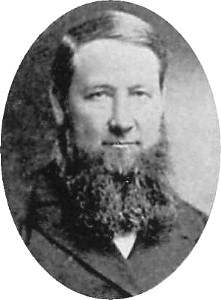
Though Briney (pictured here) and Harding were at one time close associates (Briney had preached at Harding’s hometown church in Winchester, KY for four years}, they found themselves on different sides of the fence on issues like instrumental music, missionary socieites, and the role of women in the public assembly.

When The Way merged with Rowe’s Christian Leader in 1904, Harding found himself in some heated discussions about the role of women.  Briney’s paper (which would come to represent some of the conservative thinking among the Christian Church) and Daniel Sommer’s paper (Octographic Review) essentially held the same position on the role of women in public worship. Harding responded with quite a few articles on the topic.

In the exchange below, Harding reprints an article by George Bersot (who attended Eminence College in KY with Briney) on the privilege of women to which Harding responds.   This is simply one example among many of the kind of discussion that engulfed the Stone-Campbell Movement in the first decade of the 20th century.  Along with instrumental music, missionary societies, higher criticism as well as various sociological and sectional perspectives, the role of women became a dividing line between the Christian Church and Churches of Christ.

Harding’s views extended beyond the public assemblies of the church into the public roles of women in society.  In another place than given below, Harding argued that the

“New Testament does not allow women to usurp authority over men by teaching and leading in the church, because it is wrong for her so to usurp authority anywhere. It seems clear to me that the same principles that prevent her from teaching in the church, prevail in the schoolroom or anywhere else; it is a question of women usurping authority over men and becoming leaders of them” (“Questions and Answers,” The Way 4 [5 March 1903], 417).

Harding’s own position may be summarized in this way:

  • Women should have no public role in the church and society.
  • Women are forbidden any public leadership in the church and society.
  • The voice of women should only be heard through singing in the public assembly.
  • Women should wear a veil (covering) as they participate in the public assembly.

Bersot’s position, similar to Sommer’s, is that women may audibly participate in every aspect of the assembly except those speaking roles which involved “authoritative” teaching (e.g., evangelists and bishops).

Below is the text of Bersot’s article followed by Harding’s response.

G(eorge) G. Bersot, “Woman’s Privilege in the Work and Worship of the Church,” The Way 4 (16 October 1902) 227-228, reprinted from Briney’s Monthly.

This subject should be closely studied for two reasons: (1) To place limitations upon her privilege in the work and worship of the church that the Word of  God does not warrant is to deprive the church of an element of power God has placed in it, and by so doing we incur a fearful responsibility and may also turn her activities into less worthy ways. (2) To take away restrictions that the Word of God places upon her is to assume an equally fearful responsibility in disregarding divine authority.

We premise the following as a rule to guide us in this investigation: Whatever woman did in the primitive apostolic church with apostolic permission, she may and ought to do now. And whatever she was forbidden to do by the apostles, she is forbidden to do now, and may not and ought not to do it.

If there is any error in this premise we would be glad to have it pointed out. I know that those who lay heavy restrictions upon her privilege argue that things were permitted or suffered that were only to be temporary, and were not intended to continue after that state of things passed away. Again, those who take off all restrictions, on the other hand, say that there were restrictions laid upon women then that were peculiar to the apostolic age, and were not intended to continue when that state of things passed away. Now there is just as much sense in one of these positions as there is in the other, and to my mind no sense in either of them. If the apostles expressly stated the one or the other of these things, then the argument would be a legitimate one; but they have made no such statement, hence our premise must stand.

With this premise before us we begin our investigation. We find limitations placed upon her in two places in the New Testament. 1 Corinthians 14:34,35 reads in the Revised Version as follows: “Let the women keep silence in the churches; for it is not permitted unto them to speak; but let them be in subjection, as also saith the law. And if they would learn anything let them ask their own husbands at home; for it is shameful for women to speak in the church.” Again, 1 Timothy 2:11,12: “Let a woman learn in quietness with all subjection. But I permit not a woman to teach, nor to have dominion over a man, but to be in quietness.”

Here some limitation is placed on woman’s privilege in the work and worship of the church. The extent of this limitation is the question to be settled. Does this silence extend to all parts of the work and worship of the church? If there was nothing else said anywhere else in the New Testament on this subject, we would naturally conclude that it did; but if we find her taking some part in the worship with apostolic permission in other places in the Book, then we must conclude that this silence was not intended to extend to all parts of the worship.

This same principle extends to other apparently absolute statements of Scripture. Jesus says: “For every one that asketh receiveth, and he that seeketh findeth, and to him that knocketh it shall be opened.” If there was nothing else said anywhere in the New Testament on the subject of prayer, we would conclude that there was no limitation to the things for which we might pray with the expectation of receiving. But James tells us that “ye ask and receive not because ye ask amiss that ye may spend it in your pleasures.” We find here limitations placed upon our. Hence one passage of the Word of God must be explained in the light of other passages on the same subject. If this is not a true rule of interpretation, then I know not how to arrive at a true conclusion on any Bible subject.

Now did the women take any part in the worship of the primitive apostolic church, with apostolic permission, which modifies the statements quoted above? If so, then these general statements must be explained in the light of these special ones as illustrated by the subject of prayer.

Now let us look at this statement of Scripture. 1 Corinthians 11:4,5: “Every man praying or prophesying having his head covered dishonoreth his head. But every woman praying or prophesying with her head unveiled dishonoreth her head; for it is one and the same thing as if she were shaven.”

Here we find that the women in the church at Corinth took part in public worship along with the mean, and the apostle does not forbid the praying of women any more than he does that of the men. Both are directed how to conduct this part of the service in a becoming way. Is not this a fair interpretation of this Scripture? Is not this its obvious meaning?

The more general statement that women must keep silent in the churches must be understood in the light of this particular one. Then we are led to ask to what extent they are to keep silent? We answer to the extent of the matter that was before the mind of the apostle when he issued his order. This must be gathered from the statement made and its contents. In these two Scriptures we have these statements: “It is not permitted unto them to speak, but let them be in subjection.” “Let a woman learn in quietness with all subjection. But I permit not a woman to teach, nor to have dominion over a man.” The speaking and teaching to which he here refers is that kind of speaking and teaching which would take them out of the sphere of subjection and place them in authority, and give them dominion over men. What kind of speaking and teaching in the church would do this? Not the prayers that a woman might pray, nor her prophesying, which is to “speak unto comfort and consolation,” but the authoritative speaking of an evangelist and teaching of the bishops of the congregation. These things are inconsistent with the subordinate place she occupies by reason of the order of creation and of transgression.

Now if this conclusion is correct, have we as evangelist and elders the Scriptural right to forbid them taking any part in prayer meetings except to sing?—Briney’s Monthly

James A. Harding, “Woman’s Privilege in the Church,” The Way 4 (16 October 1902) 226-227.

At another place in this issue the reader will find an article from Brother G. G. Bersot, on “Women’s Privilege in the Work and Worship of the Church.” He concludes that women may lead the prayers of the church, and that they may make addresses that are for comfort and consolation; but “that the authoritative speaking of an evangelist and teaching of the bishops of the congregation” are forbidden to them.

Let us study the passages bearing on this question carefully and see if this conclusion is correct.  My quotations are from the American Standard Version of the Revised Version. Notice that in this edition, at I Corinthians 14:33, the verse is divided, the first sentence of it being placed in one paragraph and the second one in another. The following is the paragraph in full that bears upon our question:

“As in all the churches of the saints, let the women keep silence in the churches:  for it is not permitted unto them to speak; but let them be in subjection, as also saith the law. And if they would learn anything, let them ask their own husbands at home; for it is shameful for a woman to speak in the church. What? Was it from you that the word of God sent forth? Or came it unto you alone?” (1 Corinthians 14:33-36). Paul then adds of these things, “that they are the commandment of the Lord.”

To Timothy he says: “I desire therefore that the men pray in every place, lifting up holy hands, without wrath and disputing. In like manner, that women adorn themselves in modest apparel, with shamefastness and sobriety; not with braided hair, and gold or pearls or costly raiment; but (which becometh women professing godliness) through good works. Let a woman learn in quietness with all subjection. But I permit not a woman to teach, nor to have dominion over a man, but to be in quietness.  For Adam was first formed, then Eve; and Adam was not beguiled, but the woman being beguiled hath fallen into transgression: but she shall be saved through her childbearing, if they continue in faith and love and sanctification and sobriety” (I Timothy 2:8-15).

To Titus Paul says, “Speak thou the things which befit the sound doctrine: that aged men be temperate, grave, sober-minded, sound in faith, in love, in patience: that aged women likewise be reverent in demeanor, not slanderous nor enslaved to much wine, teachers of that which is good; that they may train the young women to love their husbands to love their children to be sober-minded, chaste, workers at home, kind, being in subjection to their own husbands, that the word of God be not blasphemed” (Titus 2:1-5).

To the Corinthians Paul says: “Now I praise you that ye remember me in all things, and hold fast the traditions, even as I delivered them to you. But I would have you know, that the head of every man is Christ and the head of the woman is the man; and the head of Christ is God. Every man praying or prophesying, having his head covered, dishonoreth his head. But every woman praying or prophesying with her head unveiled dishonoreth her head; for it is one and the same thing as if her head were shaven. For if a woman is not veiled, let her also be shorn; but it is a shame to a woman to be shorn or shaven, let her be veiled. For a man indeed ought not to have his head veiled forasmuch as he is the image and glory of God; but the woman is the glory of the man. For the man is not of the woman; but the woman of the man: for neither was the man created for the woman; but the woman for the man: for this cause ought the woman have a sign of authority on her head, because of the angels. Nevertheless, neither is the woman without the man, nor the man without the woman, in the Lord. For as the woman is of the man, so is the man also by the woman; but all things are of God. Judge ye in yourselves; is it seemly that a woman pray unto God unveiled? Doth not even nature itself teach you, that, if a man have long hair, it is a dishonor to him? But if a woman have long hair, it is a glory to her: for her hair is given her for a covering. But if any man seemeth to be contentious, we have no such custom, neither the churches of God” (I Corinthians 11:2-16).

Now from these quotations it seems to me that the following conclusions are clearly deductible: In all the churches of the apostolic age the woman were required to keep silent; that is, they were not allowed to speak, to make public addresses to the assemblies. They were not to assume the leadership in assemblies in which men were present, because Adam was made first, then Eve; Eve was deceived, not  Adam; because man is the image and glory of God, but the woman is the glory of the man; the man was not created for the woman, but the woman for the man.  The woman must have her head veiled when she prays or prophesies, as a sign of authority, being subject to the man; but the man must be unveiled because he is the image and glory of God. For these reasons a woman is not allowed to teach nor to have dominion over a man, but to be in quietness. “It is shameful for a woman to speak in the church.” But a woman is allowed to teach women and children. She is allowed also to teach men in private, where the meeting is informal and there is no assumption of leadership. At such a meeting Priscilla with her husband taught Apollos. (See Acts 18:24-28.) This was an informal meeting, no leadership being assumed by any one of them. In a regular assembly he who addresses the meeting is the leader of it, controlling and directing its thought for the time being. This a woman is not allowed to do in the churches; she must not assume authority over men, she must be in subjection. She is not even allowed to ask questions in the meetings of the churches, though men frequently did this; she is required to learn in quietness with all subjection; and, if she would learn anything by a question, to ask it a home. In asking a question she would thus far control the assembly, directing its thought, presenting that which it was to consider, and even to this extent she was not allowed to be a leader of the church.

In that apostolic age women prayed and prophesied, but there is not the slightest evidence that they led the prayers in the churches or prophesied in them. Every Christian, male and female, should pray in the meetings of the church; but men should lead the prayers. He who leads the prayers directs the thought of the meeting, and is for the time being the leader of it, the one in authority. This is a position which God does not allow a woman to hold over a man in the church even for one minute.

Philip the Evangelist had four daughters who prophesied. To prophesy is to speak by inspiration of God. Any one who speaks by inspiration of God is a prophet. Whether he speaks of the past, the present or the future, he is a prophet. Philip’s four daughters spoke by inspiration, but there is not the slightest evidence that they prophesied publicly in the churches. They would not have allowed to it. “As in all the churches of the saints, let the women keep silence in the churches: for it’s not permitted unto them to speak; but let them be in subjection, as also saith the law.” Before the New Testament was written not only these four daughters of Philip, but a thousand other women endowed in like manner could easily have found ample scope for the exercise of their prophetic gift without violating God’s law by speaking in the public assemblies. It is more than probable that Priscilla prophesied when she and her husband privately taught Apollos. If she spoke by inspiration she did. By all means let the women teach, and the more the better, if they teach God’s truth; but let them not violate God’s law by doing it in the assembly of the congregation. And by all means let them pray in the congregation, when some brother leads the prayer, and in secret; and in meetings of women and children, where there is nothing to hinder their leading the prayers, that I know of; but let them be veiled when they pray, even though it be in secret. This “sign of authority” a woman should have on her head “because of the angels.”

The question is often asked, “Does not this law forbid a woman to sing in the church?” I believe the word “speak” is used by Paul in the sense of making an address. It is often so used. We say, “Brothers Smith, Brown, Jones and Johnson spoke in the meeting to-night,” meaning that each made an address. That this is the Spirit’s meaning is evident from the fact that in the same paragraph in which the women are forbidden to speak, and are required to keep silent, they are also forbidden to ask questions. For had the word “speak” been used in the absolute sense, meaning unbroken silence, it would not have been necessary to forbid the asking of questions.

It is also evident that they were not to lead in the prayers; for the prayer is itself an address made to God by the assembly; and the leader of the prayer is the leader of the church in this address. Hence the apostle says: “I desire therefore that the men pray in every place, lifting up holy hands, without wrath and disputing.” He then tells what he wants the women to do. It was the custom for those who led in the prayer to lift up their hands. (See also 1 Kings 8:22; Exodus 9:33; Ezra 9:5.) This passage makes it plain that it was the men whom the Holy Spirit wanted to lift up the hands in prayer, that is, to lead the prayer.

Brother Bersot assumes that as the women were to pray, they were to lead the prayers, the very thing to be proved; and that as they were to prophesy, they were to make public addresses in the church, the very thing God forbids them to do.  It is strange to me that such a man as George Bersot should be guilty of a logical fallacy so flagrant and manifest. The things forbidden to the women are those which involve leadership, authority, such as making addresses, leading the prayers and asking questions; and these three things are specifically forbidden. Singing in concert is not specifically forbidden, nor does it involve necessarily authority, leadership. Let us not loose where God has bound nor bind where he has loosed.


Two New E-Journals

March 11, 2011

Two new electronic journals, one named Kingdom and the other named Missio Dei, have published their inaugural issues.

Kingdom is published by the Bible faculty of Freed-Hardeman University. Its masthead quotes Romans 14:17, “For the Kingdom of God is righteousness, peace, and joy in the Holy Spirit.”   Ralph Gilmore, Distinguished Professor of Bible and Philosophy at FHU, is the editor. The intent of the journal is to publish academic articles of theological and religious significance written by “FHU students, faculty and/or alumni, although not necessarily limited to them.”  Ralph, in his introductory editorial, hopes the journal will be “Christ-centered, kingdom-centered, text-centered and service-centered in academic environment designed for spiritual growth through critical thinking.”

Missio  Dei is edited by four young missional church-planters and scholars. They are Nathan Bills (ThD student at Duke University), Charles Kiser (church planter in Dallas, TX), Greg McKinzie (missionary in Arequipa, Peru), Danny Reese (Missionary in Huambo, Angola) and Jason Whaley (Missionary, Wollongong, Australia). They were are at one time or another students in some of my classes at Harding University Graduate School of Religion. The purpose of the journal is to “provide a medium for exploring the rich tradition and ongoing practice of pariticipation in the mission of God among the churches of the Stone-Campbell Restoration Movement.”

I wish both of these journals great success and long life.


Daniel Sommer on the Public Religious “Duties and Privileges” of Women

March 10, 2011

Daniel Sommer (1850-1940), a graduate of Bethany College and the heralded successor of Benjamin Franklin among northern conservatives, lived and worked among congregations of Churches of Christ who were more open to the public voice of women than their southern counterparts.  In particular, at least in the article below, Sommer is quite explicit about the “priviledge” of women to publicly read Scripture and exhort the congregation in their worship assemblies.  Southern congregations, particularly in the Tennessee Tradition of David Lipscomb and James A. Harding, opposed any public reading and exhortation of women in the assembly.  In this the northern conservatives, often more “right-wing” than the southerners, are more progressive (or biblical?) than the southerners. In fact, the Tennesee folk are one the “extremes” to which Sommer refers.

Daniel Sommer, “Woman’s Religious Duties and Privileges in Public,” Octographic Review 44.34 (20 August 1901) 1,

Extreme begets extremes in all departments of life, and at all angles of religious thought. As a result we are requested to write in regard to woman’s public religious duties and privileges.

What woman is divinely commanded to do is no doubt her duty regardless of what any human being may think or wish, approve or disapprove. That she is commanded to become a Christian just as publicly as the circumstances of her obedience may suggest is admitted by all who read the New Testament aright, also by many others. That woman is likewise commanded to worship publicly as a Christian is likewise admitted by all who think seriously on the subject. Thus we need not quote scripture on the subject, nor reason thereon in any measure or degree. Moreover, that it is the woman’s duty as a Christian to obey the scripture which says, ‘I suffer not a woman to teach nor to usurp authority over the man, but to be in silence,” (1 Tim. 2:12), is likewise admitted, as well as the reasons which Paul gives for such restrictions.

But what do these restrictions embrace? Here is the only question to be decided and this is not difficult if we be unbiased. Certainly they do not restrict women in regard to her worship, and thus she is not restricted in regard to communing, singing, and praying in public. Any reasoning which will prevent woman from praying in public will prevent her from communing and singing.

But may a woman who is a Christian in good standing arise in a congregation and publicly read in audible tones a portion of scripture without comment? The answer to this depends on whether reading is in the New Testament called teaching. In 1 Tim. 4:13 Paul says, “ Till I come give attendance to reading, to exhortation, to doctrine.” The revised version gives the word “teaching” instead of “doctrine.” This ought to settle the question and enable all to understand that a woman may without comment read any part of the Bible publicly without thereby becoming a public teacher. But when a woman comments on scripture, applying and enforcing its meaning, she then and there becomes a public teacher and falls under condemnation of Paul’s restriction.

But may a woman teach a class in this meeting house without falling under condemnation? The question is troubling some congregations. Its answer depends on whether Paul’s restriction on women in regard to speaking did or did not refer to the public congregation when assembled. In 1 Cor. 14:34, 35 Paul says, “Let your women keep silence in the churches…For it is a shame for a woman to speak in the church.” The translation called “Living Oracles” gives us “congregations” and “congregation” in the foregoing scriptures, and this is correct. The “silence” which Paul enjoined on woman was therefore in the “congregation” when assembled, and in regard to teaching and authority. But teaching a class, especially a class of children, in a meeting house does not conflict with such restriction. Therefore, we conclude that it is woman’s privilege to teach a class in a meeting house.

Woman is the first divinely ordained teacher of children. She is made thus by nature, and God is the author of nature. Besides, Timothy’s mother and grandmother are honorably mentioned in connection with the mention that is made of the faith that was in him. (2 Tim. 1:5.)  Finally, aged women are required to be teachers of young women. (Titus 2:3-5.) Yet they must do such teaching in such manner and circumstances of Paul’s restriction. But that restriction simply forbids a woman being a teacher in the public congregation and forbids her usurping authority over the man. Up to this restriction woman may go; beyond this restriction she should not go.

But as exhortation and teaching are different the question arises, May a woman exhort in the public congregation? This question is sometimes asked, and should be answered. In response thereto we state that where Paul had “no command” of the Lord he simply gave his “judgment” as one that had “obtained mercy of the Lord to be faithful.” (1 Cor. 7:25.) We do the same, and our “judgment” is that if a sister in good standing wishes to arise in a congregation and offer an exhortation it is her privilege to do so, but let her be careful not to become a teacher. She should simply exhort on the basis of what has been taught, or on what is generally understood in the assembly, and at all times, both publicly and privately, she should avoid usurping authority over man. This needs to be emphasized, especially in the United States, where woman is so highly praised that, in many instances, she forgets the word of God, and becomes a dictator.

But may not a woman lead a woman’s prayer meeting or even preside at the Lord’s table when no mean are present who are capable of so doing? Here again we have no command but our “judgment.” A woman’s prayer meeting is not the kind of “congregation” of which Paul was writing in 1 Cor. 14th chapter. It is not a public assembly. Neither should an assembly of women on the Lord’s day to break bread be thus regarded. Men—godly men—are divinely intended to be the public teachers, and regulators of established congregations, and the public preachers to build up congregations. But with these exceptions, women—godly women—are privileged, and, in most particulars, are duty bound, to be partakers with godly men in their religious work. Priscilla helped her husband to teach a preacher named Apollos the way of the Lord more fully (Acts 18:24-26), and they were among Paul’s “helpers in Christ Jesus.” Rom. 16:3. But this does not mean that Priscilla was a public teacher or a preacher. All that she is reported as having don could have been accomplished by her without one public speech.

The foregoing paragraphs are submitted to our readers, not as an exhaustive discussion, anticipating all possible objections of gainsayers, but as sufficient to indicate the public duties and privileges of godly woman [sic] in the public congregation.