Blessed be God (Ephesians 1:3-14)
Paul opens the letter with a long blessing or doxology that is a single sentence (from verse 3 to verse 14). While our English translations do not reflect this (because that would be bad English), the rhetorical flare of the single Greek sentence is magnificent, explosive, and comprehensive.
Summary
Opening the letter by blessing God sets the tone for the whole document. One might say that Ephesians 1:3 functions as a thesis statement or a topic sentence. God is at the center of what is happening in the story Paul is telling as he explains the mystery of Christ.
The point: God takes the initiative to act by the power of the Spirit to unite all things in heaven and on earth in Christ.
The opening line is a common way of addressing God in both the Hebrew Bible and in Second Temple Judaism (see Genesis 14:20; Exodus 18:10; 1 Samuel 25:39; 1 Kings 1:48; Psalm 66:20; Psalm 68:35; Tobit 12:2). The blessing of God—the ascribing to God all God’s saving mighty deeds—is typical in Jewish prayers. Paul uses a conventional form but fills it with Christological and Spiritual (Holy Spirit) realities. His doxology blesses the Triune God for God’s saving work in the world.
God blesses (1:3), chooses (1:4, 11), predestines (1:5, 11), lavishes grace (1:8), reveals (1:9), purposes (1:9), includes (1:13), and marks (1:14). God does this to sanctify (1:4), adopt (1:5), redeem (1:7), reorder the world (1:10) and to fulfill God’s purposes (1:11).
God is motivated by love (1:4), the divine will (1:5), grace (1:6-7), and good pleasure (1:9).
God does this in or through Christ (the Jewish Messiah; 1:3-5, 7, 9, 11-13) and marks the people of God by the Holy Spirit (1:13-14). In other words, the story of salvation is a Triune work of the Father, Son, and Spirit.
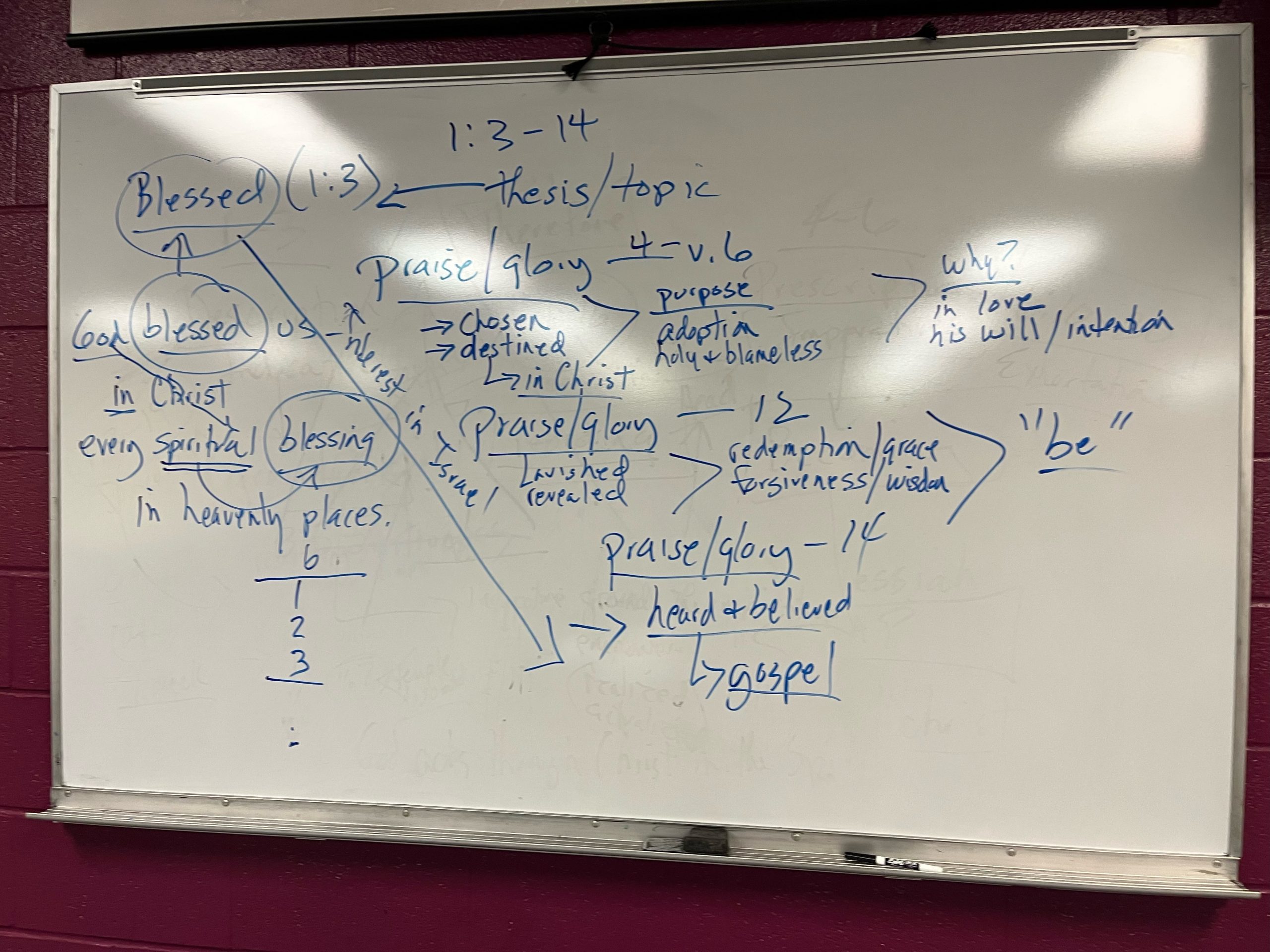
This Triune structure is, perhaps, reflected in the structure of the blessing itself, which highlights the praise of God. Three times Paul states the goal of God’s work: it is to the praise of God’s glory (1:6, 12, 14). We might outline the doxology in this way to capture its comprehensive movement.
- The Divine Initiative: God blesses, choses, predestines for the “praise of his glory” (1:3-6).
- The Christological Center: in Christ there is redemption, a reordering of the cosmos, and an inheritance for the “praise of his glory” (1:7-12).
- The Spirit’s Guarantee: marked with the seal of the Holy Spirit for “the praise of his glory” (1:13-14).
God is glorified through the work of the Triune God. God receives glory through the blessing, reordering, and sealing of a people who inherit the renewed cosmos (new creation). God accomplishes this through the mystery of Christ that gifts humanity with an inheritance as the people of God. In other words, God is glorified when God unites with humanity in the person of Christ through the presence of the indwelling Spirit. The glory of God, we might say with Irenaeus, is a human being fully alive or fully flourishing as the images of God in the world God created.
https://johnmarkhicks.com/wp-content/uploads/2025/01/Eph-1-3-14-scaled.jpeg
Going Deeper
First, what the distinction between “us” and “you” in the doxology?
The “you” are included in the “us” in Ephesians 1:13. The question is: who are the referents for these pronouns? Is this a contrast between Paul and his readers, between the church universal and the readers, or between Jews and gentiles?
Ephesians 1:3 sets the agenda. God is the one who blesses in the Messiah with all Spirited-blessings. The language of blessing is language of God’s story, starting in creation in Genesis 1 and then with the call of Abraham in Genesis 12. The language of Ephesians 1:3-12 is saturated with language that describes Israel’s relationship with God: blessing, election, adoption, redemption, forgiveness, Messiah (Christ), and inheritance. Israel blesses God for the ways in which God has blessed Israel in the Messiah with all the blessings that flow from the work of the Holy Spirit in the lives of people.
We may hear this doxology in a way similar to Romans 9:4-5 which describes the gifts of Israel. God chose Israel, blessed Israel, adopted Israel, and gave Israel an inheritance through the covenants and promises. The doxology of Ephesians 1 operates in that same orbit. In other words, the context of this doxology is not the eternal past and some abstract conception of election hidden in the secret will of God but rather the act of God to choose and bless Israel for the sake of the world as part the unfolding story of salvation history or redemptive history.
Consequently, when Ephesians 1:13 speaks to the readers as “you,” Paul is referring to the gentiles (just as he does in 2:1, 11). The gentiles are included in the story of Israel through the Messiah, they share in the promised Holy Spirit, and they now are heirs of the kingdom of the Messiah and its redemption.
Second, what is the “plan of salvation” revealed in the doxology?
God “has made known to us the mystery of his will, according to his good pleasure that he set forth in Christ, as a plan for the fullness of time[s], to gather up all things in him, things in heaven and things on earth” (Ephesians 1:9-10).
There are at least three key terms here: mystery, plan, and gather up. Each of these are important words in Ephesians that bear witness to the theology of Ephesians.
In Ephesians, “mystery” appears in 1:9 (“mystery of his will”), 3:3 (“mystery of Christ”), 3:9 (“plan of the mystery”), 5:32 (about the unity of Christ and the church), 6:19 (“mystery of the gospel”). Colossians also calls it the “mystery of God” (2:2), and Romans parallels the “gospel and proclamation of Jesus Christ” with the “revelation of the mystery” (16:25). As we will see in Ephesians 3, the mystery of Christ (or the gospel itself) is the work of God to reconcile Jew and gentile in one body through the redemption God accomplishes through Christ in the Spirit.
The word “plan” (oikonomian) is a word that describes governmental (imperial) administration or household management (see also Ephesians 3:2, 9 for the use of the same word). In effect, the word describes how God is managing the world and executing God’s goals for the world. In other words, it is God’s plan of salvation. How does God intend to rescue the world and reconcile all things?
The answer lies in the phrase “to gather up all things in [Christ], things in heaven and things on earth.” The words “gather up” are from a Greek compound word: anakaphalaiosasthai. The basic etymology of the word is to “add up things under a head or sum.” We might think of it as adding up a list of numbers and putting the sum at the top (at the head). The word, then, has a sense of reordering everything or summing up everything. In other words, it may have the meaning of to restore all things; to put everything back in its rightful place within the order of God’s good creation. This, then, is an allusion to God’s new creation when everything in heaven and earth will be renewed, rightly ordered, and set right. Everything, as Irenaeus emphasized in the second century, is recapitulated (using the word Paul uses) in Christ. It is a new beginning, a new creation, and a new heaven and new earth.
This is God’s plan of salvation; it is what God does in Christ by the Spirit.
Third, what does election mean in Christian theology?
Ephesians 1 is a classic text for the discussion of election or predestination in the history of Christian theology. It is a primary “battleground” between Calvinnists and Arminians. Without attempting to adjudicate that debate and determine who best interprets Ephesians 1, I think it is better to stake out the common ground that exists between Calvinists (Augustinians, Reformed) and Arminians (Classic, Wesleyan, Pentecostal). For a “systematic” presentation of my own theology of election, see my blog entitled: “Election: Before We Called God Answered.”
Several biblical themes provide a framework for articulating a common ground that can propel us beyond the impasse between Calvinists and Arminians. I do not claim any theological ingenuity or originality here. Quite the contrary, these theological principles are common ground between believers. It is precisely because this is true that they may provide a way to unpack a common theological framework.
- Theological: Divine Initiative
Whatever the doctrine of election means, it at least insists that God took the initiative in redemption. God made the first move. We love because God first loved. We believe because God first acted. We are redeemed because God accomplished redemption for us.
Initiative involves not merely the first act (as if God acted first and then passively sits back to see how we respond), but that God continuously acts in unrelenting pursuit of a people as a treasured possession. God’s love pursues us, engages us, and moves us.
Further, this entails that all boasting is negated. We have nothing about which to boast except what God has done through Jesus in the Spirit. Election means that God has removed all grounds for human merit and has located the ground of salvation in God’s own gracious and loving acts.
- Christocentrism: Christ as the Elect One
Christ is the Elect One. God chose Christ as the savior of the world. He is God’s chosen vessel for redemption. Both Calvin and Arminius emphasized this point, and it has been powerfully renewed in the 20th century by Karl Barth among others. Election is Christocentric since Christ is God’s Elect One. Whatever election we have, we are elect because we are in Christ and because of Christ.
Before we become steeped in the theoretical underpinnings of election, we must not lose sight of this foundational soteriological insight: God has chosen us in Christ because he has chosen Christ. We are only elect through Christ. His election is logically and ontologically prior to our own. We cannot think biblically about election if we do not first acknowledge that our election depends on the election of Christ.
- Economic: Revealed within Salvation History
The election of Christ, of course, is a revealed point. We only know that God has acted decisively in Jesus as the Elect One because God has revealed this in the history of Israel and Jesus of Nazareth. And God has interpreted those actions within the narrative of Scripture. We only know our election in Christ because God has revealed the Elect One.
This is part of the point in 2 Timothy 1:8-11. God “has saved us and called us to a holy life,” and the ground of this salvation and calling is not our own works, but God’s “purpose and grace.” We know this grace by God’s decisive act in Jesus. Even though it was hidden before creation, “it has now been revealed through the appearing” of Jesus. They mystery of Christ has now been made known by God’s apostles and prophets (Ephesians 2:20).
Debates about the “secret” will of God are unprofitable exactly because that will is “secret.” We know our election through the revelation of God in Christ. God has revealed election through Christ, and we have no other access to it. Consequently, we ought to think about election within the salvation history of God’s story, that is, within the revealed history of God in Israel and Christ.
Thinking about God’s electing grace in terms of the “eternal” mind of God is speculative, but thinking about divine election in the light of Jesus Christ is rooted in God’s historical revelation. We perceive our own election only through the revelation of that election in Christ. When we step outside of or seek to go beyond this historic revelation, we most typically enter worlds which our minds have created rather than what God has revealed. Election and assurance are economically tied to Christ. There the focus should begin and end.
- Faith: the Means by Which Election is Embraced and Experienced
Faith is the means of both justification and sanctification (if we grant the historic distinction in Protestant theology). When we make justification dependent upon sanctification, then we begin a never-ending journey since we will never be sure whether our sanctification is sufficient (in terms of its depth, amount, comprehensiveness and quality). When we sever the relationship between justification and sanctification, we become antinomian and discredit the role of sanctification as evidence of justification.
The way to avoid legalism on the one hand and antinomianism on the other is to see faith as the principle that unites justification and sanctification. We are justified by faith, and we are sanctified by faith. Faith is primarily a trusting allegiance, a loyalty, a submission to the King of Israel.
We are justified before God by faith, and faith is the means by which the Spirit transforms us. Faith is the means of salvation and assurance from beginning to end. We are elect, then, through faith in Christ. Faith functions as an instrument, not as a meritorious act. It is the way we come to know our own election.
Summary
We know we are elect through trusting in Christ. Whatever theory may lie behind one’s theology of election, these four points healthy common ground for unity. Both Calvinists and Arminians affirm these points, though with additional nuances and caveats. Faith is the means of election, and our only access to know God’s decision is through faith.
Calvin, for example, correctly says that the question is not, “Am I elect?” but “Do I trust Christ?” Calvin spoke of Christ as “the mirror wherein we must, and without self-deception may contemplate our own election” (Institutes, 3.24.5). Calvin thought whoever pursues the question by asking whether they are elect or not “plunges headlong into an immense abyss, involves himself in numberless inextricable snares, and buries himself in the thickest darkness…Therefore, as we dread shipwreck, we must avoid this rock, which is fatal to everyone who strikes upon it” (Institutes 3.24.4).
The assurance of election is rooted Christological: We are elect when we trust in Christ as the Elect One. Election “from below” is mediated through faith in Christ. Here Calvinists and Arminians can agree. “If Pighius asks how I know I am elect, I answer that Christ is more than a thousand testimonies to me” (Concerning the Eternal Predestination of God, 8.7).