Revelation 12:1-6 — Two Signs in Heaven

September 5, 2013

The drama of the second (Revelation 4:1-16:20) has not yet ended. We are yet in the middle of it. Heaven has opened the seven seals (Revelation 6:1-8:5) and sounded the seven trumpets (Revelation 8:6-11:19) but we have not yet seen the final, climatic bowls of wrath (Revelation 15-16).  sandwiched between the trumpets and the bowls is the dramatic story of war in heaven and war upon the earth. It functions similar to the interludes that came between the sixth and seventh seals (Revelation 7) and trumpets (Revelation 10:1-11:14). This “interlude” identifies the players in the drama.

It is as if someone has hit the pause button on one screen–the drama of the unfolding sevens–and our attention has been arrested by another screen. The “interlude” of Revelation 12-14 will take us back to the beginning of the story as it reminds us that the conflict between God and the kingdom of this world is a long one.  The conflict was waged in the Garden of Eden, on the shores of the Red Sea, and in the birth and ministry of Jesus. What the followers of the Lamb experience is nothing new; the world powers have always opposed the kingdom purposes of God. The “interlude” identifies and describes the “war.”

John introduces the conflict by describing two signs that appear “in heaven.” The first sign is a woman clothed in creation itself–robed in the sun, standing on the moon and the twelve stars on her head in the form of a victory wreath (stephanos).  The second sign is a blood-red dragon whose seven heads were diadems and whose tail creates havoc on the earth by showering it with a third of the stars. The woman affirms creation while the dragon destroys it. The woman wears a victory wreath like the martyrs while the dragon rules the earth as a destroyer of the earth (cf. Revelation 11:18). The woman is God’s beloved while the dragon is God’s enemy.

Startlingly, the woman is pregnant and feels the birth pangs. She is about to give birth. The dragon menacingly stands in front of her ready to destroy whatever comes out of her. The birth is part of God’s redemptive story and the dragon opposes it.

A son is born. The son, protected by God, inherits a throne when he ascends to God. The dragon’s purpose is frustrated. Though the dragon wears seven royal diadems, the son assumes the throne. The son will reign rather than the dragon. The woman flees the anger of the dragon; she flees from the dragon into the wilderness for safety, a place prepared by God.

God delivers the son by snatching him up to heaven, but the woman is left upon the earth. She hides in the wilderness where she will stay for 1260 days or three and one half years (42 months).

Who are these “people”? What is happening?

The one certain identification in the text is the identity of the son. John gives us an interpretative key. He is the one who will “rule all the nations with a rod of iron.” This alludes to Psalm 2 where God’s anointed king will inherit the earth and the nations will experience God’s wrath. Revelation 11:18 also alluded to Psalm 2. The reign of the kingdom of the anointed (Messiah) began when the son was ascended to the right hand of God to sit upon his throne. The birth and ascension of Jesus are described in Revelation 12:5; the rest of the story–what filled the pages between those two events–is assumed. The readers know the history of the faithful witness who went to the cross in obedience to the Father and was raised from the dead to ascend to the throne. The son reigns.

Who is the woman?  We might say Mary and this would be partly correct but not mainly correct. The woman represents something much greater than Mary herself. The woman appears “in heaven.” The woman wears the martyrs victory wreath. The woman is those who have overcome, but those who overcame before the birth of the Messiah. The woman is faithful Israel. She gives birth to the Messiah. Mary, of course, represented Israel as the one through whom the Messiah came. So, at one level–a literal level–the woman is Mary, but the point is symbolic. Mary represents Israel. The chosen people of God gave birth to Jesus. Perhaps at even deeper level the woman represents Eve from whom the whole of humanity has come; she is the mother of all. She is the one whose seed would crush the serpent’s head. So, we might read this at three levels–Eve, Israel and Mary.

Who is the dragon? As with Mary, we might say that at a literal level the dragon is Herod who sought to destroy the Christ child in Bethlehem. But again the dragon is “in heaven” and the seven crowns and ten horns describe something much larger than Herod himself. The symbolic picture at least leads us to Roman power. Rome, as a world power, opposes the kingdom of God. In Revelation 17 we will see “seven heads and ten horns” explicitly identified with Roman imperial authority. It is not only Herod who seeks to destroy Christ; it is Roman power itself. But there is a cosmic dimension to this figure. The dragon is “in heaven” and is an enemy of the cosmos itself. Indeed, the dragon is identified in Revelation 12:9 as “that ancient serpent called the devil or Satan.” This is the one who opposed Eve herself and led the original couple astray even as he now leads the “whole world astray.” So, we might read this at three levels as well–Serpent, Rome and Herod.

Who, then, is the woman who flees?  She flees into the wilderness just as Israel fled from the armies of Pharoah into the wilderness for safety. But the woman is more than Israel at this point. The woman represents the whole people of God. This is indicated by the length of time she will stay in the wilderness.  It is the same length of time that the two witnesses in Revelation 11 prophesied against the ruling powers. Just as the two prophets represent a witnessing church, so here the hiding woman symbolizes the one people of God, now composed of Jew and Gentile.

The trial that has come upon the whole earth is the result of a cosmic battle between the kingdom of God and the kingdom of this world. The cosmic powers of evil are warring against the faithful people of God. This was true in the Garden. It was true at the Red Sea. It was true at the cross. It was true in first century Asia Minor. It is still true. The war is not yet over.


On Reading Micah (Micah 1:1)

September 4, 2013

Micah, a contemporary of Isaiah, was from a small town 25 miles southwest of Jerusalem called Moresheth near the Philistine city of Gath. Micah was a rural prophet while Isaiah was close to the seat of power in Jerusalem. Ministering during the reigns of Jotham, Ahaz and Hezekiah (ca. 750-686 B.C.), he lived in momentous times.

During the time of these Judean kings, the northern part of Israel is annexed by Assyria. By 740 B.C. Tiglath-Pileser (745-727 B.C.) had conquered all of Syria (Aram). In 734 B.C., the Assyrian Emperor acquired a permanent foot in Palestine by annexing what was northern Israel (essentially the Galilee region) and setting up a base of operations near Gath. By 732 all the nations in the Levant were paying Assyria tribute.

When Israel foolishly thought they might remove Assyria’s yoke and refused to pay the tribute, Shalmaneser V (727-722 B.C.) besieged and sacked Samaria in 723/722 B.C. Sargon II (722-705 B.C.) then subjugated Palestine as the smaller states paid tribute as well as putting down a revolt in Egypt in 720 B.C. He had to put down another revolt among the small states in 711 B.C.

When Sargon was assassinated in 705 B.C., the king of Judah–Hezekiah– rebelled along with some of the small states in the region as well as Babylon. They were all hopeful that Egypt would rebel as well. But Sennacherib (705-681 B.C.) ended their hopes by 701 B.C. While Sennacherib did not sack Jerusalem, he decimated the Judean countryside.

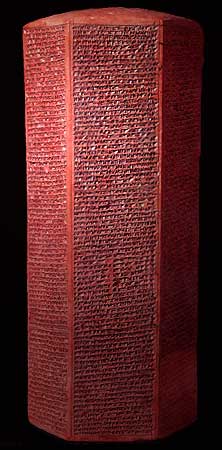
In 1830 a six-sided clay prism inscribed on six sides was found in Nineveh in 1830. It is now in the Oriental Institute of the University of Chicago.  prism1It describes how Hezekiah “would not submit to my yoke” and so he “took forty-six of his strong fenced cities” along with “smaller towns.” He “plundered a countless number.”  He took 200,156 prisoners, “old and young, male and female, together with horses and mules, asses and camels, oxen and sheep, a countless multitude.” As for Hezekiah, he shut him up “in Jerusalem, his capital city, like a bird in a cage.” Eventually, he claims, Hezekiah paid a high tribute, including “thirty talents of gold and 800 talents of silver” along with other “rich and immense booty.”

As a result of this, Sennacherib established a policy (along with his successor Esarhadon [681-669 B.C.]) of non-interference with Judah–as long as Judah did not interfere with the “Via Maris” (the trade route by the sea).  Consequently, Judah remained an independent state.

Micah lived through these turbulent times. He probably experienced numerous Assyrian incursions (including the exile of Israel and its capital Samaria) and especially the devastating invasion of 701 B.C. when Judah was raped by Assyrian power.

What does a prophet say to a people who lived under such powerful threats and through such devastation? This is the message of Micah. It is a filled with warnings and woes, but also hope and witness. Micah laments the fall of Samaria  and warns Judah that they are next if they do not renew their covenant with Yahweh. Micah wants to turn Judah back to God.

The text, as we have it, easily divides into three sermons or homilies. Each begins with the summons to “Listen” ( The first (Micah 1-2) moves from lament over the fall of so many Judean cities (1:2-16) to a rationale for their destruction (2:1-11) but leaves Judah with a hopeful future (2:12-13). The second sermon (Micah 3-5) pronounces judgment upon political and religious leaders (3:1-12) and then glories in Yahweh’s return to his people through a new David (4:1-5:14).  The third sermon (Micah 6-7) begins with a covenant lawsuit (6:1-8) along with a rationale for the judgment of Judah (6:9-16) followed by a lament (7:1-6) but again ends in hope (7:7-20).

Micah’s sermons have a similar pattern. He begins with a lawsuit or judgment oracle, expresses lament, and then offers hope.

Surrounded by the nations and living under the threat of imperial pressure, Judah must choose in whom she will trust. The political dynamics are addressed by Isaiah but Micah, presumably speaking to the rural people of the land in Judah, calls for a faithful life that trusts in the promises of Yahweh. This is where Judah will find hope, peace and security.

The final verses of Micah tell the underlying story. God forgives and delights in steadfast love (hesed). God has not forgotten. God is faithful. God will remember his promise to Abraham.

Though the days are dark, the story is not over.


Revelation 11:15-19 — A Climactic Announcement

August 31, 2013

The drama of Revelation’s second vision (Revelation 4:1-16:21) comes to a climactic moment when the seventh trumpet sounds. The whole of heaven–the four living creatures, the twenty-four elders, myriads of angels and the great multitude–have seen the seven seals opened and all seven trumpets sounded. Heaven anticipates something dramatic.

The seventh horn is trumpeted and “loud voices in heaven” announce the coming reality.

 “The kingdom of the world has become the kingdom of our Lord and his Christ, and he shall reign forever and ever.”

The significance of this announcement is difficult to overestimate. It is the goal of God’s work in the world, that is, that the reign of God through the Messiah would destroy hostile powers and fill the earth. It is the essence of the Lord’s Prayer, “Thy Kingdom come, thy will be done on earth as it is heaven.”

The announcement comes as an accomplished fact to which the twenty-four elders respond. The “loud voices in heaven” are apparently the heavenly host, or perhaps God’s own inner circle (such as the four living creatures).  The redeemed, represented by the twenty-four elders, respond by getting off their thrones, falling prostrate before God and worshipping the one who sits on the throne.

We give thanks to you, Lord God Almighty,
     who is and who was,
because you have taken your great power
     and have begun to reign.
The nations were angry,
     and your wrath has come.
The time has come for judging the dead,
     and for rewarding your servants the prophets
          and your saints and those who reverence your name
both small and great
and for destroying those who destroy the earth.

The thanksgiving hymn explains the meaning of the announcement. It is a eucharistic offering to the Pantokrator (Almighty) Lord God–the one who sits on the throne as the who always has been and continues to be–who now has begun to execute his reign on the earth through his great power. The “time” has come and God’s “wrath” has come.

This timing is about the fulfillment of Israel’s hopes and promises. It is for what the church has prayed. Psalm 2 forms the backdrop for the hymn. The nations have raged against God, but now the time of God’s wrath has come (cf. Psalm 2:1-5). The nations have raged against God’s anointed (God’s Christ), but now God’s reign will defeat the kingdom of this world (cf. Acts 4:24-30). The hopes of Psalm 2 are now realized.

The transformation of the kingdom of this world into the kingdom of God’s Christ is the moment when the world is set right, when God’s righteousness prevails. This “setting right of the world” involves judging the dead–the righteous (holy ones [saints], prophets and those who fear God’s name) are rewarded and those who destroy the earth are themselves destroyed. The hostile powers to the kingdom of God are overthrown because they are bent on destruction. They have martyred the saints of God but the martyrs have overcome through martyrdom.  The church–the martyred witnesses of Revelation 11–is not delivered from martyrdom but through martyrdom. This is victory.

What, however, is the meaning of this announcement at this point in the drama of Revelation? Many readers of the Apocalypse divide the book at this point into two halves, chapters 1-11 and 12-22. I think this ignores the literary and visionary divisions within the book (“in the Spirit” at 1:10; 4:2; 17:3; 21:10). The recurrent theophanic description (“peals of thunder, rumblings, flashes of lightning and an earthquake”) unites the second vision (4:5; 8:5; 11:19 and 16:18) as it concludes the seven seals, thunders and bowls of wrath. Chapters 4-16 function as a unit that progressively describes the disintegration and end of an empire (the seals only affect 1/4 of the earth, the trumpets 1/3, and the bowls of wrath the whole earth).

The climatic announcement at Revelation 11:15, then, comes in the middle of this progression within the second vision. Even though it announces an accomplished fact, the drama is not yet complete. The final battle has not yet been won. The temple of God is still in heaven (Revelation 11:19) rather than coming to the new earth as the New Jerusalem (Revelation 22:1-5). The drama has not yet reached its final stage; the story is not over.

So, what is the point of the announcement if it has not yet happened in the flow of the drama? In the tradition of the Hebrew prophets, heaven itself announces the future as if it has already happened. Among Hebrew prophets this is known as the “prophetic perfect.” The future is described as it if it were a past event; the future is as certain as the past.

Heaven is certain, and consequently the saints on the earth who are suffering and dying may be certain as well, that the future reign of God will fully come. The nations (including Rome) will be defeated, the martyrs will be rewarded, and the kingdom of this world will become the kingdom of God and the Christ. God will win.

The church is encouraged to follow the Lamb like the two witnesses in Revelation 11. Even though the nations rage against God’s anointed people, God’s wrath will one day destroy those who are destroying the earth. Empires will fall, and the kingdom of God will fill the earth.

That future is as certain as the past.  Thanks be to God!


Revelation 10: John’s Prophetic Call

August 16, 2013

After the fourth trumpet an eagle soared across the sky to announce the first of three woes (Revelation 8:13). The second woe followed the fifth trumpet (Revelation 9:12). As readers we expect to hear the third woe after the sixth trumpet in order to  transition to the seventh trumpet. Instead, the third woe does not appear until Revelation 11:14.  Like the pause between the sixth and seventh seals (Revelation 7), the drama again pauses between the sixth and seventh trumpets (Revelation 10:1-11:13). The pauses have similar functions.

The “interlude” of Revelation 7–coming between the sixth (6:12-17) and the seventh seals (8:1-5)–answered the question who could stand in day when the wrath of God and the Lamb is poured out on the inhabitants of the earth? The answer is those whom God has sealed and when those whom God has sealed pass through the trials of life (particularly the martyrs) they stand before the throne of God in victory.

The “interlude” of Revelation 10:1-11:13–coming between the sixth (9:13-21) and the seventh trumpets (11:14-19)–affirms John’s prophetic call and blesses the faithful witness of the church. In other words, the drama of judgment pauses to again describe the condition of the church as it endures the consequences of Roman hostility and God’s judgment of Rome. More specifically, it describes the function of the church during this cataclysmic period of history, that is, to bear witness to gospel and proclaim God’s message.

The first half of the “interlude” or “pause” affirms John’s prophetic call. John stands in the tradition of the great prophets of the Hebrew Bible, especially–as several allusions confirm–Ezekiel and Daniel. The first half of Revelation 10 is modeled after Daniel while the second half of Revelation 10 follows the lead of Ezekiel. John appropriates the apocalyptic images and prophetic acts of these two prophets.  In effect, this not only confirms John’s call, but it also says that his message participates in the tradition of those prophets, that is, apocalyptic messages of judgments against nations. John has been given the apocalypse of Jesus the Messiah that God’s people might know the end to which the empire will come in answer to their prayers for justice.

Revelation 10:1-7 reflects the apocalyptic and prophetic traditions of Daniel 10:5-6 and 12:4-7.  Like Daniel, John sees a great or mighty angel(s) who appears for dramatic announcements. John sees an angel (1) robed in a cloud, (2) crowned with a rainbow, (3) a bright sun-like face, and (4) legs like fiery pillars. Each of these images are divine metaphors drawn from both apocalyptic literature and the Hebrew Bible.  For example, the cloud and fiery pillars remind us of the divine presence in the wilderness during Israel’s wanderings. The rainbow was previously seen in the divine throne room (Revelation 4:3) and the bright face reminds us Roman images of their gods. The angel (messenger) brings a divine message dressed in the metaphors of a divine commission.

Further, the angel is holding a “little book” (biblaridion). What is this “little book”? As is clear from the rest of the chapter, it contains a prophetic message that John is to announce to the nations. But the difficult question is the relation of this “little book” to the “book” (biblios) whose seals the Lamb has opened.  The book lies open and unsealed in the hand of the angel. It seems reasonable to connect the two without identifying them. In other words, it might be that the “little book” is part of the “book” though not necessarily the whole of it.  Whatever the case, the angel brings the book as part of John’s prophetic commission and it stands in continuity with the book the Lamb opened if not part of it.

The appearance of the scroll in the hand of the angel may also mean that further warnings are issued through the seven thunders before the message of the book will be fully implemented. When the angel descended to earth, the angel shouted and the seven thunders roared.  They are about to roll through the earth just as the trumpets. The angel may have appeared to release the thunders. But a “voice from heaven” shut down their revelation. God decides that the voice of the thunders will be sealed up; they will go unheard. John is forbidden to write them down.  In effect, there will be no more warnings.  The seals and the trumpets were sufficient warning.

If the purpose for sealing the thunders was unclear, the mighty angel clarifies so no one will misunderstand. The picture here is foreboding–the angel has one foot on the earth and one on the sea. The angel represents power over all chaos, over the whole planet.  The angel then swears or declares an oath with the right hand raised to heaven (God). The God by whom the angel swears is the everlasting Creator of everything that exists and the language reminds us of Revelation 5:13. The whole creation worships the one who sits on the throne and the angel swears by the Creator.

The message is significant:  “There will be no more delay! But in the days when the seventh angel is about to sound his trumpet, the mystery of God will be accomplished, just as he announced to his servants the prophets.”

The message is good news. What God “announced” to the prophets was, more literally, “gospeled”  to them. It was a proclamation of good news.  God has good news for the faithful witnesses who have struggled against the empire and refused to compromise. The announcement,then, is encouragement for the faithful; God has not forgotten their cry for justice.

The good news is the accomplishment of the mystery of God. The good news, over which the angels themselves rejoice, is that the kingdom of the world will become the kingdom of God which is heralded when the seventh trumpet sounded (Revelation 11:15).  The good news is that the faithful witness of the martyrs will be vindicated, and God will set things right. The empire will fail to destroy the people of God and the empire will collapse under the weight of its own sin. The mystery of God–what the martyrs wanted to see but was hidden from them–will be revealed when the martyrs are vindicated.  There will be no more delay; judgment is coming.

Revelation 10:8-11 reflects the apocalyptic and prophetic traditions of Ezekiel 2:8-3:3. John is told to do what Ezekiel was told to do, that is, to eat the scroll. To eat the scroll is to digest the message of the book. It is to accept the commission to prophesy the message of the Apocalypse, or to declare the fulfillment of the mystery of God.

Like with Ezekiel, the book tastes sweet on the tongue but is bitter to the stomach. The commission is received with joy and hope but the message is a sour one. It is a message of woe, mourning, and judgment.  It is good news for God’s faithful witnesses, but it is judgment for the inhabitants of the earth. But the message, as we will see in Revelation 11, contains a sour note even for the followers of the Lamb as many are yet to suffer for their witness.

The significance of eating the book is clear from the words of commission in Revelation 10:11:  “You must prophesy again about many peoples, nations, languages and kings.” John will speak a divine message regarding nations and kings, against empires and Caesars.  God has heard the cries of the martyrs and now commissions John to speak the truth about empire. John stands in relation to the Roman empire just as Ezekiel stood in relation to Jerusalem–he is given a prophetic, even apocalyptic, message of judgment.

John eats the book, and therefore he “must prophesy.” John must proclaim the judgment given him. This is his prophetic call.


Psalm 2 – God Reigns Over the Nations

August 14, 2013

Psalm 1 counseled wisdom. Worshippers, as they pray, mediate and sing the Psalms, align themselves with the way of righteousness. Psalm 2 assures these worshippers that Yahweh reigns and even the nations must ultimately submit to the God of Israel. Psalm 2, then, as a further introduction to the Psalter, grounds the worship of and prayers to Yahweh in God’s universal reign. Yahweh provides wisdom through the Torah (Psalm 1) and Yahweh rules the cosmos (Psalm 2). With these themes in hand, the door is open to walk through the hills and valleys of the Psalter.

Psalm 2 offers its theological vision in four strophes. The first depicts the nations in rebellion (1-3) while the second identifies Yahweh as the true locus of sovereignty in the world (4-6). The third affirms the role of Yahweh’s king among the nations (7-9) while the fourth offers some advice for the kingdoms of the earth (10-12). The outer strophes focus on Yahweh’s relationship to the nations while the inner two strophes focus on Yahweh’s own sovereignty.

This is the voice of faith. Israel royal history gives no evidence that other nations (especially empires) should fear Yahweh’s king. Israel (and later the much smaller Judah) are surrounded by vast empires like Egypt, Assyria and Babylon. Their power dwarfs that of Judah. Like Jerusalem (Zion), the nation itself is a small ridge surrounded by higher mountains. In the larger scheme of things, Jerusalem is nothing but a small regional power. Judah’s territory would easily fit between Nashville and Knoxville, TN!

The Psalm’s boldness is profound. It is little wonder that the nations mock Yahweh’s anointed. The nations will simply throw off whatever shackles that Israel might suppose enslaves them. There is no contest.

But the Psalmist, and Israel’s gathered worshippers, see the world through the lens of faith. They envision Yahweh enthroned in the heavens. God reigns over the nations. Eyes of faith can see this when Israel is gathered for worship. Singing and praying the Psalms they see the world as faith envisions it. Yahweh is enthroned and the nations will serve Israel’s God.

Yahweh’s enthronement also means that God’s anointed represents the reign of God in the world. Yahweh anoints a king, calls him “Son,” and gives him an inheritance which is the whole earth. The reign of the king in Israel, then, is a sign of hope; it is the covenant faithfulness of God. The king symbolizes God’s commitment to the Abrahamic promises. Consequently, the enthronement of the king is something to celebrate, and that may be the origin of this Psalm originally. It is one of the “royal Psalms.”

The nations will be judged by how they treat God’s anointed. Cautioned and warned, the nations should serve Yahweh and “kiss the son.”

An Assyrian general or an Egyptian Pharoah must have laughed at such language. Perhaps they were enraged by such claims. In either event, Israel, they must have thought, has lost touch with reality.

Yet, someone placed this Psalm at the beginning of the Psalter. It reminded Israel that as they sang and prayed these Psalms they do so with the confidence that God reigns over the nations and that God’s anointed will inherit the earth itself. Such faith is only nurtured through worship.

It is the kind of worship we find in the Apocalypse. Marginalized in a hostile culture, dwarfed in size by Roman religions, and surrounded by magnificent temples dedicated to Roman gods, goddesses and Caesars, the seven churches of Asia Minor envisioned God and the Lamb, the Messiah, on thrones in heaven. The climax of the Apocalypse (pictured in both 11:18 and 19:19) embraces the vision of Psalm 2 as the Lord’s Anointed defeats the powers of evil in such a way that the earth itself becomes the kingdom of the Lord (11:15). The nations become the heritage of God’s Anointed.

The language of Psalm 2 is our language. We worship the one who sits on the throne and the Lamb (God’s Messiah). We confess that God reigns even though evil and chaos still abound. We hope for the coming of the kingdom of God when the meek will inherit the earth. We live those moments by faith and when we gather to worship God and the Lamb we see it with the eyes of faith, just like Israel in Psalm 2.

So, we boldly pray, “Our Father, who art in heaven, hallowed by thy name, thy kingdom come, thy will be done on earth as it is in heaven.”

Come, Lord Jesus!


Psalm 1 – Two Ways, a Wisdom Poem

August 13, 2013

The opening Psalm functions as a kind of preface or introduction to the whole collection. It orients the worshipper to a particular path and the value of pursuing the life the Psalter envisions. Indeed, it offers us a choice.

There is the way of the wicked (sinners, scoffers) and the way of the righteous. There are two ways, two paths, or two directions. One scoffs at life, misses the point of life, and is openly hostile to God. The other yearns to practice the Torah, follow God’s instruction, and incessantly repeats the words of the Torah. Often, however, life is much more ambiguous than that, but our basic orientation is nevertheless pointed in one of two directions.

One way will prosper like a fruit tree by water while the other will disappear like dust in the wind.  As a piece of wisdom this does not mean that there are no exceptions. The rest of the Psalter tells us otherwise as laments and imprecations abound. Rather, wisdom inculcates character development, and, generally, good character will bear good fruit while an evil character will suck the life out of us.  Wisdom orients us even though in tragic moments it may frustrate us (as in the case of Job). Nevertheless, wisdom guides choices, especially in midst of tragedies.

At the same time, the orientation is valuable because every human being must make a choice. Even indecision is itself a choice. We live and we choose. Wisdom provides a far-sighted horizon for choices that lie in front of us. Instead of plunging into waters of immediate gratification, wisdom invites us to walk a long path towards wholeness. It is, in fact, the long path of praying, singing, and even murmuring the Psalms under our breaths.

We choose this long, hard road because we seek transformation rather than gratification. We seek deep-seated joy rather than fleeting happiness.  Even though we know this path has many bumps in the road–and the laments of the Psalms testify to them–we pursue it because we know that Yahweh “knows the way of the righteous.”

We embrace this difficult path because we know that Yahweh is committed to those who pursue it. God is deeply and intimately connected to those who follow the “way of the righteous.”

This introductory Psalm provides essential wisdom for navigating the diverse and wide-ranging emotions that will bubble up as worshippers rehearse, practice, and live out the Psalter. Those who truly hear this wisdom are blessed because Yahweh knows the way they have chosen.


Revelation 9: Imagine Your Worst Nightmare

August 10, 2013

The fifth and sixth trumpets announce the ancient world’s worst nightmares. The terrifying images of Revelation 9 are worthy of our most horrifying apocalyptic movies. It seems 21st century western culture loves apocalyptic movies, whether it is the earth destroyed by a meteor, large armies battling for Middle Earth in the Lord of the Rings trilogy, or the end of the world in 2012.  We have a fascination with apocalypses…whatever they may be. Perhaps, however, that is no different from first century culture.

Revelation 9 paints two apocalyptic, cataclysmic and terror-inducing pictures. One image arises out of nature and the other from humanity, though they are both in this text the result of angelic movements. One is a destructive swarm of locusts while the other is a huge invasion force. Both were the worst nightmares of ancient peoples as locusts destroyed crops while armies pillaged human treasures (including people). These are nightmares from which one hopes to wake up.

The opening of the fifth and sixth trumpets in Revelation 8:13 is the flight of an eagle soaring overhead and shouting, “Woe, woe, woe to those who dwell on the earth.” The three woes announce the next three trumpets, and the announcement serves as a warning to the inhabitants of the earth.

An eagle pronounces the woe (“angel” in NKJV is based on inferior manuscripts). This is culturally significant in several ways. First, the “eagle of God” (aetos dios) is associated with Zeus (Jupiter) and it was a sign of power and immortality. It was often thought the messenger to/for the gods as the eagle could soar above storm clouds and fly into the presence of the gods.  Second, the eagle was a symbol of Roman power. Every Roman egion had a standard headed by an eagle (aquila). Consequently, this eagle that comes from the one who sits on the throne contrasts with the eagle of Roman power and religion.

The woe, however, is not for everyone. As we will see, the events associated with the fifth and sixth trumpets will not harm those who belong to God (the sealed 144,000). The “those who dwell on the earth,” then, are distinguished from those who are sealed with God’s name. This is the Apocalypse’s language for those who follow the beast rather than God (Revelation 13:8; 17:8). The contrast is between those who “dwell in heaven” (those who belong to God; cf. Revelation 12:12; 13:6) and who “dwell on the earth.” In other words, this is technical language for those whose citizenship is upon the earth rather than in heaven. They are part of the socio-political, anti-Christian powers (cf. Revelation 6:10; 11:10). They look to the powers rather than to one who sits on the throne in heaven for their guidance and life. This is the essence of idolatry.

The Fifth Trumpet

As in Revelation 8:10, a star falls from heaven in response to a trumpet blast, but in Revelation 9:1 this star is personified as one who is given the key to the Abyss. Some identify this star with Satan who fell from heaven. The problem, however, is that what is released from the Abyss opposes the reign of Satan in the world. The locusts attack the inhabitants of the earth who serve Satan’s beasts. It seems better to think of this “star” as an angelic messenger who does God’s work by releasing the locusts. God will use evil (demonic?) to afflict evil (empire).

What is the Abyss or “bottomless pit”? It is clearly a place of evil (Revelation 11:7; 17:8); a kind of prison for evil forces. We might compare it cosmically to “black holes,” though the symbolic language does not intend to identify this as a specific place in the cosmos. Rather, it is apocalyptic language for anti-creation and chaos. The “black hole” of God’s good creation are the forces of darkness, chaos, and destruction. These arise from the deep recesses of both human hearts and the cosmic chaos (good creation arose out of the “waters” of chaos).This anti-creation motif is present in the darkening of the sun.

The scoripion-tailed locusts were given power (divine permission) to torture rather than kill the inhabitants of the earth for torture.  The earth itself, devastated in the first four trumpets, is unharmed by the locusts. This reversal of expectation (we expect locusts to harm the grass, plants and trees) emphasizes the human devestation that the locusts will infllict. They will increase the pain of life for humanity. The inhabitants of the earth will prefer death over life because of their sting. Life will become unbearable. THe plague of locusts, of course, reminds of the similar plague upon Egypt though apocalyptic language is note used in Exodus as it is here (Joel 2 is also serves as a backdrop).

The detailed description of the locusts is the most thorough in the Apocalypse. They are large horse-like creatures with human heads but lion-like teeth. The are armoured and their wings sound like a chariot assault. Their weapon is their sting which does not kill but inflicts unimaginable pain.  But it only lasts five months–a limited amount of time and probably defined by the natural life cyle of locusts. The leader of this horde is Abaddon (Hebrew) or Apollyon (Greek) and both names mean “Destroyer.” This is neither a Roman Emperor nor Satan since the object of destruction is the empire and the inhabitants of the earth. Rather, this is more reminiscient of the “angel of death” (as in 2 Baruch 21:23) who rules God’s realm of the dead (cf. Bauckham, Climax of Prophecy, 65). Abaddon was a name for the place of the dead in the Hebrew Scriptures (cf. Job 31:22; Psalm 88:11; Proverbs 27:20).

These are not modern attack helicopters but an apocalyptic image for a series (five months) of terrifying experiences. The nature of the experience is undefined. It does not have to be defined–it is a nightmare. It is life in a collapsing empire where the security and prosperity of the empire is disappearing. Whatever forces engender that collaspe seem like a plague of locusts. It is a picture of destruction.

The Sixth Trumpet

The sixth trumpet is the second woe announced by the eagle. This trumpet announces the massing of a huge army on the borders of the empire. This is a nightmare that every nation fears, especially when the assembled warriors more than tripled the population of the Empire itself. While the Roman Empire may have been between 50-60 million, the army gathered at the Eurphrates is 220 million. A 220 million man army on the frontier of the Empire dwarfs the size of the Roman legionaries (possibly around 150,000).

This army gathers at the command of God. The voice “from the four horns of the golden altar before God” has divine sanction if it is not God’s own voice.  This voice gives the order to release the four angels who manage the grand army of the Euphrates. That the angels were “bound” may indicate that they are demonic, but this may only refer to how they had been previously limited in their use of the army. They had waited and prepared for this moment. It is an angelic action at the command of God. The army moves against the empire; it moves against the powers or the forces of Satan and evil.

It is actually a mounted calvary–220 million strong. But it is not ordinary calvary. The horse’s heads were like lions’ heads, their tails like the heads of sakes, and they breathed smoke, fire and sulfur. Their breath alone killed one-third of humanity.

For readers within the Roman empire the image of a mounted calvary at the Eurphrate conjures up the terror of a Parthian army which was Rome’s greatest enemy. Rome never defeated the Parthians except to a stalemate on their eastern border. Parthia was an empire that stretched from the Euphrates to what is now eastern Iran. The threat of an invading army from a competing empire has always generated fear whether it is the Mongols in Russia, or the Turks in Europe, or Cold War fears not many years ago. The threat is a constant one in human history.

The apocalyptic image, which includes an exaggerated armed mass of humanity, represents the fear of invasion and massive violence. The voice from the altar assures the seven churches of Asia that the Roman legions are not the real power in the world, and that same voice assures us that no earthly power–no empire–controls their own destiny. God holds the cards and when God plays out the hand, no empoire can stand.

Conclusion

On occasion, it appears, God releases chaos upon the earth for warning and judgment. God is sovereign over the chaos. God permits and even empowers it to disrupt the peace of the empire.

Why does God churn the waters? Revelation 9:20-21 provide one reason. It is the same reason present in many of the prophets of Israel (cf. Amos 4). God releases choas in order to warn humanity about coming judgment. Their choices and lives have moral significance–a reckoning will come. Divinely permitted chaos reminds humanity that God is paying attention to their works and lives. God uses chaos to prompt repentance but it is often ineffective because human hearts are so committed and bound to their own black holes.

Just as the drama pauses again for another interlude, John editorializes on the sins that provide the rationale for divine judgment. He identifies two broad categories: (1) human allegiance to idolatry (“works of their hands”) and (2) human selfishness.

Idolatry is misplaced allegiance. It substitutes something else in the place of God. It worships demons rather than God. Idolatry identifies the source of life and peace with something other than the Creator God. John equates the whole pagan religious system with the demonic and irrational (worshipping gods that cannot “see or hear or walk”).

Human selfishness is at the root of the second category.  The second commandment (the second half of the Ten Commandments) is to love one’s neighbor. Murder, sorcery, sexual immorality, and theft violate that love. It abuses and exploits the other for the sake of one’s own interests.

Love God and love your neighbor. These are the greatest commandments. When humanity pursues a different agenda, God releases chaos as a warning but with a transformative intent. God is not willing that any should perish but that all would come to repentance. Unfortunately, as is the case so many times throughout history, humanity does not repent.


Revelation 8: Prayer and Plagues

August 3, 2013

The Lamb took the book out of the hand of the one who sits on the throne and began opening the seals. The opening of the first four seals were accompanied by four horses that spread destruction upon one-fourth of the earth. The next two seals asked two questions. The martyrs asked “how long” will the persecution continue and the inhabitants of the earth asked “who can stand” when the wrath of the Lamb is unreleased. Then the unfolding drama of the seals pauses in Revelation 7 to assure the church that they belong to God and their martyrs are even now victorious as they stand before the throne and the Lamb.

And then….there is silence. Thirty minutes of silence. What is the significance of this silent pause when the reader expects to see the events that will accompany the opening of the seventh seal? Silence probably reflects a sense of awe and/or expectancy. The silence functions to heighten the suspense. All of heaven now waits in reverential awe to see what will happen next. What will happen now that the seventh seal has been opened? And what happens is that seven angels appear.

Seven angels, who stand before the throne of God, are given seven trumpets. Why are they given trumpets? Given the temple imagery that abounds in John’s description of the heavenly throne room, the trumpets may function much like those in Israel’s temple (cf. 2 Chronicles 7:6; 29:26; Ezra 3:10). Trumpets were not only used to praise God but they were used to announce the coming of God. In other words, when sacrifices were offered and the priests sound the trumpets, “all Israel stood.” It is a liturgical symbol of divine entrance. In the context of Revelation 8-11, God comes in judgment (cf. Revelation 15:6-8) and the trumpets probably announce the coming judgment. They announced that God is now announcing the prayers of the saints.

Essentially, the prayers go up and the fire comes down.  An angel stood near the altar and burned incense which “went up before God” along with the prayers of the saints. The twenty four elders also hold bowls of incense “which are the prayers of the saints” (Revelation 5:8) and the martyrs under the altar prayed that God would act to avenge their blood (Revelation 6:9-11). The angel, in response to the prayers, then hurled “fire from the altar” upon the earth. This is God’s response to the prayers of the saints. The ensuing plagues that accompany the trumpet blasts are God’s response. The first three trumpet blasts include “fire” as part of the plague that affects one-third of the earth.

When the angel threw the fire upon the earth, “peals of thunder, rumblings, flashes of lightning and an earthquake” followed. This is the language of divine theophanies–God is acting. But it is also a literary device that holds the first vision together as a unit. The vision (“in the Spirit”) of Revelation 4-16 begins with this description as a manifestation of divine presence in the heavenly throne room (4:5) and now it follows the seventh seal (8:5). This language also appears at the seventh trumpet (11:19) and the seventh bowl (16:18). The language unites the literary unit as it reminds the reader that these judgments are themselves divine theophanies. God is present in the Empire to destroy its power.

The successive judgments of God are progressive in nature. While the opening of the seals only affected one-fourth of the earth, the trumpets reek havoc upon one-third of the earth. The intensification suggests a progressive work whose purpose is not only punishment but also a warning. The progressive nature of the judgment provides opportunity for repentance (Revelation 9:20-21). The Empire is crumbling but slowly and not all at once. It is headed for a cataclysmic ending but the process is prolonged. While this provides the potential for a season of repentance, it is also frustrating for the martyrs under the altar who cry, “How long?”

Like the six seals, the trumpets sounded in a 4+2+Interlude+1 pattern. The first four trumpets, like the first four seals, are grouped together, and the final three trumpets follow separated by the “Woe” pronouncement of a flying eagle (Revelation 8:13). The 6+1 pattern reminds us of creation with its six days separated from the seventh day. The plagues in Egypt have a 9+1 pattern and this represents uncreation (the reversal of creation). The seven trumpets have literary and theological links to the Egyptian plagues. What God did to the Egyptian Empire, God is now about to do the Roman Empire. The grace of divine creation is now, in response to the idolatry, oppression and immorality of the Empire, reversed and God undoes in uncreation what was provided in creation. Like the Noahic flood itself, God judges human violence in oder to save the creation itself.

While the links to the plagues on Egypt are more apparent in the seven bowls, it also influences how the seven trumpets are described. The first trumpet includes the Egyptian plagues of hail and fire along with a reference to blood. The second trumpet includes water turning to blood.  The fourth trumpet resembles the darkness that fell upon Egypt.

The reversal of creation is also present in the trumpets. The earth is set ablaze as trees and grass are burned up, living creatures in the sea perish because the sea is turned into blood, a great star falls from the sky which poisons the earth’s fresh water, and one-third of the sky is darkened such that one-third of the day and night are now without light. The primordial chaos which God ordered and bounded is here released in a limited way. God still reigns over the chaos, but God here uses the chaos as punishment and warning. This reflects how the prophets spoke about nations in the Hebrew Bible, including Israel itself (cf. Amos 3-4). God is moving among the nations with purpose, specifically to relieve the Lamb’s followers from Roman oppression.

Just as God heard the cries of Israel in Egyptian bondage, so God responds to the prayers of the believers under Roman oppression.

Does God so such things today? We certainly pray, “Your kingdom come,” and that prayer involves the destruction of evil and its structures. We lament oppression and injustice as we petition God to remove them from the earth. I would hope that our prayers are not misguided. On the contrary, this is the pattern of prayer in the narrative itself. Israel prayed for deliverance in both Egypt and Babylon, and the saints in Asia Minor prayed for justice amidst Roman injustice and violence. It seems we can pray for the same today and trust that the pattern in the narrative is still active. We certainly confess it as an eschatological reality but we might also hope that God is yet active in the world to defeat evil, violence and injustice, even by bringing down Empires.

We, of course, do not have prophetic eyes to see what God is doing. We–or at least I–have not been given apocalyptic visions that interpret what God is presently doing. We cannot say with any specificity or definitiveness that God has judged this nation or that nation for this or than specific reason. We can only confess that God is at work, that God’s righteousness will set things right, and trust that God will ultimately defeat evil within the cosmos. Then, and only then, will the new heaven and new earth appear where we will dwell with God in peace, prosperity and righteousness forever and ever.


Revelation 7: Who Can Stand in the Day of Wrath?

July 29, 2013

Who can stand on the days when the wrath of God and the Lamb are poured out on empires? That is the question asked when the sixth seal is opened in Revelation 6:12-17. The shaking of the Roman empire, as with all empires, will affect everyone from rich to poor, from free to slave. Who can escape God’s anger as judgment falls upon the empire?

The natural disasters, violence, economic hardship, and war that fall upon empires affects everyone. But this raises the question of what happens to the followers of the Lamb? What will happen to those who bear faithful witness throughout the unleashed chaos that accompanies the opening of the seals in Revelation 6?

Revelation 7 answers that question. Instead of moving to the seventh seal, which the reader eagerly anticipates, the drama pauses to answer the question. The followers of the Lamb are sealed before the seventh seal is opened. This chapter functions as a kind of “interlude” between the sixth and seventh seals in order to illuminate the circumstances of the God’s servants as the seals proceed. Though the empire is undergoing convulsions, the faithful witnesses are “sealed.”

John’s vision identifies two groups of people: (1) the 144,000 in 7:4-8 and (2) the “great multitude” in 7:9-10. Who are theses groups and how are they related to each other? How, then, does this answer the question of Revelation 6:17?

144,000 — The Church Militant

Before the destructive forces of the four winds are released upon the earth, God seals the 144,000.  Four angels were “given power to harm the earth and sea,” but they are restrained from releasing the winds until the 144,000 are sealed. We might imagine that the judgment that the seals represent are  delayed until arrangements are made for the servants of God. In other words, the opening of the seals and the sealing of the servants are  contemporaneous events. As the Lamb opens the seals and judgment begins with the empire, at the same time the servants of God are sealed. God is sovereign over this process.

An angel from the east, an angel with the “rising sun” which bore cultural images of power, comes with a signet ring to seal the servants of God. Animal and slave branding was common in the Roman world, and these are God’s “slaves” (doulous). This seal contrasts with the “mark” that the followers of the beast will receive in Revelation 13:16-17. The nature of the seal might reflect the engraving that was on the headdress of the high priest that functioned “like a seal” which stated “Holy to the Lord” (Exodus 28:36-38). Indeed, eschatologically, everything–even the pots and the pans–will be engraved (sealed) with “Holy to the Lord” (cf. Zechariah 14:20-21). The “sealed” belong to the Lord; they are consecrated to God’s purposes. In other words, the seal is a mark of ownership.

They are “sealed” for protection. This does not mean they will not suffer as the empire convulses and dies, but that they are identified as God’s people throughout the suffering. They are “sealed” in the sense that they will not experience divine judgment (cf. Ezekiel 9:3-10) even as they too experience the travail of the empire’s fall. They are protected in that their faithful witness will usher them into the throne room of God. They will not experience the Lamb’s wrath but the Lamb’s loving embrace.

But who are these 144,000 and what do they represent? Some (like Bauckham, Climax of Prophecy, 216-218) suggest that this is depicted like a military census (cf. Numbers 31:4-6). The servants of God–the “sons (males) of Israel”–are numbered for battle.  It is, in the context of this second vision (Revelation 4-16), a small number compared with the 200,000,000 mounted troops that will gather in Revelation 9:16.

Some believe the 144,000 are either a literal or symbolic number of ethnic Jews who have converted to Christianity, and some even think they are 144,000 Jewish-Christian evangelists in the last days. But there are reasons to doubt that this number describes ethnic Jews. Rather, it appears as a symbolic number for the church (whether ethnic Jews or Gentiles) upon the earth. If this is literal Israel, the tribe of Dan is missing. Are we to believe that literally no one from the tribe of Dan would be represented among faithful Israel? The absence of Dan is probably due to Dan’s association with idolatry (Judges 18:30; 1 Kings 12:29; Testament of Daniel 5:6).

The “servants” of God in Revelation are consistently described as Christians, that is, the term describes all believers (cf. Revelation 1:1; 2:20; 6:11; 10:7; 11:18; 19:2, 5, 10; 22:3, 6, 9). The number 144,000 servants are only male (like an ancient army) and their seal is something shared by all believers in Revelation (Revelation 3:12; 22:4). All believers in Revelation are heirs of Israel as the church–God’s new creation–is a kingdom of priests ransomed by the Lamb (Revelation 5:9-10 with Exodus 19:6).

It is the church upon the earth that is sealed, that is, the church militant. The angel from the east delays the four winds that will “harm the earth and sea” until the church is sealed. Consequently, this must be the church on the earth that is numbered as 144,000. The number is symbolic 1,000 x 12 x 12–the whole church is sealed.

Who can stand the wrath of God and the Lamb? The sealed servants of God who are the faithful witnesses that live in the empire as it begins to crumble.

An Innumerable Host — The Church Triumphant

Question: Who can stand in the day of the Lamb’s wrath (Revelation 6:17)? Answer: The “great multitude” stands before the throne of God and before the Lamb (Revelation 7:9).

There is continuity between the 144,000 and the innumerable host. Indeed, there is movement between them. The 144,000 are the sealed servants of God upon the earth who become part of the innumerable host through their faithful witness, that is, through “overcoming” just as the Lamb overcame. When saints die in the Lord as part of the 144,000, they join the innumerable host from “every nation, from all tribes and peoples and languages” that stand before the throne of God and before the Lamb. Who can stand the wrath of God and the Lamb? Faithful witnesses. They stand before the throne of God rather than hiding in the mountain caves (this is the contrast between the end of Revelation 6 and the status of those before the throne). They are the church triumphant, that is, the church that has overcome through faithful witness rather than through violent revolution.

This seems clear from the question elder asks and the elder’s answer. The innumerable host has come out of the “great tribulation” and they have “washed their robes and made them white in the blood of the Lamb.” The “great tribulation” refers to the convulsions which the earth experiences. The word “great” does not mean the biggest or necessarily the climatic tribulation, but a severe one (like Jezebel’s in Revelation 2:22). Tribulation is something which John shares with the seven churches of Asia (Revelation 1:9) and which the churches have constantly experienced under imperial pressure (Revelation 2:9). In other words, these are those who have shown themselves faithful during their trials and tribulations living in the Roman Empire. They have moved from earth to heaven, from among the “sealed” 144,000 to join the innumerable host.

The innumerable host is described in Revelation 7:9-12.  The descriptors are illuminating.

  • Size — we have no way of knowing how many Christians populated the Roman Empire at the end of the first century, but this description is surely beyond the imagination of those early believers. They probably saw themselves as small and rather insignificant, but in this vision they see that they participate in a larger and grander assembly than they could have imagined.
  • Multi-cultural — different national identities, different languages, different ethnicities. The Roman Empire included such differences, and the kingdom of God expands the borders of the Empire as “every nation” is part of this heavenly assembly. “Every nation” echoes the promise to Abraham (Genesis 17:5).
  • Liturgical Robes — the assembly is a worshipping assembly gathered before the throne and the Lamb in white robes (which is the Roman color for temple priests and participants). It is the same robe given to the martyrs at the altar in Revelation 6:11 and given to those who come out of the 144,000 and join the assembly in Revelation 17:13-14. Those who wear these robes have access to the tree of life (Revelation 22:14). These robes belong to all faithful believers.
  • White Robes — they are white because they have been washed in the blood of the Lamb. This may refer to the expiatory sacrifice of the Lamb, but it may also allude to the blood of their faithful witness, that is, martyrdom.
  • Victory Palms in their Hands — palm branches represent victory and were a regular part of triumphal entries into a city by returning armies and victors. These are those who have “conquered” or “overcome.”
  • Worshipping Assembly — “Salvation belongs to our God who sits on the throne, and to the Lamb!” Their victory (deliverance or rescue) belongs to God and the Lamb; they did not achieve it themselves.

This innumerable assembly is then joined in praise by the angels, twenty-four elders, and four living creatures as they fall prostrate before the throne to worship God. They echo their previous praise in Revelation 4 & 5.

The difference between the scenes in Revelation 4 & 5 and here in Revelation 7 is the presence of the victors, that is, the innumerable host. Though all creation is present in some sense in Revelation 5, the victors are not specifically identified. But here we now know–through the progress of the drama and the unfolding vision–that gathered with the living creatures, twenty-four elders, and myriads of angels are the redeemed of the ages as well. The faithful witnesses, including the martyrs (perhaps especially the martyrs), are present in the throne room of God and they join the heavenly host in worship around the throne.

Where is this innumerable host? They poem beautifully describes their present experience and eschatologically anticipates the full reality of the new heaven and new earth. This is not yet that as here the redeemed serve God in a temple when there is no temple in the new heaven and new earth. The earth is still undergoing conflict so this gathering is not the final one but the present one. Revelation 7:9-17 depicts the present experience of saints who have died in the Lord.

So, where is this?

before the throne of God
serving in the temple
sheltered by the presence of God

This is a liturgical picture. The word “serve” (latreuousin) is the term used to describe the role of the Levites in Israel’s temple. Before the throne of God and in God’s temple, the multi-cultural assembly is gathered to worship. Their worship is covered by God’s tent (tabernacle) which is the dwelling presence of God–the shekhinah glory that led Israel in the wilderness (Exodus 40:34-38) and dwelled in Israel’s temple (2 Chronicles 5:12; 7:1). This presence will fill ultimately heaven and earth in the new Jerusalem so there is no need for a temple in the Eschaton.

Those before the throne, however, already experience the future. Already they experience the promises of Isaiah 49:10 and Isaiah 25:8–no more scorching heat and no more tears. But, along with the rest of us, they await the fullness of God’s promises in the new heaven and new earth in the new Jerusalem. They yet await the resurrection of their bodies and the transformation of a groaning creation; they yet await the final victory as even more martyrs are continually added to the innumerable host (cf. Revelation 6:9-11).

Before the throne of God, the Lamb is also present as the shepherd of God’s people who guides and waters the people of God so that they no longer suffer. They no longer experience the thirst and heat of the earth but rather drink the living water of God’s presence. There are no more fears and no more tears though they yet await, like the martyrs at the altar, the fullness of the kingdom of God upon the earth.

So, where are those who die in the Lord? They are before the throne of God, they serve God day and night in God’s temple, and the one who sits on the throne shelters them with his presence.

Where are the dead? They are with the Lord.


Revelation 6 – Divine Judgments on Empires

July 20, 2013

The Lamb, having taken the book of prophetic judgment from the hand of God, now begins to open it by breaking the seals. Systematically, the Lamb breaks one seal after another–six in Revelation 6. As each seal is opened John hears and sees a variety of images that evidence divine judgment or are related in some way to that judgment. These images are not the content of the book but rather a series of symbolic enactments that dramatize the process of opening the book. The Lamb is only breaking the seals at this point rather than opening the book itself. The symbolic enactments, however, point to the disintegration of world order and the (re)introduction of chaos into human society. At one level, the Pax Romana is on the verge of dissolution.

The vision unfolds in a pattern of 6+Interlude+1. Six seals are broken in consecutive fashion, but then there is a lengthy interlude (7:1-17) before the seventh seal is broken (8:1-5). While the first six seals portray divine judgment, the interlude answers the question “who can stand the day of wrath” that appears in the last words of chapter 6 (6:17). The prospect of divine wrath (chapter 6) is followed by the assurance of divine love for the people of God (chapter 7).

The Symbolism of the Six Seals

At this point interpretations begin to vary widely. Historicists believe the seals picture the fall of the Roman Empire while Preterists attempt to identify specific seals with specific events relating to the destruction of Jerusalem or the fall of the Roman Empire (depending on how they date the Apocalypse). Futurists generally connect the seals to the Great Tribulation that occurs prior to the second coming of Jesus and many interpreters see allusions to specific contemporary realities (e.g., “red” = Russia or “large sword” = nuclear weapons). Idealists understand the dramatic progression of the seals, trumpets, and bowls as apocalyptic symbols of the recurring conflict between the kingdom of God and world powers without attempting to identify any specific relation to any particular Empire though the battle at the time of the Apocalypse is between Rome and the kingdom of God.

Some futurists, for example, believe the first seal is the beginning of a yet future Tribulation period (based on 7:9ff). But this isolates the text from its first century moorings and disconnects the martyrs in 6:9-11 from the setting of the seven churches of Asia. The seals must, in some way, relate to the social setting of the seven churches rather than merely predict some  specific distant future moment in history.

How one interprets the six seals depends on how one approaches the Apocalypse as a whole and how one understands the unfolding drama.  My own perspective is that the seven churches of Asia Minor find themselves in conflict with Roman claims, power, and imperial religion. Our interpretation must begin with that. The power of the language and its meaning must connect with the immediate audience of this book. As an Apocalypse, however, it addresses a wider audience in terms of its theology, philosophy of history, and the world conflict between God and Satan. My perspective, therefore, is a combination of a preterist-idealist vision.

The Apocalypse offers thoroughly apocalyptic and theological account of the conflict between the church and Rome, but it embedded in that account is the recurring conflict between the kingdom of God and world powers in the future. The Apocalypse offers a theological account of how the kingdom of God relates to world powers by confronting the late first century church with a call to faithful witness in the midst of Roman Empire. Consequently, the Apocalypse is not so much interested in the recounting of history (and thus we should not seek to identify specific symbols with historical events in the first century or twenty-first century) as it is describing the world in which we live where world powers oppose the kingdom of God.

1. The Archer on a White Horse: Conquest.

When the Lamb opens the first seal, one of the four living creatures thundered “Come.” Or, perhaps better rendered, “go and do your thing” as a passive imperative (Fair, Conquering with Christ, 187). This is this divine permission for what is about to happen as is also indicated by the phrase “was given.” Though what follows in the six seals is chaotic, violent, and destructive, God nevertheless is sovereign over it. God permits it, oversees it, and delimits it (only a 1/4 of the earth is affected).

Since it is the Lamb who opens the seal, the rider on the white horse is not the Lamb himself. Though Christ appears on a White horse in Revelation 19:11, this scene is not that one. Rather, this is one of four horses, and this rider carries a bow rather than a sword. The scene in Revelation 19 is climactic, but here the judgment of the six seals is just the beginning.

Instead, the rider on the white horse represents a conquering ruler. This is clear from the conquest language (6:2) and the victory wreath (stephanos). The picture is conquest. It is the disturbance of the Pax Romana, and it is the destiny of all empires–they, too, will be conquered. The bow may allude to Rome’s enemies as the Parthians in the East were a major threat to the Empire in the first centuries CE, but this would only symbolize all of Roman’s opponents rather than identify any specific one.

2.  The Sword-Wielding Rider on a Red Horse:  War.

The second living creature releases (“Come”) a rider on a red horse. The red horse symbolizes bloodshed as the presence of the sword-wielding rider indicates. The rider is given a “large sword” which does not remain inactive. Rather, the rider “was given” (divine permission) the ability to foment war. He removes peace with the result or for the purpose that human beings will kill (slaughter) each other.

3.  The Inflationary Rider on a Black Horse: Famine.

The third living creature releases (“Come”) a rider on a black horse. Since the rider has a pair of scales in his hands, the color probably represents the economic hardship which includes inflationary prices. The amount of wheat and barley available for a day’s wage would only feed a single mouth. Day laborers and their families, then, would ultimately starve. At the same time, the wealthy would continue to feast with their wine. The symbolism might point us to the economic oppression that the wealthy inflict on the poor as they control the markets and prices.

4.  Death Riding on a Pale Horse: Hades.

The fourth living creature releases (“Come”) death itself on a pale horse with Hades close behind. Death exercises control over 1/4 of humanity through a variety of means: sword, famine, pestilence, and wild beasts. In some ways the fourth rider summarizes the effect of th first three and extends it to other dimensions (pestilence and beasts). The first four seals, then, form a unit of sorts where the primary point is the release of chaotic forces that undermine the “peace and safety” of the Pax Romana, and that of all Empires. No Empire controls the chaos of disease, natural disasters, or even war. Death always comes, even to the greatest Empires.

5.  Martyrs Seek Justice at the Altar: Lament.

When the Lamb opens the fifth seal, nothing is released but rather John sees something that he had not previously noticed. He sees martyred saints “under the altar.” Like the Lamb himself, they had been slaughtered (same Greek verb as in Revelation 5:6, 9). Though many have seen the altar as a reference to the martyr’s sacrifice of their lives, it is better to see the altar as an allusion to the ancient practice of asylum where victims seek justice on the horns of the altar (cf. Oster; Stevenson, Slaughtered Lamb, 143-9). Stevenson suggests that the altar imagery includes the idea of protection for the innocent, justice for the victim, and punishment for the guilty. The souls under the altar, then, are present to claim innocence, justice and vengeance.

Their lament, then, is imprecatory. It not only raises the question of when God will finally act but it also seeks justice for victims. The lament question (“How long?”) resonates with so many biblical laments (e.g., Psalms 6:2-3; 13:1-2). The desire for justice also resonates with many prayers in Scripture (including imprecatory requests in the Psalms, e.g., Psalms 7, 58). The continued cry for justice indicates that the seals are not the final answer to the problem as lament continues both in heaven and on earth.

God listens and God answers. However, the answer is not what one might expect. Rather, the seals do not end the injustice; they do not avenge the blood of the saints. More martyrs are yet to come and join the souls under the altar. The time has not yet arrived for the end to martyrdom, injustice, and oppression. Justice has been delayed until a time of God’s own determination. God is sovereign over the chaos and the persecution; it will end when God decides it is time. God has a purpose for continued persecution.

6.  Humanity Hides: The Wrath of the Lamb.

The sixth seal functions as a response to the martyr’s cry, “How long?” The sixth seal does not answer the question of when God will respond but rather whether the Lamb is indifferent to the suffering of his people. Answer? The Lamb is angry (Revelation 6:16-17).

This anger is expressed in cosmic terms–earthquake, solar eclipse, blood-stained moon, falling stars, devastated crops, a rolled up sky, sinking islands, and removed mountains. Often these are interpreted as end-time eschatological events, but this does not appreciate how the language of the Hebrew prophets has shaped the vision. This language is no different from what one finds in the prophets regarding the fall of empires and nations (cf. Isaiah 13:10-13; 24:1-6, 19-23; 34:4; Jer. 4:23-28; Ezekiel 32:6-8; Joel 2:10, 30-31; 3:15-16; Amos 8:8-10; cf. Ian Fair, Conquering with Christ, 195-196.). The cosmic shake is another way of describing the upheaval of nations which, in many ways, felt like the destruction of the earth itself. More specifically, the language is theophanic, that is, it pictures the appearance of God in the world to destroy evil and enact justice (Stevenson, 150-151). God has showed up and the cosmos shakes. God is beginning to answer the lament of the saints.

It is cosmic in the sense that every human person within the nation or empire is affected by what happens. From the greatest (“kings of the earth”) to the lowest (“slave”), no one can escape the consequences of such national and imperial devastation. The drastic effects of a fallen empire felt by everyone and it creates fear. At the same time, however, only 1/4 of the earth is affected by the seals. The seals are not the final act in the drama; they are only the beginning of divine judgment.

Fear drives humanity to hide from the “face of the one who is seated on the throne, and from the wrath of the Lamb.” The heavenly throne room is evoked–the one who sits on the throne and the Lamb, but this is no comfort for those the inhabitants of the earth. God will seek justice for the martyred saints and the Lamb will avenge their blood. Neither God nor the Lamb are indifferent; they are already responding through breaking the seals, and they will ultimately defeat the powers and redeem creation. But only when the time is right.

The Prophetic Meaning of the Six Seals

The second vision (Revelation 4-16) intends to show its original readers “what must take place” in the future (4:1). There is a futurist dimension to the vision, but it is fundamentally future to the original readers (the seven churches of Asia in the late first century).

How, then, should we read this “futurist” picture? Many interpreters–of whatever hermeneutical stripe (Historicist, Preterist, Futurist)–attempt to tie the specifics of the text with concrete historical events. While this may be sometimes appropriate, the overwhelming movement of the drama as prophetic literature is to dramatize the judgments of God against the nations. Specific historical events are not necessary for that and the search for specifics draws attention away from the broad sweep of the drama itself. Further, specifics are always uncertain about the past and speculative about the present or future. Such uncertainty and speculation does not serve the interests of the book well since it introduces fruitless discussions. More importantly, it is better to hear the theological message that warns believers of accommodation to cultural idolatries than to argue about specific historical correlations (which are always uncertain at best).

The drama narrates through symbolism and apocalyptic language the conflict between the world powers and the kingdom of God. This is the fundamental point rather than a chronological sequence of historical events. The cycles of human rebellion and divine judgment, of empires and their fall, are present throughout all human history. Each is an act in the drama which tells the story of the conflict. To treat this literature otherwise is to remove it from its own setting as apocalyptic literature.

So, how do the six seals inform us theologically? At least three points are clear whatever hermeneutical approach one takes.

1. Chaos is present within human history.

The description of the six seals underscores the reality of evil and chaos in the world. We cannot deny the reality of war, famine, injustice, pestilence, and death. We should not too quickly look past that reality to some future hope but rather acknowledge the chaos that fills the present world. This is why the world needs redemption; it is why it needs the book opened. The world needs renewal.

The Christian response to such chaos is at least (1) lament and (2) faithful witness. We cry out for justice and we practice justice.

2.  God is sovereign over history and its chaos.

God permits the chaos. God permits war, pestilence, and famine. This is not an arbitrary permission as we will see in future texts (cf. Revelation 9:20). The seals describe past and present reality but they are also divine acts (God releases the riders through the voice of the living creatures) intended to renew the nations unto repentance. God is so sovereign that he limits the damage (1/4 of the earth) and limits the numbers of the martyrs. God has a purpose and that purpose is present even in the midst the chaos.

3. God listens and responds to the lament of the saints.

Lament is an essential dimension of human experience. Humans question God (“how long?”) and they yearn for justice (“avenge our blood”). Lament is not unchristian since martyred saints are present in the heavenly throne room voicing their lament. Even heaven itself is incomplete and unfinished as long as injustice and chaos exist upon the earth. The anticipation that the Lamb will finally defeat evil and eradicate injustice is the cause of celebration in heaven but it is as yet unrealized. So, lament continues…even in the heavenly Jerusalem.

Conclusion

The Lamb takes the book from the hand of the one who sits on the throne and begins to open it by breaking the seals…one at a time. Each seal depicts the experience of the Empire and believers within the Empire. It is the beginning of divine judgment upon the Empire and it announces the stark reality that chaos will ultimately envelope all empires, even the ones to which people now pledge allegiance.