Arminianism on the Righteousness of Saving Faith

December 22, 2008

Recently a researcher in Europe asked for a copy of my article The Righteousness of Saving Faith: Arminian Versus Remonstrant Grace (published in Evangelical Journal in 1991) to assist his investigation of Arminianism. It gave me the opportunity to dig it up and put it on my website.  The article is based on my Ph.D. dissertation The Theology of Grace in Jacobus Arminius and Philip van Limborch: A Study in Seventeenth Century Dutch Arminianism completed at Westminster Theological Seminary in 1985. I have not yet put my dissertation online (perhaps soon).

The article argues for a distinction between Arminianism and Remonstrantism. In other words, there is a difference between Arminius and what often passes for “Arminianism” in contemporary discussions. Roger Olson’s recent Arminian Theology: Myths and Realities (who makes significant use of my dissertation) seeks to help us make this distinction.  Classic or Historic Arminianism is much closer to Reformed theology than many of its contemporary expressions, including what we find in the Stone-Campbell Movement.

What I think is significant for the Stone-Campbell Movement in this discussion is that historically there have been at least two understandings of grace within the movement.  If we focus the discussion of grace on the “righteousness of saving faith,” the difference between Classic Arminianism and Remonstrantism rears its head within the Stone-Campbell Movement as well.

My published work on K. C. Moser illustrates this disagreement within Churches of Christ.  What I have called the “Tennessee Tradition” (e.g., R. C. Bell) pursues an Arminian understanding of grace and the nature of saving righteouenss.  What I have called the “Texas Tradition” (e.g., Guy N. Woods) practically reproduces the Remonstrant understanding of grace. (For those interested in the broader Texas/Tennessee contrasts, see Kingdom Come by Bobby Valentine and myself).

The critical difference is something like this.  Classic Arminianism affirms that the righteousness of saving faith is external to faith itself, that is, the righteousness that saves is from God and is a gift to us. Classically, this righteousness is the work of Christ imputed to us. Remonstrantism affirms that the righteousness of saving faith is inherent within faith itself, that is, our faith is a righteousness which God counts as obedient righteousness. Classically, Remonstrantism denies the imputation of Christ’s righteousness and affirms that our obedience is a cause of our own righteousness.  Those who grew up in Churches of Christ in the mid-20th century may have heard this as:  God has done his part (2 points) and now we add our part (2 points) so now we have salvation (4 points), that is, 2 + 2 = 4. Significantly, the “part” we play is, in fact, a contribution of righteousness through obedience by which we measure up to the “plan” that God has graciously enacted to save us.  In effect, our own righteousness saves us by our obedience, but it is viewed as “grace” because the plan is God’s gift.  God gives the plan (his 2 points), and we work the plan (our 2 points), and the result is we are saved (4 points). In effect, we save oursleves by our own righteousness–which is what Calvinists have always accused Arminians of believing.  But it is true of Remonstrants and others, but not of Arminius and Classic Arminianism.

I don’t intend to argue this here, but submit the publications on my website for your reading as you have interest.  The details of the argument are provided there.


Brokenness – Value?

August 26, 2008

When my wife and I exercise in our bonus room we watch some kind of DVD.  Today we watched the biography of St. Patrick.  Though I was familiar with much of his story, I was intrigued when the video narrated the following from his Confession.

“I am, then, first of all, countryfied, an exile, evidently unlearned, one who is not able to see into the future, but I know for certain, that before I was humbled I was like a stone lying in deep mire, and he that is mighty came and in his mercy raised me up and, indeed, lifted me high up and placed me on top of the wall. And from there I ought to shout out in gratitude to the Lord for his great favours in this world and for ever, that the mind of man cannot measure.”  Confession of St. Patrick, 12

He saw his enslavement in Ireland as a divine punishment for his own sins and irreligiosity. His enslavement was a humbling which he took to heart and it ultimately changed his life.  As a slave he spent hours alone tending the flocks and he used that time to pursue God in quietness and solitude. It had a profound affect on his life. His humbling turned him to God so that God could utilize a useless stone mired in mud (sin) as a building block in his kingdom. His years of meditation, prayer, and service brought him to this conclusion about his own life.

It reminded me of a biblical text from the longest “chapter” in the Bible.

“Before I was afflicted I went astray, but now I obey your word…It was good for me to be afflicted that I learn your decrees…I know, O Lord, that…in your faithfulness you have afflicted me.  May your unfailing love be my comfort…Your faithfulness continues through all generations” (Psalm 119:67, 71, 75, 76a, 90a).

Psalm 119 is one of those Psalms that has, at times, seemed rather monotonous to me. By the time I am through the eigth letter of the Hebrew alphabet, the Psalmist seems rather repetitive. “Boring” is a word that comes to mind….but that is on my bad days, my distracted days, days of relative spiritual apathy.

But I am always struck by the Teth section (verses 65-72),  It contains an astounding, indeed unfathomable, statement.

“It was good for me to be afflicted.”

I admit it.  I don’t like that statement.  It has, at times, seemed incredulous to me. It is one of those “hard sayings” in the Bible. But there is more! As we continue to read the Psalm, he makes another astounding, indeed for many unfathomable, statement.

“…in your faithfulness you afflicted me.”

God did it!  I don’t know specifically what he did to the Psalmist, but the Psalmist believes God afflicted him. Not only that, he believes it was an act of divine faithfulness.

Can affliction be a act of faithful love? It seems so. For this particular Psalmist, he saw the affliction as Yahweh’s loving wake-up call in order to arrest his degeneration, to round up his lost sheep.

“Before I was afflicted I went astray, but now….”

But now…that is the key. Affliction can become an experience of divine grace. It calls us to introspection, to humility, to dependance upon God. And God is present in the midst of that affliction to receive us, love us and renew us.

I’ve been there. I’m there now. Affliction is sometimes a divine act of transformation.

But we must be careful here. We cannot interpret another’s experience, only our own.  And we cannot say that all affliction fits the language of Psalm 119.  The Psalmist interpreted his own experience as a moment of divine grace, but it does not mean every affliction must conform to his interpretation. Not everyone of mine does. Job’s did not either–Job was not afflicted because he went astray.

But sometimes it does. Sometimes I see a divine hand in my affliction. I see his mercy and his grace. I see his call to holiness. I see an invitation to become like him.

Sometimes affliction is what what I need, what is best for me, and is a pathway to true peace.

God’s mercy is wondrous, his faithfulness sure, and his sovereign power effective.


Created for Hermeneutics–Part V (Theological Application)

May 18, 2008

This is my last post under the heading of “Created for Hermeneutics.”  In the near future–after a little break this week–I will continue a discussion of hermeneutics.  My plan is to summarize and critique some aspects of traditional Stone-Campbell hermeneutics in one series and then initiate another series which offers an alternative (though not disconnected) vision for contemporary theological hermeneutics. So, this post completes series one, but I anticipate two more series in the near future after a small break.

The theology of atonement is a huge discussion in contemporary Christian thought. In one form or another, it has been one of the leading topics for debate and rancour in the last 250 years. And it has a long, tumultuous history extending back at least to Abelard and Anselm in the medieval period. It has also been a source of some contention with the Stone-Campbell Movement as well.

At one level, we recognize that whatever happened in Jesus or through Jesus for our reconciliation (atonement) is an unfathomable mystery. It is ultimately located in the heart of the Triune God that is impenetrable to our finite minds. Whatever truths we might recognize about this act of God in Jesus are limited and partial. The Truth of the atonement lies in the mind of God and it is inaccessible to us as Truth–our finite minds could never grasp the infinite Truth as God knows it. It would be like a physics professor explaining quantum theory to a three year old. The Truth of the atonement will, I think, always remain an eternal mystery (for even in eternity we will not fully know the mind of God), but one which we will enjoy and plummet throughout eternity.

At another level, we recognize that the story of Israel and Jesus in Scripture offers insight into what God did in Jesus. The Truth is partially unveiled through a multiplicity of metaphors that permit our finite minds to grasp and apprehend some limited truths about the atonement. These metaphors point us to the Truth but they do not exhaust it, comprehend it or encase it. Rather, the metaphors–and the truths we apprehend through them–point us toward the great mystery that transcends our capacity to understand.

The Truth, then, is revealed metaphorically or analogously that we might apprehend in our limited, partial way some truths about the Truth. These truths are not the Truth–they do not contain the fullness of God himself as God knows his own work in atonement. But these truths do give us authentic insight (understanding) into what God has done in ways that are conducive to our limited ability to interpret and understand the significance of divine acts in history. The intent of this revelation is not that we might be perfect in knowledge (to know as God knows and to know what God knows) but that we might be conformed to the image of God’s son.  The function of theology (including theologizing about the atonement) is performative, that is, that we might participate in the mission of God in the world as his iconic images.

Since our interpretations of the atonement (and texts that speak of the atonement in Scripture) are always limited, it should be no surprise that at various times in the history of the church particular ways of thinking about the atonement (or particular metaphors) have dominated. The patristic era emphasized ransom (usually a ransom paid to Satan) and Christus Victor (Christ’s triumph over the powers of evil at the cross and in his resurrection) partly due to the ancient culture’s obsession with demonic forces and their power in the lives of people. Eastern churches tended to emphasize the incarnation rather than the cross as the centerpiece of how God reconciles the world to himself as they stressed the mystery of the union between God and humanity. The medieval Archbishop Anselm emphasized the honor of God in ways that reflected the feudal setting of the medieval world. Calvin, a trained lawyer, emphasized the legal dimensions of atonement (penal substitution) as his context was focused on the nature of righteousness and justice in salvation. Hugo Grotius, the father of international law, emphasized the exemplary nature of the punishment Christ suffered as a function of God’s moral governance of the world which was a primary concern for international law on the eve of and during the 17th century’s Thirty Year’s War. The social movements of late 19th century political liberalism and Marxism emphasized a social justice that Ritschl and others also saw as the atoning function of Jesus through the progress of the kingdom of God.  Those who embrace a pacifist tradition (e.g., Mennonites) have generally emphasized a transformative version of the atoning work of Jesus–it is not fundamentally about legality but about transformation as we become like Jesus.  Contemporary Emergent thinkers tend to emphasize the missional, transformative and social dimensions of the atonement by seeing the political and social character of the mission of Jesus in his ministry as part of the inbreaking of God’s kingdom into the world.

These are quite diverse understandings of the atonement.  Which one is the true (absolute) understanding?  Shall we say….all of them? But I would quickly add that even their sum total is not equivalent to the Truthin God’s mind.  Nevertheless, each of them is, to one degree or another, rooted in a biblical metaphor and each of them illuminates an aspect or dimension of God’s atoning work. We should embrace all the metaphors and seek to understand their meaning.  But it is also true that cultural contexts shape which metaphor we emphasize.  In fact, the cultural situation may illuminate a biblical metaphor in ways the church had not previously seen. God can work through culture to teach his church what their their blinders did not able them to see in Scripture (e.g., slavery? oppression of women? Crusades?). In contemporary theology, for example, the recognition of the political language surrounding Jesus’ ministry and death has some quite thrilling implications as well as disconcerting ones for nationalism and patriotism.   Different metaphors, surfaced and highlighted by cultural influences, gain attention and are developed in the church’s understanding. Our cultural situatedness influences our hermeneutical conclusions and sometimes this is a work of divine grace through culture.

Given the situatedness in which we understand and proclaim the gospel, it is natural that one or two metaphors might emerge at any given time as the most relevant to the times.  Theology is, to that extent, culturally situated and shaped by its situation. Anselm’s satisfaction theory worked in the feudal era and Calvin’s penal substitution resonated with his hearers who were seeking legal assurance of salvation.  It may be different metaphors today; perhaps liberationist or missional or incarnational themes proclaim the good news today in ways that are readily understand in the culture where penal substitution and governmental theories do not. Diverse metaphors enable proclamation to diverse audiences in diverse times.

Consequently, I would suggest that the diversity of atonement metaphors and their understanding is a good thing.  These various approaches are diverse but true. They each point us to the mystery of what God did in Christ.  Our task is to encourage dialogue and appropriation of each of these metaphors so that we might understand more and more of the mystery that is beyond our understanding.  Sometimes the metaphors are in tension.  Perhaps we can’t resolve those tensions (perhaps we should not try as we might force square pegs into round holes), but it should not surprise that since these metaphors point us to a mystery that is beyond our understanding that sometimes our finite minds cannot “make sense” of how all the metphors work together.  We should be careful that we do not reduce the tension in order to domesticate the mystery. I think Joel B. Green does something of this in his contributions to The Nature of Atonement: Four Viewsthough I think he underplays the themes associated with penal substitution (I would recommend Hans Boersma’s Violence, Hospitality and the Cross: Reappropriating the Atonement Tradition).

Hermeneutically, however, the point I wanted to illustrate here is how a theological-biblical topic might have diverse interpretations and at the same time they are all true. We might quibble with formulations, object to particular constructions of these metaphors or deny some implications that interpreters draw out, but the metaphors themselves are diverse and they bear witness to the Truth of the divine mystery through diverse but true interpretations of that mystery. Diversity, in this context, is a God-given good. And that diversity helps us perform and embody the story of God more authentically as God’s imagers.


The Love and Glory of God

May 8, 2008

In my first post in the series on Arminianism and Calvinism, I suggested that at the heart of Calvinist theology is the desire to preserve the glory of God as the sole cause of salvation and that the heart of Arminian theology is the desire to preserve the faithfulness of God to his own relentless love for every one of his creatures. I then raised the question of whether the priorty of God’s heart is his own glory or love? Or, do we have to choose?

I appreciate the Reformed emphasis on God as the sole cause of salvation–God alone initiates and grounds our salvation and we do not contribute one iota to the merit of redemption. I, too, want to preserve the glory of God in a way that excludes human boasting.  At the same time I appreciate the Arminian emphasis on the love of God that desires the salvation of every human being.  I think both of these emphases are on target.

The problem is the correlation of these two emphases. How do we conceive their relation?  With due respect to my Calvinist friends whose heritage I deeply appreciate, the fundamental problem with Calvinism is that it ultimately exalts the glory of God over the love of God.  God is ultimately more concerned about his glory than he is loving every human being.  To me that is an ego-centered God who is willing to leave some in damanation so that he might be glorified.  I know this needs explanation.  So here goes….

According to the Reformed understanding of election, God elects some out of his love to the praise of his glory and leaves the others to their own damnation.  The love of God serves the glory of God in such a way that only a few are loved while others are unloved since they are left in their sin.  To be sure their damnation is their own; they sinned.  But God choses not to save them. In other words, he chooses not to love them.  Why does he not love them?  Why does he not love all of them?  The fairly standard Calvinist response is that God shows his justice and holiness for the sake of his own glory.  God, then, is more concerned about his glory than he is their salvation.

This means–amazingly–that God is more ego-centered than he is other-centered.  He loves the world, but only in a limited way.  He must love the world in such a way that his glory has priority since his glory demands that he execute justice upon part of his creation.  He does not save all because he must display the glory of his holiness and justice.  He does not save all because he does not love all.

This is my fundamental problem with Calvinism.  It turns the gospel story on its head.  The gospel is other-centered rather than ego-centered.  The gospel story is about God’s love for his creation–all his creation.  It undermines what I take to be one of the fundamental truths of Scripture–God’s love for his creation, for all his creation. To be sure, Calvinists would argue that God does love; he loves his elect but only the elect.  [I am using “love” here in a salvific sense since it is difficult for me to think of God loving those whom he willingly allows to be damned when it would only take his own decision to save them.] Yet, his holiness and justice also means that he refuses to choose to elect all so that his glory might be displayed. He leaves many in damation because of his glory. That, to me, is an ego-centered God who exalts his own glory over the love of all his creation.

I know this characterization of Calvinism’s implicit theology is rather harsh.  I don’t intend it as such. As I have said, I think there is lots of common ground between Calvinism and Arminianism, there are emphases in Calvinism that I embrace and appreciate, and the hearts of my Calvinist friends are pious, loving and holy. But the system, I believe, leaves us with a God whose ego is greater than his love.

I would offer a different alternative.  I believe the glory of God is his delight in loving his people; the glory of God is the pursuit of a people for himself as he calls every human being into relationship with himself. The glory of God is the triune fellowship in relation with the human community.  God displays his glory by loving his creation–all his creation and seeking relation with every person in his creation.  He enjoys his glory by being in authentic relation with those who respond to his love.  The glory of God is loving community; it is other-centered and finds its joy (delight) as being-in-relation.  There certainly is a dimension of the glory of God that involves his holiness and justice.  God manifests this glory against sin but, I think, he would rather enjoy communion with his people in the relationship as the manifestation of his glory.  The Calvinist God willingly chooses in terms of his own will alone to allow his creatures to damn themselves for the sake of his glory rather than electing them to salvation out of his own will alone.

The joy of the triune community is, in part, that the Father loved the Son before the creation of the world.  This is the glory of the triune God.  It is being-in-relation.  This is now the glory of God in redemption.  It is being-in-community with his creation as he loves the world, pursues every human being, and pours his love into the hearts of those who believe. From the Arminian perspective, this being-in-relation is mutual and reciprocal though God takes the initiative and is the enabler of the relationality itself. Being-in-community is the relation of mutual enjoyment by mutual choice.

Much of that Calvinism could affirm as well, but the dividing point is that the Calvinistic God choses to damn some for the sake of his own glory by leaving much of his creation in their sin.  That is a different definition of glory than being-in-relation and the delight of community. And this is the crux of the difference between Arminianism and Calvinism.


Eternal Security or “Once Saved, Always Saved”

May 8, 2008

There is considerable confusion in terminology when talking about current views of assurance on the theological scene.  In this post I want to clarify at least one significant difference.

Calvinists and Arminians agree on a signifcant point:  all the elect will persevere in faith.  Those who do not persevere in faith are not elect.  They further agree that faith is the instrument by which God perseveres the elect though they disagree about the nature of human participation in the origin and continuance of faith.

But another perspective is quite popular in the American context. It first arose out of 19th century Dispensational thought, was promoted by the Schofield Bible, and is commonly found among Southern Baptists communitites (though not all of them) as well as in other faith communities.  It is sometimes called “Eternal Security” or “Once Saved, Always Saved.”  Good examples of this perspective are found in some popular Southern Baptist preachers (e.g., Charles Stanley) and promoted by the Grace Evangelical Society.

“Eternal Security” is understood, in this perspective, as the possession of eternal life by a believer at the moment they believe and even if they stop believing. A person is eternally secure (saved) whether they continue to believe or not if they have at least at one moment in their life trusted in Jesus. It is not merely that faith alone saves but that faith eternally saves at the moment of belief even if one later stops believing. The warning texts in Scripture and the role of good works is an oft discussed topic among adherents of this perspective but generally the function of works and warnings is about the nature of the reward in the eschaton than about entrance into the grace of the eschaton. In other words, works and even the perseverance of faith will determine the level of reward but they have nothing to do with salvation itself.

Here are a couple of example statements.

Charles Stanley, Eternal Security, 74: “The Bible clearly teaches that God’s love for His people is of such magnitude that even those who walk away from the faith have not the slightest chance of slipping from His hand.”

Bob Wilkin, “Saving Faith and Apostacy: Do Believers Ever Stop Believing?”:  “While our salvation is guaranteed from the moment we trust in Christ, our faith is not.”

I don’t intend to engage a critique of this position in this post. Rather, my interest is merely to point out that there is a huge difference between the Arminian/Calvinist notion of perseverance and this particular definition of “eternal security.” The former recognize that saving faith perseveres while the latter does not believe faith must persevere for salvation. Of course, advocates of this persuasion encourage believers to persevere and they would think it detrimental to the nature of the heavenly reward for believers to dismiss the importance of sanctification and growth in faith.

Arminians and Calvinist hold significant common ground on this point. Here there is practical and ecclesial agreement, but this agreement is often missed because the position identified as “Eternal Security” is sometimes mistaken as a Calvinist position. Calvinists and Arminians both share the conviction that saving faith will persevere. Each should value this in the other.


The “P” in TULIP

May 6, 2008

All who persevere in faith are elect.

Both Calvinists and Arminians can agree with the above statement. For the Calvinist, those who do not persevere in faith, though they at one time seemingly had faith, never possessed authentic faith in the first place (e.g., Calvin’s own example is Simon Magus in Acts 8). For the Arminian, those who do not persevere in faith lost their faith as a result of trials and temptations (e.g., the weeds that choked new faith in the parable of the sower is a favorite Arminian example). Whatever the theoretical rationale for the lack of perseverance–for the Calvinist it is because they are not elect and for the Arminians it because they did not continue to cooperate with God’s enabling grace–the two theologies converge on the first sentence of this post. Only those who persevere in faith are elect and all the elect will persevere in faith.

What the Calvinist claims, seeking to trump the Arminian position, is that the Calvinist’s assurance is greater than the Arminian’s because their assurance is more certain. It is more certain because they are perservere since they are elect rather than merely elect through the perseverance of faith. For the Calvinist, the elect persevere because they are elect while for the Arminian faith is the means of election. Consequently, Calvinists tend to say that they have assurance (certainty) about the future while Arminians have only a weak hope (possibility) in the present.

But I don’t buy this. Calvinists know that many who seemed to have authentic faith did not persevere. Calvin spoke of those who had “temporary faith” (Institutes, 3.2.11). God indeed enlightened them for a moment but then withdrew his light because they were not elect (Institutes, 3.24.8). This creates the epistemological problem of how one knows whether they have authentic faith or only temporary faith since even those with temporary faith think they have authentic faith.

Calvin’s response was that those with authentic faith have “signs” that are “sure attestations” to saving faith (Institutes, 3.24.4). One of the “signs” is itself perseverance, according to Calvin, along with others. However, I find this deeply problematic. How does one read the signs and what are the indubitable signs? There must be indubitable signs if assurance is certain. How do I know that I don’t have a merely temporary faith? Calvin suggests that those who “investigate [the word] rightly, and in the order in which it is exhibited in the word, reap from it rich fruits of consolation” (Institutes, 3.24.4). Assurance, then, depends upon a correct reading of the word (recognizing the signs) and a honest application of those signs to individual believer (is there room for self-deception here?).  Assurance, then, in Calvin’s system depends upon a human understanding and application of the word to their own specific situation in order to discern whether they have saving faith. 

Paul Helm, a renowned Reformed philosophical theologian, illustrates the core problem, it seems to me. He writes: “So it would appear that a person may be a true believer and yet not be assured that he is one, because he has misunderstood the signs. Similarly, a person may not be a true believer, but may think that he is, because he has misread the signs.”  This seems to make assurance dependent upon correct (right) understanding. It becomes an intellectual assessment–it is a human act.  Misunderstanding can destroy assurance–even in a Calvinist theological system. So, even though Calvinists might suggest that they are elect by eternal decree,  the assurance of their election is dependent upon human epistemology. This seems ironic, does it not?  In other words, God elects people solely by his grace and irresistibly gives them faith, but believers can only be sure they have authentic faith by their own human assessment of the signs present in them.

My point is not that we cannot have assurance. To the contrary, I believe we are assured through faith.  Rather, my point is that the Calvinist has no more present or future assurance than does the Arminian because Calvinists cannot be certain that their faith is saving except in the same way that Arminians are certain that their faith is saving. 

I would agree with Calvin on the most significant point.  We are assured through faith–as we trust in Christ he mirrors our gracious election by the Father. Through the power of the Spirit we trust in Jesus as our redeemer and experience union with him. Faith is the means of assurance–upon this both Calvinist and Arminian can agree. We can know we are saved and we know this through faith, even a weak faith. Further, I would suggest it is not fundamentally a matter of human understanding but the experience of trust in the one who saves.

Here, then, is the practical common ground between Arminians and Calvinists–all who persevere in faith are elect.

In another post I will comment more another perspective that is dominant in many faith communities which is neither Arminian nor Calvinist–it is the view of “eternal secruity,” or “once saved, always saved,” or “if one has ever believed even though they no longer believe, they are yet saved.”  Both Calvinist and Arminian agree that all the elect will persevere in faith but this novel perspective (it is only 150 years old) does not believe perseverance is necessary or a means to salvation.  More to come on that perspective in the near future.


Election–Common Ground Between Arminians and Calvinists

May 5, 2008

The often acrimonious debates between contemporary Arminians and Calvinists are not new.  The history of this discussion dates back 1600 years and has been continuous within Christian circles.  It can be tracked, in part, with the following discussions:

  • Augustine vs. Pelagius (early 5th century)
  • Gottschalk vs. Rabanus (late 9th century)
  • Bradwardine vs. Ockham (mid 14th century)
  • Luther vs. Erasmus (early 16th century)
  • Calvinism vs. Arminianism (early 17th century)
  • Jansenism vs. Jesuits (mid 17th century)
  • Whitefield vs. Wesley (mid 18th century)
  • Hodge vs. Finney (mid 19th century)
  • Regular Baptists/Presbyterians vs. Stone-Campbell/Methodists (19th century)
  • Grudem/Piper/Hall vs. Pinnock/Cottrell/Piricilli (late 20th century)

This, of course, is not an exhaustive list and neither does it mean that each column would agree in all particulars with others listed in that column. In other words, not all the “Calvinists” would be uniform in their perspectives any more than all the “Arminians.”  Wesley, for example, is no Pelagian and neither is Luther an Augustinian in every respect.  The list does, however, represent the general tension with Christian history. More importantly, it represents the historic nature of the dispture.

Common Theological Ground

Despite the tension, I think there are fundamental areas of agreement between Calvinism and Arminianism within the current discussion, even on the doctrine of election. Several biblical themes provide a framework for articulating a common ground which could perhaps transcend the hostility between the two groups.  I make no claim to any theological ingenuity or originality here. Quite the contrary, these theological principles are common ground between believers.  It is precisely because this is true that they may provide a way to unpack a common theological framework.

1. Divine Initiative

Whatever the doctrine of election means, it at least insists that God took the initiative in redemption. God made the first move. We love because he first loved us.  We believe because he first acted. We are redeemed because he accomplished redemption for us. This initiative is not limited to the first act as if God first acted and then passively sits back to see how we respond.  Rather, God continuously acts as he unrelentingly pursues a people for himself. God’s love pursues, engages and moves us. This entails that all boasting is negated. We have nothing about which to boast except that God has elected us in Jesus. Election means that God has removed all grounds for human merit and has locatd the ground of salvation solely in his gracious and loving acts.

 2. Christocentrism

Christ is the Elect One–elected by the Father to the Father’s glory.  Christ is the Father’s chosen vessel for redemption. Both Calvin and Arminius emphasized this point, and it has been powerfully renewed in the 20th century by Karl Barth. Election is Christocentric since Christ is God’s Elect One.  This does not undermine the fundament theocentrism of Scripture because the Father elects Christ to the praise of his own glory (Ephesians 1).  Whatever election we have, we are elect because we are in Christ. Before we become steeped in the theoretical (even speculative) underpinnings of election, we must not lose sight of this fundamental soteriological insight. God has chosen us in Christ because he has chosen Christ. We are elect only through Christ. His election is logically and ontologically prior to our own. We cannot think biblically about election if we do not first acknowledge that our election depens on the election of Christ.

3. Economic Revelation

The election of Christ, of course, is a revealed point. We only know that God has acted decisively in Jesus as the Elect One because God has revealed himself in history and interpreted his actions in Scripture. We only know our election in Christ because God has revealed his Elect One.  Paul makes this point in 2 Timothy 1:8-11.  God “has saved us and called us to a holy life,” and the ground of this salvation and calling is not our works, but God’s “purpose and grace.” We know this grace by God’s decisive act in Jesus. Even though it was hidden before creation, “it has now been revealed through the appearing” of Jesus.  Debates about the “secret” or “hidden” will of God are unprofitable exactly because that will is unknown. We know our election through the revelation of God in Christ. God has revealed his election through Christ and we have no other access to it.  Consequently, we ought to think about election within the salvation history of God’s sotry, that is, within the revealed history of God in Israel and Jesus. Thinking about election in terms of the “eternal” mind of God is speculative, but thinking about divine election in the light of Jesus is rooted in God’s historic revelation.  We perceive our own election only through that revelation.  When we step outside of or seek to go beyond it, we enter worlds which our minds have created ratehr than what God has revealed. Election and assurance are economically (this world revelation) tied to Christ.  There the focus should begin and end.

4. Instrumentality of Faith

Faith is the means of both justification and sanctification. When we make justification dependent upon sanctifiation, then we begin a never-ending journey since we will never be sure whether our sanctification is sufficient (in terms of its depth, amount, comprehensiveness and quality). When we sever the relationship between justification and sanctification, we become antinomian and discredit the role of sanctification as evidence of justification.  The way to avoid legalism on the one hand and antinomianism on the other is to see faith as the principle that unites justification and sanctification. We are justified by faith and we are sanctified by faith. Fath is the means by which we accounted righteous (declared “not guilty”) before God and faith is the means by which the Spirit transforms us.  Faith is both the means of salvation and the means of assurance. We are elect, then, through faith in Christ.  Faith functions as an instrument, not as a meritorious act. It is the means by which we come to know our own election.

The Difference

For Arminians, election is the effect of faith.  There is an election independent of faith and this is God’s own election of Jesus Christ. God took the initiative to redeem and elected his Son to save the world. In that sense election is not the effect of faith. But in the application of redemption to believers, faith functions as a means by which election is known.  It is a cooperative, dynamic relationship between God and humanity. Faith is synergistic in the sense that God yearns for reciprocal and authentic relationship between himself and his people. In this sense election is the effet of faith where faith functions as a means to election. God has elected Christ and we are elect in Christ through faith.

For Calvinists, faith is the effect of election. People come to faith because they are elect and no else comes to authentic faith. Election decrees faith; or election appoints some to faith and God gives them faith by his own free grace and initiative.  God is the sole cause of faith and faith comes irresisitibly to those whom God has elected.

Economic (Practical) Common Ground

Practically, the key question for election is our historic relation to Jesus Christ–our relation to him within history. While some Augustinians in the history of theology have focused the question in terms of “Am I elect?” as if one could see into the eternal mind of God, most have recognized that this is not the proper question. No on can see into the hidden will of God to discover in the abstract whether they are elect or not. Calvin believed that one who tries this “Am I elect?” question “casts himself into the depths of a bottomless whirlpool to be swallowed up; then he tangles himself in innumerable and inextricable snares; then he buries himself in an abyss of sightless darkness…Consequently, if we fear shipwreck, we must carefully avoid this rock, against which no one is ever dashed without destruction” (Institutes, 3.24.5).

The key question is: do you trust the God who has revealed himself in Jesus? Calvin correctly says that the question is not “Am I elect?” but “Do I trust Christ?” Calvin spoke of Christ as “the mirror wherein we must, and without self-deception may, contemplate our own election” (Institutes, 3.24.5) Faith is the mans of election, and our only access into the electing decision of God is through faith. I see my election through faith–through trusting in Jesus as God’s Elect One.  Upon this both Calvinist and Arminian can agree.

Assurance, then is christological.  I am elect as I trust in the Elect One. Election “from below” (rooted in history rather than “from above” which is an attempt to peer into the eternal mind of God) is mediated through faith in Christ. Here Calvinists and Arminians can agree.  “If Pighius asks me how I know I am elect,” Calvin wrote, “my answer is that Christ is, to me, more than a thousand testimonies” (The Eternal Predestination of God, 137). Only in Christ are we elect and pleasing to God and so it is to him we must turn. He is the Elect One and mediates election.  The critical issue is “do we trust Christ?”  According to Calvin, Christ is the mirror of our election and when we look at Christ through faith we see our own election.

This point was illustrated for me in my “Doctrine of Christ” class taught by Dr. Robert Strimple at Westminister Theological Seminary.  One student raised his hand and asked Dr. Strimple if Arminians can be saved?  His response was direct and terse:  “Yes, if they trust in Christ.”

For a fuller discussion of this practical common ground, see my article entitled “Mediating the War Between Calvinists and Arminians on Election and Security: A Stone-Campbell Perspective” on my Academic page which was originally published in the Stone-Campbell Journal 6.2 (2003), 163-184.


Calvinism and Arminianism: What Do They Want to Preserve?

May 3, 2008

There has been significant interest over the past decade in a resurgent Calvinism (or Reformed Theology).  Some call it a “New Calvinism” (as per Collin Hansen’s book Young, Restless, Reformed: A Journalist’s Journey with the New Calvinists). The popularity of John Piper as well as the renewal of Calvinism among the Southern Baptists (specifically Southern Baptist Theological Seminary) is a signal of a new vibrancy for the Reformed tradition. Read a review and discussion of this new phenomenon here.

The blogosphere is full of ongoing discussions between Arminians and Calvinists. My blogroll contains two such sites–Evangelical Arminians and John Piper’s Desiring God. The discussion is seemingly endless.

My own training was at Westminster Theological Seminary from 1977-1979 (M.A.R.) and 1981-1985 (Ph.D.). Consequently, I have a certain familiarity with the Reformed tradition, particularly the Westminster Confession of Faith. At the same time I grew up in the broadly Arminian Stone-Campbell tradition (often more Pelagian in character than Arminian) and have taught in schools within that tradition for twenty-five years. I have a certain familiarity with Arminianism as well. Indeed, I once told one of my Westminster Professors that my biblical, theological and historical studies at Westminister had helped moved me from Pelagianism to Arminianism but I could not cross the Rubicon into Calvinism.

I have a rather deep appreciation for Reformed theology as a whole though I cannot embrace the theological system itself as characterized by the TULIP. My books on sacramental theology, for example, evidence a great indebtedness to Reformed formulations. But I also have a deep appreciation for classic Arminianism (Arminius himself) and its related evangelical expression in Wesley.

It is important, I think, to understand what the Calvinist and Arminian think is so important–what is it that they want to preserve?  This is a crucial question. It can be a significant starting-point for mutual appreciation even though we may not find full agreement.

At the heart of Reformed theology is the desire to give God all the glory and to exclude all human boasting in the work of salvation. Faith is wholly located in God’s electing grace and sovereign work. The ground of election is God’s own will. Humans cannot boast of their salvation in relation to anything within themselves; salvation is rooted in God’s act of election. Calvinists seek to preserve the glory of God as the sole cause of salvation.

At the heart of Arminian theology is the desire to proclaim God’s love for all humanity–for every single human person. The philanthropy of God is the root of salvation and this love extends to all; God does not desire the loss of any human. Arminians seek to preserve the faithfulness of God to his own relentless love for every one of his creatures.

The two cross swords in answering the question, “Why are some damned?” The Calvinist responds: “because they were not chosen” (or more specifically, they are damned because of their own sin and God chose to leave them there). The Arminian responds: “because they did not believe” (or more specifically, unbelief is a human rejection of God’s gracious offer of salvation). Calvinists accuse Arminians of making faith a meritorious cause of salvation which becomes a ground of boasting and detracts from the glory of God (in other words, humans save themselves with their own faith). Arminians accuse Calvinists of subordinating the love of God to the glory of God in that God leaves some in their sin to demonstrate his justice as well as for the sake of his own glory (in other words, he loves his own glory more than he loves his world).

Calvinists ask how faith as a human act does not become a human work of righteousness if God himself has not elected a person to faith out of his own grace. Arminians ask why everyone does not believe if the sole cause of faith is the gracious work of God in election and God loves everyone. The Calvinist wants to preserve God’s glory and the Arminian wants to preserve God’s love.

Ultimately–at least at a theoretical level or in the context of the Arminian/Calvinist debate–one must choose which is the priority of God’s heart: is it his glory or his love? Or, do we have to choose? That is a subject for another post.


Zwingli: Bible and Sword

March 21, 2006


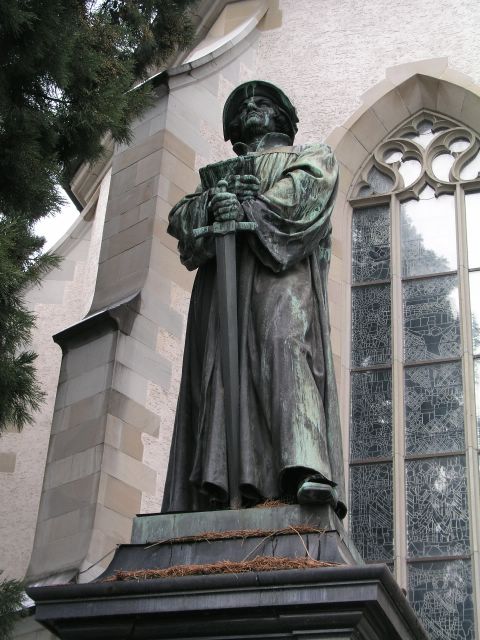
The Zwingli Statue in Zurich Posted by Picasa