Will We Join God’s Party?

April 30, 2006

Text: Luke 15

Who would not want to party with God? Can we even imagine a scenario in which we would turn down a party invitation from God?

One of my favorite expressions in Scripture describes how God delights in his people and rejoices over his people (e.g., Zephaniah 3:17). This unveils the heart of God who yearns to share life with his people and enjoy them forever. God wants us more than we want him, and to love him creates such joy in his heart that God sings over his people. God enjoys a party.

Surely one of his favorite moments is when a sinner repents and returns home, and yet this is the moment that often creates tension within the church, especially if they are not one of us—one of our kind, one of our people, one of the respectable types.

It is in the face of this tension that Jesus tells three parables—the lost sheep, the lost coin and the lost son. But his point is not so much about lostness as it is an invitation to rejoice in their being found. It is an invitation to rejoice with Jesus, to rejoice with the Father, over the retrieval of one of God’s people.

Jesus felt the tension between his ministry and those contemporary religious leaders. They mocked his proactive seeking and fellowship with tax collectors and “sinners” (read “prostitutes”). “This man welcomes sinners,” they complained, “and eats with them”! They were scandalized by Jesus’ welcoming relationship with sinners.

I’m reminded of a church whose leaders suggested that a converted prostitute attend another church in town. I’m reminded of a church where a leader asked an impoverished couple who attended with me one Sunday morning whether they had any better clothing to wear to the sacred assembly. I’m reminded of an elder’s wife who remarked to me that though she would support the new evangelistic effort among African-Americans in her south Alabama town she would not have “them” over to her house to eat at her table.

So, Jesus tells three parables….three parables the church needs to hear over and over again because we still miss the point and fail to practice the kingdom of God.

In the first two, the owners proactively seek what is lost. He finds the lost sheep and she lost coin, and they are estatic. They rejoice over their finds (“joyfully puts it on his shoulders”), and invites others to share the joy. “Rejoice with me” is the invitation…what has been lost is found! The invitations in Luke 15:6, 9 are followed by similar sayings that describe the joy of heaven (Luke 15:7, 10). The invitation to rejoice over partying with sinners is an invitation to join the party in heaven.

The lost son, as we all know, returns home. He finds a father who welcomes him and throws a party. He welcomes the sinner and eats with him. The father invites everyone to rejoice with him. His rationale is simple and jubilant: “this son of mine was dead and is alive; he was lost and is found.”

The parable could have ended there with a recounting of the joy of heaven. The previous parables did. But Jesus is focused—he wants to bring the point home. Indeed, he wants to specify the invitation. Just as Jesus welcomes sinners like the lost son, so he also invites the religious leaders to the party—the father invites the elder brother.

The older brother is angry; he will not attend the party. It does not matter if he hurts the father whom he loves, he is too angry with his brother and more so with his father. Indeed, he is angry because the father is fundamentally unfair. He coddles his younger son and undermines faithfulness. He, the elder brother, is the standard of faithfulness and the younger brother does not measure up.

But, the father pleads, “this brother of yours was dead and is alive again; he was lost and is found.” The rationale is repeated again from the father’s earlier invitation to his household (just as the joy of heaven was repeated in the earlier parables). The rationale should be sufficient—we should rejoice over the return of one who was lost more than we value our own faithfulness. We should party with the prodigal rather than sulk over our—perhaps more pointedly, take pride in—our own faithfulness.

The father invites his elder son and humbles himself as he pleads with his elder son: we have to celebrate and rejoice. (And here Luke combines two words he has used previously but separately in the narrative.) We must party—there is something to celebrate. The joy of heaven is awakened and we must join the party. We must celebrate with God—and we will if we have the heart of God and his mission is our mission.

We too easily dismiss this application of this parable. We prefer to see ourselves as the prodigal—there is a happy ending to that story. But we fail to see that we “religious people” are more probably the elder brother.

And more remarkably we are actually called to imitate the father in this parable. We are called to compassionately receive the prodigal—to welcome the sinner, and we are called to invite the elder brothers in our midst to the celebration. We seek the lost and invite the saved to rejoice with us. In this way, we party with God and share the joy of heaven.

The mission of God is to welcome sinners and eat with them. And so the church eats every Sunday and invites sinners to the party.


When Darkness Reigns

April 15, 2006

Text: Luke 22:39-23:56

One of the dimensions that I love about Mel Gibson’s “The Passion of Christ” (though there are several aspects I don’t like at all) is the sense of darkness that pervades the first quarter of the movie. He captures the mood, but not only the mood—he captures the reign of darkness on that Friday.

Darkness begins and ends Luke’s account of “Good Friday.” As the temple guards, elders and chief priests arrest Jesus in the garden, Jesus announces, “this is your hour—when darkness reigns” (Luke 22:52). Darkness reigned till Jesus breathed his last, and Jesus died in darkness as God blocked the sun (Luke 22:44). Good Friday was a dark day epitomizing the darkness that enveloped the world; symbolizing the darkness that has choked the world since the Fall. Good Friday, however, was the hour of evil’s triumph. On that day Satan’s reign tyrannized the Son of God.

Luke’s narrative draws out that dark reign through the events that transpire. His story tells us what happens when darkness reigns.

When darkness reigns….

• Good people fail to pray
• Friends betray friends
• Swords are drawn
• Disciples deny their teacher
• The innocent are convicted
• The guilty are released
• The law is subverted for interests of power and control
• The righteous are mocked
• Women weep over the loss of their children
• Soldiers demean and torture others
• The condemned insult each other
• The blameless are executed

Luke paints a dark scene from the garden to the cross. But his canvass has rays of light. The dawning sun breaks into the darkness, just as he announced at the beginning of his gospel (Luke 1:78-79).

The kingdom of God is dawning and breaking into the darkness. Even when darkness reigns, the kingdom of God cannot be smothered and snuffed out. Light appears even within the darkness.

Even though darkness reigns….

• Kingdom people refuse to use the sword even when threatened; Jesus said “No more of this!”
• Kingdom people pursue the will of God despite the consequences; Jesus said, “yet not my will, but yours be done.”
• Kingdom people confidently anticipate the fulfillment of kingdom in hope; Jesus says, “the Son of Man will be seated at the right hand of the mighty God.”
• Kingdom people weep for the brokenness of the world rather than over their own suffering for the sake of the kingdom; Jesus said, “do no weep for me; weep for yourselves and for your children.”
• Kingdom people forgive their persecutors; Jesus said, “Father, forgive them.”
• Kingdom people invite others into the kingdom; Jesus said, “today you will be with me in paradise.”
• Kingdom people trust in God’s work despite the reign of darkness; Jesus said, “Father, into your hands I commit my spirit.”

Kingdom people follow Jesus. They, like Simon from Cyrene, pick up the cross and follow Jesus. Kingdom people assault the powers of darkness by submitting to the will of God and trusting in the promise of the coming kingdom. Kingdom people follow Jesus.

Darkness reigned on Good Friday, but the kingdom of God also broke into that darkness. Even as darkness reigns in our day—in whatever way it reigns, as kingdom people we are called to follow Jesus….and it may take us to a cross.

“Father, into your hands I commit my spirit.”


New Book Announcement

April 6, 2006

Kingdom Come: Embracing the Spiritual Legacy of David Lipscomb and James A. Harding is the title of a new release by Leafwood Press, a division of ACU Press. It is due out in May 2006.

Bobby Valentine and John Mark Hicks are the authors.

“Many assume that Churches of Christ views 1930-1960 were those of the major forefathers such as James A. Harding and David Lipscomb. We must therefore read this book, for as the result of the authors’ detailed scrutiny of the writings of Lipscomb and Harding, we are soon disabused of our unwarranted illusions. These two forefathers were not simply polemicists. They were spiritual giants who heralded living in the face of the coming again of the Lord, trusting him for all of life’s needs, walking in the Spirit, prayer, Scripture reading, peace keeping and more. The authors do an excellent job of elaborating on how Scripture and contemporary scholarship sustain the commitments of Lipscomb and Harding and challenge our own life before God and in his church.”

Thomas H. Olbricht
Distinguished Professor Emeritus of Religion, Pepperdine University.

Can we say anything good about 1906?

This book recovers a piece of forgotten history from 1906. Some of the finest examples of kingdom living to be found among Churches of Christ are found in the midst of that heartbreaking year of division. The “best” of Churches of Christ in 1906 is represented by the life, thought and practice of David Lipscomb (1831-1917) and James A. Harding (1848-1922), despite the fact that Lipscomb and Harding participated in the conditions which resulted in division.

Their kingdom theology and spirituality, we believe, provides the contemporary church with a way forward into the future. If Churches of Christ—and other parts of the Stone-Campbell Movement as well—would re-appropriate their kingdom themes and practices, we believe the church would more fully participate in the emerging kingdom of God which will one day fill the earth with divine righteousness.

Below is the Table of Contents.

Introduction

1. Introducing a Spiritual Legacy: Foreigners at Home

Part A. Kingdom Dynamics: Divine Action

2. Shadows of the Second Coming: “Thy Kingdom Come”

3. God Still Works: Trusting God’s Providence

4. Holy Spirit: God’s Redemptive Presence in the World

Part B. Kingdom Spirituality: Four Means of Grace

5. Listening to God: Reading Scripture

6. Releasing the Oppressed: Fellowship as a Means of Grace

7. Communing with God: The Lord’s Day and the Lord’s Table

8. Crying for the Kingdom: The Privilege of Prayer

Part C. Kingdom Life: Free to Serve

9. The Prince of Peace: Pledging Allegiance to the Kingdom

10. No Creed But Christ: Freedom to Think and Speak

11. No More Shadows: Towards Cosmic Liberation

Afterword

12. The Road Not Traveled: Where Do We Go From Here?

My apologies for posting this a second time, but I’m testing some problems with blogdigger.


Lipscomb and Harding Photo

March 22, 2006


Harding and Lipscomb — joint photograph of the co-founders of the Nashville Bible School Posted by Picasa


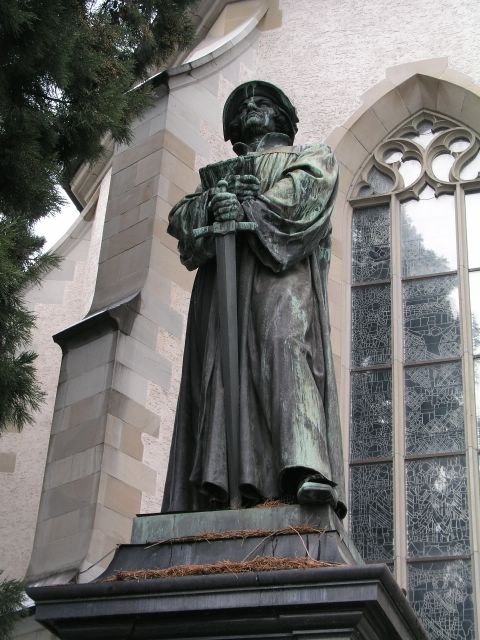
Zwingli: Bible and Sword

March 21, 2006


The Zwingli Statue in Zurich Posted by Picasa


Sword Talk

March 21, 2006

Two swords are enough. Really? Not!

This enigmatic statement by Jesus in Luke 22:38 has created some stir in the history of Christian thought. Some have even allegorized it to mean that Christians carry two swords—the word of God (Scripture) and the state weaponry (real swords). I’m reminded of the statue of Zwingli in Zurich holding a Bible and a sword. As a result Jesus’ “it is enough” comment has been used to sanction not only self-defense but just war.zwingli

To read the text that way is to miss the point as widely as the disciples themselves did, and we are at least in a better narratival position to understand it than they were. After all, in the next few hours when a disciple draws his dagger and cuts off the ear of the high priest’s servant, Jesus rebukes the disciples by redemptively healing the servant. The narrative rejects the use of the sword. The story of Jesus in the Garden returns good for evil and rejects returning evil for evil, which—of course—is consonant with Jesus’ own message in his ministry (cf. Luke 6:27). Jesus practices what he preaches. Amazing stuff, huh?

So, how are two swords “enough”? Enough for what? To defeat those who are coming to arrest Jesus? Jesus refused their use. Enough for the advancement of the kingdom against Rome? Hardly. But the disciples apparently thought it was for either self-defense or for the prosecution of the kingdom since when they saw the threat that Judas brought into the garden they asked, “Should we strike with our swords?” With perhaps some frustration in his voice, Jesus retorted “No more of this!” (Luke 22:51.)

Maybe we are going the wrong direction here. Maybe Jesus did not intend to say that “we have enough swords.” Or, if he did, perhaps there is a strong tinge of sarcasm here or perhaps frustration. Maybe Jesus means something like “Enough of that; no more sword talk” (The Message). Maybe Jesus intends the same meaning that Yahweh had when he said to Moses, “That is enough,” the matter is closed…discussion over (Deut. 3:26).

I feel like that with my teenagers sometimes. As we become more involved in a discussion they miss my meaning or they don’t have the maturity or experience to catch the point. And so I say something like, “discussion over…this is fruitless…let’s move on.”

So, perhaps Jesus was not really talking about swords at all. Perhaps he was using the “sword” to make a larger point. When the disciples took the exhortation to sell their cloaks and buy swords literally, Jesus says, “Enough of that; you guys don’t get it, do you?”

Jesus was contrasting the hospitality of their Galilean ministry with the hostility of their present circumstances. While in Galilee they could depend on the warm reception of the villages, here in Judea—indeed, in the next few moments—the disciples will encounter hostility. The situation has changed. Whereas before they needed neither purse nor sandals, now they need a sword instead of a cloak (a necessity for staying warm at night). The urgency of the contrast is startling. They will need a sword more than they need warmth. The point is not that the disciples need to literally secure a sword, but they need to realize the charged and changed atmosphere in which they now move.

They need to prepare themselves for a trial. Satan is about to test them, just as he is about to test Jesus himself. They should get ready to face the hostility. But Jesus does not mean to literally face it with a sword or a purse or a bag, but to prepare their hearts, to steady their faith and get ready for the trial they are all about to endure. Danger is in the air—secure a sword, be prepared for battle. But not a battle that wields a literal sword, but one that engages the Satanic influences that filled the air that night.

When the disciples took the reference to the “sword” literally, Jesus ends the discussion—perhaps a bit frustrated similar to his experience on the boat in Galilee which Mark narrates (a case where they took “yeast” literally to Jesus’ utter amazement, cf. Mark 8:14-21). One can almost hear Jesus again saying, “Do you still not understand?” as he leads his disciples to the garden where they will be tested…and fail.

Jesus is not interested in swords. He rejects the use of the sword. The one who lives by the sword dies by the sword. Jesus is interested in preparing his disciples for their test, their trial. They fail, but Jesus nevertheless prays for them, pursues them, and expects to again sit at table with them in his kingdom. They fail, but Jesus is gracious. They take up the sword, but Jesus forgives them. They flee, but Jesus still wants them. They ultimately return and Jesus accepts them and gives them a place at his table—not just a place, but a throne at the table. They are royalty at the king’s table.

We, too, misunderstand, and even use the sword. And, no doubt, Jesus is frustrated with us. But he continues to pray for us, pursue us and invite us to his table.

But only if we could learn that we don’t need any swords. When will we learn? Two swords are too many in Jesus’ kingdom.


Table Talk

March 19, 2006

Text: Luke 22:24-38

Kingdom talk enveloped the last supper Jesus ate with his disciples. It was Passover time. Kingdom expectations were in the air. Jewish sensibilities were heightened during the Passover as they anticipated the imminent arrival of the Messiah. Jesus had predicted that by the time of the next Passover the kingdom would have already come. In that atmosphere the discussion at the table was no doubt lively and boisterous. Indeed, the disciples debated who among them would be considered the greatest in Jesus’ kingdom.

But there was another dimension to that table. The atmosphere was also ominous and foreboding. Jesus knew that hostility to him had reached a climax—the blade was hot and ready to strike. Judas had betrayed him and that night Jesus would face his enemies in the garden and at the house of the high priest. Jesus would be tried, but so would the disciples. Even at the table they debated who the betrayer might be.

There were two discussions at that table—one about the kingdom and one about betrayal…and both pointed to the failure of the disciples to grasp and embrace the mission of Jesus.

Judas had already had his trial, and he failed. His end would not involve redemption. He opted out of the mission of Jesus. But the rest of the disciples would also be tried that night. They would face temptation, like the temptation of Jesus in the garden itself. And they would desert their teacher. Where Jesus called them to lose their lives in his mission so that they might save them, they chose to preserve their lives by denying him.

Jesus’ table talk accentuates three failures on the part of the disciples. They failed to grasp the servant character of the kingdom of Jesus. They failed the test of discipleship—to follow Jesus into suffering. They failed to grasp the nonviolent nature of Jesus’ mission.

The kingdom table is about service. When the disciples argued about who was the greatest in the kingdom of God, Jesus rebuked their ambitious desires. They had failed to grasp the nature of Jesus’ own regal leadership. Unlike pagan benefactors who use wealth and power to secure their own interests and dominate others, Jesus sacrifices his own body and blood for the sake of others. Even though he is the host of this table, he nevertheless serves it. His kingdom table embodies self-emptying, self-sacrifice and self-abasement. He does not exploit power or status for his own self-interests, but for the sake of others.

The kingdom table is about following Jesus into suffering for the sake of the world. This is the trial that the disciples would face that very night. Satan determined, with divine permission, to test their loyalty and commitment to discipleship (“you” is plural). Will they suffer with Jesus or will they save their own lives? Satan would find out, and Jesus knew the answer. So, Jesus prays that the disciples, Peter in particular, would find the faith to renew their commitment and strengthen each other. They will fail, but Jesus hopes for their future and envelops them with grace.

The kingdom table is about encountering hostility with non-violence. Unlike previous instructions in his ministry, here Jesus counsels his disciples to take bags and clothes with them. The situation has changed. Instead of the popular ministry of healing and preaching in Galilee, now in Judea—in the temple precincts—the ministry of Jesus encounters violent hostility. Now Jesus counsels buying swords. And the disciples inform him that they have two daggers. “It is enough,” Jesus says. Would two daggers be enough for self-defense? No, it is enough because Jesus has no intention of using the daggers in his kingdom mission. Indeed, he later rebukes Peter when he responds violently with one of those daggers and Jesus warns that those who live by the sword die by the sword. “It is enough” does not mean that they have sufficient weaponry but rather more like “enough of this discussion…you disciples still don’t understand.” The Son of Man must be numbered with the transgressors; he will defeat evil through suffering rather than through violence. Jesus will not return evil for evil. He will overcome evil with good.

We sit at this same table every Sunday. When eat the Lord’s Supper we sit at his kingdom table. This table calls us to service, discipleship and non-violence.

This is Luke’s story—it is the good news of the kingdom of God. The kingdom comes among us in the person of Jesus as one who serves others, suffers for others and loves his enemies rather than returning evil for evil.

As disciples of Jesus who eat at his table this is our story as well. To sit at the table of Jesus is to embrace his story and to follow him. In our journey through Luke, we have followed Jesus into the water, and followed him into the wilderness. We have followed him to tables with sinners and prostitutes. We have followed him in ministry to the disenfranchised (widows), outsiders (tax collectors), lepers (even a Samaritan one), and outcasts (the poor). We have sat with him at a Passover table, and now we are called to follow him to the cross.

And the question is now ours. As we sit at table with Jesus today, are we willing to follow the one who serves others instead of his own ambitions? Are we willing to follow Jesus to a cross? Are we willing to love our enemies? Or, are we more like the disciples at that Passover table than we might like to admit?

Despite our failures—despite the failures of the disciples—Jesus invites us to his table. He even anticipates our failures but yet graciously invites us back. Jesus even today prays for his disciples as the great high priest, and today we draw on his strength to embrace his kingdom mission and follow him. Today we sit at table with Jesus and encourage each other to continue the mission of Jesus, even if it costs us our ambitions, wealth, power and lives.


Traitor at the Table

March 12, 2006

Text: Luke 22:1-23

The betrayer sat at the table with Jesus and Jesus knew who the betrayer was. He was one of the Twelve, one of the chosen. He had cast out demons and proclaimed the coming of the kingdom. Jesus had prayed over that choice and yet Satan entered Judas’ heart and Satan won the battle.

The leaders of Israel—the powers that ruled its religion and temple—wanted to entrap Jesus so that he would lose his popularity among the people. But they had been unsuccessful. They wanted to kill him but were unable to seize him in a way that would not create a disturbance or even riot. They wanted to avoid Roman intervention, and the Romans were on heightened alert during Passover time.

And Judas provided the opportunity. He knew where Jesus spent his nights. He knew where Jesus might be taken in secret away from the public crowds that hung on his every word in the temple. So Judas arranges Jesus’ arrest and then goes to sit at table with him. Judas and Jesus eat the Passover together that night.

The table that night must have been quite a festive occasion. Oh, I know that we usually think of the Passover as a solemn, almost morbid, event, and especially the last Passover Jesus has with his disciples. It was, after all, the night on which he was betrayed and the night he announced his coming death. But Jesus also announced something wondrous that night.

The Passover was a celebratory festival which anticipated the coming reign of God as well as remembering Israel’s past deliverance from bondage. It remembered good news in the past and anticipated future good news. It was hopeful for the future as it celebrated the past. The Passover was a time of great rejoicing and excitement that brought Israel to the edge of their seat.

I believe its festive character pervaded the table that night. Indeed, Jesus’ announced good news at the beginning of the meal. At the moment, seemingly, when the host was to rehearse the meaning of the Passover (the haggadah) at the second cup of wine, Jesus announces the coming of the kingdom of God. Not that unusual except that he declares that the next time he and his disciples eat the Passover together it will be in the kingdom of God.

The disciples must have been astounded by such a statement. No doubt they have been wondering when the kingdom would come, and now they know it will come within the next year—according to their measurement of Jesus’ words. Next year, at the next Passover, they will be eating with the Master in the kingdom of God! (More than likely this generated the subsequent discussion about who was going to be the greatest in the kingdom.)

No doubt they sang the little hallel (e.g., Psalm 113) with great gusto at that moment. “Praise the Lord…The Lord is exalted above all the nations…He raises the poor from the dust and lifts the needy from the ash heap…Praise the Lord.”

Judas heard this too and no doubt sang Psalm 113 with the rest of the disciples sitting at that table. I wonder what he was thinking. I wonder if he doubted his earlier arrangement. Had he acted too soon? Or, would his act precipitate the coming kingdom? I don’t know; no one does. But he was at the table, eating with Jesus and still intending to complete the betryal.

Then, as the main meal begins, Jesus gives a new meaning to this last supper. The “supper” (eating the lamb) begins with the breaking of the bread. But with this bread Jesus reinterprets the meal. Hereafter, the Passover will be eaten in his memory. In the future, the disciples will remember Jesus. The sacrificial meal will honor his sacrifice as he gives his body for humanity. Jesus himself, rather than the lamb, will be the sacrifice. Jesus is the lamb!

Judas is still at the table. He eats the bread, and he eats the roasted lamb. The bread is for him too—the body of Jesus is given for Judas too.

Having eaten the lamb (“supper”), Jesus takes the cup which is now either the third or fourth cup of wine at the Passover meal. But the wine is no longer about Israel’s past redemption, but it is about Jesus’ own sacrifice. It is his blood and it inaugurates a new covenant. The new covenant (reminding us of Jeremiah 31) is about forgiveness, but it is also about the law written in our heart. The blood cleanses but it also makes new—and a new relationship is enacted between God and his people.

And Judas is at the table. His hand is on the same table with Jesus. He drinks the cup—the blood is poured out for him too.

But Judas is the betrayer, though he sits at the table as one of the disciples. He sings the Psalms of redemption (e.g., Psalms 114-118). He sings “this is the day the Lord has made, let us rejoice and be glad in it.” He eats the bread and drinks the cup; and he sings the songs. He listens to the Master…but his heart is in another place. He has a different agenda.

Sound familiar? To what extent are we all Judas today as we sit at this table with Jesus? Do we eat and drink with divided hearts? Do we sing the songs and hear the word only to dismiss their meaning for the sake of our own agendas? To what extent do we eat and drink with our own agenda instead of in covenant with Jesus?

Table time is covenant time. It is when we renew our pledge to God and God renews his pledge to us. It is a time of communion, but also rededication. It is a time to again choose whom we will serve. It is a time of covenant renewal—God renewing his covenant with us (“this is my body given for you” and “this is my blood poured out for you”) as we renew covenant with him.

But even in this moment of talk about betrayal there is hope. Yes, the Son of Man will die, but he is the Son of Man. He is the eschatological human who breaks in from the future to declare the coming kingdom of God. The Son of Man dies but the kingdom will come!

Yes, “this is my body” and “this is my blood.” Yes, the lamb is sacrificed for the sins of the world. But Jesus will eat and drink again with his disciples when the kingdom of God comes. Death is not the end. The grave is not the final stop. Though he suffers, the Son of Man will enter glory and the kingdom will come. The joy of the kingdom will conquer death, and Sunday will transform Friday. On Sunday, Jesus ate with his disciples again, and even now the living Christ, the eschatological Son of Man, eats with his disciples. But let us be vigilant lest we ourselves are Judas at that table. Let us eat in faith and hope and commitment.


Dare We Doubt Together?

February 24, 2006

Nine years ago Jennifer delivered Leah stillborn. The next Sunday her congregation sang, “God is so good.” The words caught in Jennifer’s throat, and she could not sing. Instead she found a place to weep alone.

“I’m dead inside,” Becky says. Her church, shepherds, family and friends had begged God for sixteen-year-old Joshua. But Jeff’s and Becky’s only son died as a result of surgical complications nearly a year ago. “How, God, can this be the reality of my life?” Becky asks.

Though for six months Liesa had requested special prayers for her only son, 23-year-old Chad died in a car accident one year ago. Feeling the overwhelming shock and loss, Liesa, along with her husband Ted, struggles to find the heart to worship.
Like Jeff and Becky, we also named our only son Joshua with the prayer that God would make him a leader among his people. He lived sixteen years before his weak body lost its long struggle with a genetic disorder two years ago.

Since October Becky and Jeff, Liesa and Ted, and Jennifer and I have met twice a month to share our hearts and thoughts. We cry and pray together. We study Scripture and discuss the twists and turns that happen in our lives. We vent our feelings and hurts.

Grief has not created intellectual doubt within our group. We believe God is there, but we do wonder why God is not here. We believe God exists, but we wonder why he permitted such horrendous loss in our lives. Like C. S. Lewis, after the death of his wife of three years, we are not “in much danger of ceasing to believe in God” as much as “coming to believe such dreadful things about Him” (Grief Observed, 5).

Grief has not attacked the intellectual dimensions of our faith but did create an emotional distance between God and us. We do not doubt God’s reality, but he feels so distant. We feel angry. Did God not hear us? Did he forget us? We hurt. Did he decide to leave us in pain instead of continue our joy? We feel betrayed. Did God give us such wonderful gifts of life only to, as Job says, take them away? (Job 1:21). We even sometimes feel abandoned.

The lament Psalms ask similar questions. “Why do you hide yourself, Lord, in times of trouble?” (Psalm 10:1b). “How long, O Lord…How long must I bear pain in my soul, and have sorrow in my heart all day long?” (Psalm 13:1a, 2). “Lord, where is your steadfast love of old”? (Psalm 89:49). “Why do you hold back your hand; why do you keep your hand in your bosom?” (Psalm 74:11).

We discovered that our relationships with God enabled total honesty with him. In grace we are free to be honest—-to pray what we authentically feel. Before God and with each other we are able to be who we are rather than pretend who we are “supposed” to be. We bonded as a group because we shared the same journey in our lives. Indeed, through the journey we have experienced God’s presence through confronting him with our hurt and anger.

Most—-perhaps those who have not lost a child—-would be appalled at the words we speak. Many would not understand, and some might condemn. We do not expect everyone to understand. Perhaps without experiencing loss of this magnitude there is no genuine empathy or understanding. We feel safe in our little group because of our shared experience. We verbalize our feelings, confess our ignorance and wrestle with God together. It is our “safe place” to express our faith through doubts and questions. All grievers need a “safe place.”

Can faith doubt and question? The doubts and questions are real, but it is faith nonetheless. Genuine faith perseveres and is sustained through faithful lament. Without lament emotional doubt would eat away faith like a cancer, but through lament faith speaks to the one who alone can heal that emotional pain and close the distance. God, we are confident, will hear us and comfort us through our lament. God will draw near even as we at times feel so distant from him. He will carry us when we cannot walk and he will be present even when we are angry.

Lord, we believe. Help our unbelief.

Originally published in New Wineskins (May-June 2003)


Kingdom Come

February 5, 2006

Text: Luke 17:11-37

Journeying to Jerusalem, Jesus traveled along the border of Galilee and Samaria where he encountered ten lepers outside a village. This kind of scene is becoming familiar in Luke. Jesus meets, in the course of his daily existence, the social outcast, the disenfranchised, the broken people of his world. He moved in circles and places that offered opportunity for redemptive engagement with the “poor” of the land.

Responding to their cry for mercy, Jesus sent all ten to the priest and as they went, they were cleansed of their skin disease. Only one, however, returned to thank Jesus—and that one was a Samaritan. Luke calls attention to it—as narrator he identifies his ethnicity and the words of Jesus refer to him as a “foreigner.” He alone, apparently, is grateful and “saved” (NIV says “made well” in 17:19).

A Samaritan Leper! Ethnically, socially, religiously, ritually unclean! He was made pure (cleansed of his impurity), healed (of his disease) and saved (forgiven of his sins). Luke uses all three words to describe his redemption—his salvation; wholly saved—in every respect.

The kingdom is present. The fallenness of the world is reversed. The sick are healed, the polluted (ritually, socially) are cleansed, and the lost are saved. This is Luke’s story—the presence of Jesus is the presence of the kingdom of God. Through him and in him, the future has arrived in a way that reverses the curse and turns the world back upside right.

But some cannot see it. The Pharisees—even with all they have witnessed, though they may not have seen the leper miracles Luke positions before their question—ask, When will the Kingdom of God come? The kingdom was present before their eyes, and they were blind to it. They were looking for the wrong thing.

They sought cosmic, cataclysmic signs. They thought it would come with the defeat of the Romans, perhaps at the time of the Passover. They imagined a nationalistic renewal of the Davidic kingdom as the Messiah took up his rule in Jerusalem. They thought the kingdom would be detected by observation, that is, by rational scrutiny, deductive logic, scientific analysis and visual assessment. They would identify the kingdom by their own criteria.

And they missed the kingdom before their eyes. They missed how the dead are raised. They missed how the blind see. They missed how the poor are included at the banquets. They missed how women were part of Jesus’ entourage—they were disciples too. They missed how the kingdom of God is evident by the redemption of a Samaritan leper!

The kingdom of God is not a matter of political maneuvers and the defeat of the Romans, but rather the presence of the future where renewal reverses the curse. The kingdom of God is not a psycho-analytical, mystical presence within the human soul (as the NIV translation might intimate), but is rather the dynamic activity of God to redeem what is fallen in the world. The kingdom is present in Jesus. The kingdom of God was “among” them, not “in” them.

And yet to affirm the presence of the kingdom in the now—even in the ministry of Jesus—is to create a tension in the lives of disciples. The “now” does not always look like the kingdom. Fallenness still exists. The poor are not honored in culture; the leper is still ostracized; ethnic groups are still divided by hatred; and many do not see the kingdom and have lost their way.

For this reason, I think, Luke continues his narrative with Jesus’ instruction to his disciples. While 17:20-21 is directed toward the Pharisees, 17:22-37 is directed toward his disciples. The disciples need the hope that this world—in its present fallen state—is not the fullness of the kingdom of God. As wonderful as the ministry of Jesus is, and as wonderful as the present experience of redemption in the family of God is, this is not the final chapter in God’s story. There is yet another chapter to be written.

The day or days of the Son of Man are coming when the fullness of God’s reign will be made known (revealed). It will be sudden but decisive. It will be redemptive but also destructive. One will be taken (saved like Noah and Lot) but another will be left (lost like the flooded Noahic world and Sodom and Gomorrah). It will be a cataclysmic event on the style of Noah and the destruction of Sodom and Gomorrah. That day has not yet arrived, but it is coming.

Life goes on. People eat, drink, marry, buy, sell, plant and build. This is the world in which we live. There is nothing evil about these activities, of course; they are the stuff of life and they are sanctified activities.

But they are distracting. They become the focus of human existence. They become the raison d’etre of human existence. We seek our satisfaction there; we come to believe meaning is found there. We try to “keep our life” there and preserve the meaning we have created for ourselves. We lose sight of the kingdom of God. We no longer “watch” for the kingdom and embrace its meaning for our lives now. We seek to keep our life rather than lose it for the sake of the kingdom.

When our life becomes so valuable that it is exchanged for life in the kingdom of God, then we are like Lot’s wife who valued her life in Sodom more than the kingdom of God. When we absorb the values of this life, this fallen world, then we lose the kingdom. When we value our ethnic, nationalistic or religious culture more than we value the kingdom, then we become like Lot’s wife.

Jesus reminds his disciples to “lose” their life in his kingdom in order to find it because when we seek to find our life in this world we will lose the life God intends for us.

How could the Pharisees have missed it? Was it not obvious? How can we miss it? We invest in buying and selling, in planting and building as if this is where we will find the kingdom of God. But the kingdom of God is revealed when Samaritan lepers are redeemed!

Are we truly about kingdom business in this church? It is so easy for us to lose sight of the kingdom because we are seeking to find our lives.

Luke calls us to discipleship in the kingdom of God in the present as we wait for the full revelation of the Son of Man in the future. It is Luke’s way of saying, “Seek first the kingdom of God, and all these things will be added to you” (Matthew 6:33).