Psalm 104 – Derek: Meditating on the Way

January 23, 2025

Psalm 104 celebrates creation as God’s continuous work from laying the foundations of the earth to giving breath to every living thing. God lies at the center of the creation; it is not about life per se or human utility. Rather, the creation is God-centered. Out of God’s steadfast love, God gifts the creation with goodness, life, and joy. Psalm 104, however, is also a lament that challenges Israel (and us) to honor God’s good creation rather than destroy it. For more on Psalm 104, see these links.

Psalm 104

https://digitalcommons.acu.edu/sumvid/54/

Psalm 104: For God So Loves the World

The Mini-Bible: The Bible in Five Psalms (Pss 103-107


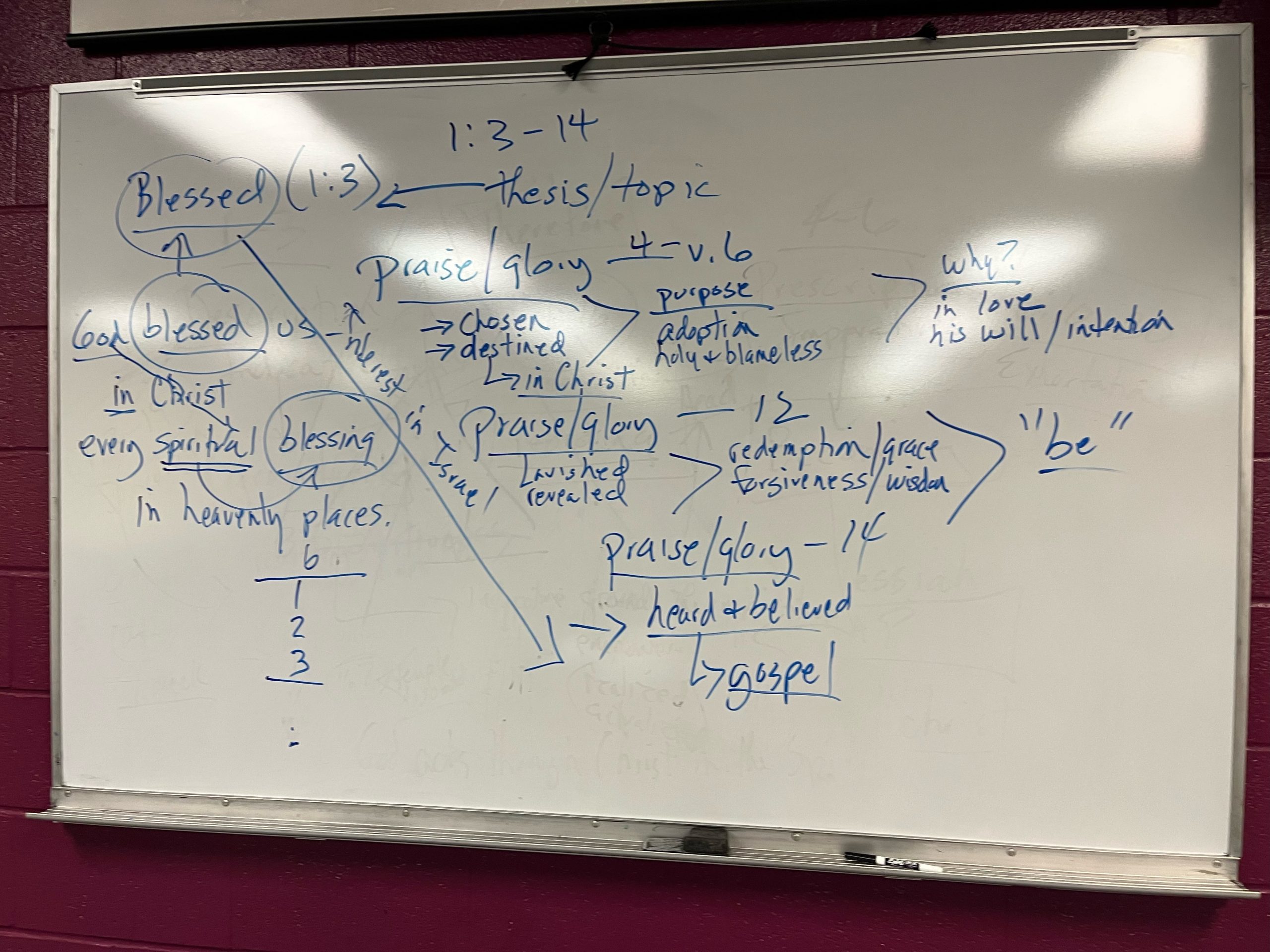
Blessed be God (Ephesians 1:3-14)

January 22, 2025

Paul opens the letter with a long blessing or doxology that is a single sentence (from verse 3 to verse 14). While our English translations do not reflect this (because that would be bad English), the rhetorical flare of the single Greek sentence is magnificent, explosive, and comprehensive.

Summary

Opening the letter by blessing God sets the tone for the whole document. One might say that Ephesians 1:3 functions as a thesis statement or a topic sentence. God is at the center of what is happening in the story Paul is telling as he explains the mystery of Christ.

The point: God takes the initiative to act by the power of the Spirit to unite all things in heaven and on earth in Christ.

The opening line is a common way of addressing God in both the Hebrew Bible and in Second Temple Judaism (see Genesis 14:20; Exodus 18:10; 1 Samuel 25:39; 1 Kings 1:48; Psalm 66:20; Psalm 68:35; Tobit 12:2). The blessing of God—the ascribing to God all God’s saving mighty deeds—is typical in Jewish prayers. Paul uses a conventional form but fills it with Christological and Spiritual (Holy Spirit) realities. His doxology blesses the Triune God for God’s saving work in the world.

God blesses (1:3), chooses (1:4, 11), predestines (1:5, 11), lavishes grace (1:8), reveals (1:9), purposes (1:9), includes (1:13), and marks (1:14). God does this to sanctify (1:4), adopt (1:5), redeem (1:7), reorder the world (1:10) and to fulfill God’s purposes (1:11).

God is motivated by love (1:4), the divine will (1:5), grace (1:6-7), and good pleasure (1:9).

God does this in or through Christ (the Jewish Messiah; 1:3-5, 7, 9, 11-13) and marks the people of God by the Holy Spirit (1:13-14). In other words, the story of salvation is a Triune work of the Father, Son, and Spirit.

This Triune structure is, perhaps, reflected in the structure of the blessing itself, which highlights the praise of God. Three times Paul states the goal of God’s work: it is to the praise of God’s glory (1:6, 12, 14). We might outline the doxology in this way to capture its comprehensive movement.

  • The Divine Initiative: God blesses, choses, predestines for the “praise of his glory” (1:3-6).
  • The Christological Center: in Christ there is redemption, a reordering of the cosmos, and an inheritance for the “praise of his glory” (1:7-12).
  • The Spirit’s Guarantee: marked with the seal of the Holy Spirit for “the praise of his glory” (1:13-14).

God is glorified through the work of the Triune God. God receives glory through the blessing, reordering, and sealing of a people who inherit the renewed cosmos (new creation). God accomplishes this through the mystery of Christ that gifts humanity with an inheritance as the people of God. In other words, God is glorified when God unites with humanity in the person of Christ through the presence of the indwelling Spirit. The glory of God, we might say with Irenaeus, is a human being fully alive or fully flourishing as the images of God in the world God created.

https://johnmarkhicks.com/wp-content/uploads/2025/01/Eph-1-3-14-scaled.jpeg

Going Deeper

First, what the distinction between “us” and “you” in the doxology?

The “you” are included in the “us” in Ephesians 1:13. The question is: who are the referents for these pronouns? Is this a contrast between Paul and his readers, between the church universal and the readers, or between Jews and gentiles?


Ephesians 1:3 sets the agenda. God is the one who blesses in the Messiah with all Spirited-blessings. The language of blessing is language of God’s story, starting in creation in Genesis 1 and then with the call of Abraham in Genesis 12. The language of Ephesians 1:3-12 is saturated with language that describes Israel’s relationship with God: blessing, election, adoption, redemption, forgiveness, Messiah (Christ), and inheritance.  Israel blesses God for the ways in which God has blessed Israel in the Messiah with all the blessings that flow from the work of the Holy Spirit in the lives of people.

We may hear this doxology in a way similar to Romans 9:4-5 which describes the gifts of Israel. God chose Israel, blessed Israel, adopted Israel, and gave Israel an inheritance through the covenants and promises. The doxology of Ephesians 1 operates in that same orbit. In other words, the context of this doxology is not the eternal past and some abstract conception of election hidden in the secret will of God but rather the act of God to choose and bless Israel for the sake of the world as part the unfolding story of salvation history or redemptive history.

Consequently, when Ephesians 1:13 speaks to the readers as “you,” Paul is referring to the gentiles (just as he does in 2:1, 11). The gentiles are included in the story of Israel through the Messiah, they share in the promised Holy Spirit, and they now are heirs of the kingdom of the Messiah and its redemption.

Second, what is the “plan of salvation” revealed in the doxology?

God “has made known to us the mystery of his will, according to his good pleasure that he set forth in Christ, as a plan for the fullness of time[s], to gather up all things in him, things in heaven and things on earth” (Ephesians 1:9-10).

There are at least three key terms here: mystery, plan, and gather up. Each of these are important words in Ephesians that bear witness to the theology of Ephesians.

In Ephesians, “mystery” appears in 1:9 (“mystery of his will”), 3:3 (“mystery of Christ”), 3:9 (“plan of the mystery”), 5:32 (about the unity of Christ and the church), 6:19 (“mystery of the gospel”). Colossians also calls it the “mystery of God” (2:2), and Romans parallels the “gospel and proclamation of Jesus Christ” with the “revelation of the mystery” (16:25). As we will see in Ephesians 3, the mystery of Christ (or the gospel itself) is the work of God to reconcile Jew and gentile in one body through the redemption God accomplishes through Christ in the Spirit.

The word “plan” (oikonomian) is a word that describes governmental (imperial) administration or household management (see also Ephesians 3:2, 9 for the use of the same word). In effect, the word describes how God is managing the world and executing God’s goals for the world. In other words, it is God’s plan of salvation. How does God intend to rescue the world and reconcile all things?

The answer lies in the phrase “to gather up all things in [Christ], things in heaven and things on earth.” The words “gather up” are from a Greek compound word: anakaphalaiosasthai. The basic etymology of the word is to “add up things under a head or sum.” We might think of it as adding up a list of numbers and putting the sum at the top (at the head). The word, then, has a sense of reordering everything or summing up everything.  In other words, it may have the meaning of to restore all things; to put everything back in its rightful place within the order of God’s good creation. This, then, is an allusion to God’s new creation when everything in heaven and earth will be renewed, rightly ordered, and set right. Everything, as Irenaeus emphasized in the second century, is recapitulated (using the word Paul uses) in Christ. It is a new beginning, a new creation, and a new heaven and new earth.

This is God’s plan of salvation; it is what God does in Christ by the Spirit.

Third, what does election mean in Christian theology?

Ephesians 1 is a classic text for the discussion of election or predestination in the history of Christian theology. It is a primary “battleground” between Calvinnists and Arminians. Without attempting to adjudicate that debate and determine who best interprets Ephesians 1, I think it is better to stake out the common ground that exists between Calvinists (Augustinians, Reformed) and Arminians (Classic, Wesleyan, Pentecostal). For a “systematic” presentation of my own theology of election, see my blog entitled: “Election: Before We Called God Answered.”

Several biblical themes provide a framework for articulating a common ground that can propel us beyond the impasse between Calvinists and Arminians. I do not claim any theological ingenuity or originality here. Quite the contrary, these theological principles are common ground between believers. It is precisely because this is true that they may provide a way to unpack a common theological framework. 

  1. Theological: Divine Initiative

Whatever the doctrine of election means, it at least insists that God took the initiative in redemption. God made the first move. We love because God first loved. We believe because God first acted. We are redeemed because God accomplished redemption for us. 

Initiative involves not merely the first act (as if God acted first and then passively sits back to see how we respond), but that God continuously acts in unrelenting pursuit of a people as a treasured possession. God’s love pursues us, engages us, and moves us. 

Further, this entails that all boasting is negated. We have nothing about which to boast except what God has done through Jesus in the Spirit. Election means that God has removed all grounds for human merit and has located the ground of salvation in God’s own gracious and loving acts. 

  • Christocentrism: Christ as the Elect One

Christ is the Elect One. God chose Christ as the savior of the world. He is God’s chosen vessel for redemption. Both Calvin and Arminius emphasized this point, and it has been powerfully renewed in the 20th century by Karl Barth among others. Election is Christocentric since Christ is God’s Elect One. Whatever election we have, we are elect because we are in Christ and because of Christ.

Before we become steeped in the theoretical underpinnings of election, we must not lose sight of this foundational soteriological insight: God has chosen us in Christ because he has chosen Christ. We are only elect through Christ. His election is logically and ontologically prior to our own. We cannot think biblically about election if we do not first acknowledge that our election depends on the election of Christ.

  • Economic: Revealed within Salvation History

The election of Christ, of course, is a revealed point. We only know that God has acted decisively in Jesus as the Elect One because God has revealed this in the history of Israel and Jesus of Nazareth. And God has interpreted those actions within the narrative of Scripture. We only know our election in Christ because God has revealed the Elect One. 

This is part of the point in 2 Timothy 1:8-11. God “has saved us and called us to a holy life,” and the ground of this salvation and calling is not our own works, but God’s “purpose and grace.” We know this grace by God’s decisive act in Jesus. Even though it was hidden before creation, “it has now been revealed through the appearing” of Jesus. They mystery of Christ has now been made known by God’s apostles and prophets (Ephesians 2:20).

Debates about the “secret” will of God are unprofitable exactly because that will is “secret.” We know our election through the revelation of God in Christ. God has revealed election through Christ, and we have no other access to it. Consequently, we ought to think about election within the salvation history of God’s story, that is, within the revealed history of God in Israel and Christ.

Thinking about God’s electing grace in terms of the “eternal” mind of God is speculative, but thinking about divine election in the light of Jesus Christ is rooted in God’s historical revelation. We perceive our own election only through the revelation of that election in Christ. When we step outside of or seek to go beyond this historic revelation, we most typically enter worlds which our minds have created rather than what God has revealed. Election and assurance are economically tied to Christ. There the focus should begin and end.

  • Faith: the Means by Which Election is Embraced and Experienced

Faith is the means of both justification and sanctification (if we grant the historic distinction in Protestant theology). When we make justification dependent upon sanctification, then we begin a never-ending journey since we will never be sure whether our sanctification is sufficient (in terms of its depth, amount, comprehensiveness and quality). When we sever the relationship between justification and sanctification, we become antinomian and discredit the role of sanctification as evidence of justification.

The way to avoid legalism on the one hand and antinomianism on the other is to see faith as the principle that unites justification and sanctification. We are justified by faith, and we are sanctified by faith. Faith is primarily a trusting allegiance, a loyalty, a submission to the King of Israel.

We are justified before God by faith, and faith is the means by which the Spirit transforms us. Faith is the means of salvation and assurance from beginning to end. We are elect, then, through faith in Christ. Faith functions as an instrument, not as a meritorious act. It is the way we come to know our own election. 

Summary

We know we are elect through trusting in Christ. Whatever theory may lie behind one’s theology of election, these four points healthy common ground for unity. Both Calvinists and Arminians affirm these points, though with additional nuances and caveats. Faith is the means of election, and our only access to know God’s decision is through faith.

Calvin, for example, correctly says that the question is not, “Am I elect?” but “Do I trust Christ?”  Calvin spoke of Christ as “the mirror wherein we must, and without self-deception may contemplate our own election” (Institutes, 3.24.5). Calvin thought whoever pursues the question by asking whether they are elect or not  “plunges headlong into an immense abyss, involves himself in numberless inextricable snares, and buries himself in the thickest darkness…Therefore, as we dread shipwreck, we must avoid this rock, which is fatal to everyone who strikes upon it” (Institutes 3.24.4).

The assurance of election is rooted Christological: We are elect when we trust in Christ as the Elect One. Election “from below” is mediated through faith in Christ. Here Calvinists and Arminians can agree. “If Pighius asks how I know I am elect, I answer that Christ is more than a thousand testimonies to me” (Concerning the Eternal Predestination of God, 8.7).


Psalm 103 — Derek: Meditating on the Way

January 16, 2025

If one sees the God of Israel as fundamentally vindictive, angry, or malicious, then one might want to meditate and pray Psalm 103 regularly. The psalmist recognizes God has not treated as we deserve, forgives our sins, liberates us from our oppression, and heals our wounds because God is steadfast love, gracious, and merciful. God removes our sins from us as far as the east is from the west. Join Bobby Valentine and John Mark Hicks in a meditation and reflection on Psalm 103 in order to see the God of Israel more clearly and embrace God’s mercy.


Lesson 1: On Reading Ephesians (Ephesians 1:1-2)

January 15, 2025

Ephesians is Paul’s most comprehensive letter. It was intended for circulation among various congregations for public reading in their assemblies. The first three chapters unfold the mystery of God in Christ by the power of the Spirit as the plan of salvation, and the final three chapters invite believers to participate in that mystery by becoming like Christ by the power of the Spirit as part of the new creation.

Paul, an apostle of Christ Jesus by the will of God, to the saints who are [in Ephesus] and are faithful in Jesus Christ: grace and peace from God our Father and the Lord Jesus Christ” (Ephesians 1:1-2).

The letter’s salutation and greeting are typical for Paul’s letters. They identify the sender/author (Paul), the recipients (faithful saints), and greet the readers (grace and peace). Each element is soaked in the reality of “Jesus Christ.” The author is an apostle of Jesus Christ, the recipients are “faithful in Christ Jesus,” and grace and peace come from both the Father and Jesus Christ. At the same time, “the will of God” and the activity of “God our Father” are prioritized. It is the Father, for example, who initiates the scheme of redemption in Ephesians 1:3-14.

While Paul identifies himself as an apostle (one sent with authority), he will also remind them he is a prisoner in chapter 3. His apostleship does not mean he is privileged or exalted but that he serves and suffers for Christ. Nevertheless, he is chosen by God–the will of God has sent him as an authoritative representative of the Messiah (Christ).

The recipients of the letter are identified as “saints” (holy ones) who are faithful in Jesus the Messiah. They believe, but the word is more wholistic. It is not simply an intellectual affirmation or belief but an obedient commitment that arises out an allegiance to Jesus the Messiah, the Davidic King of Israel. They are “faithful” rather than simply believers in a minimal sense.

Grace and peace are high values often used in Christian greetings. They flow from the reality of God and his Messiah, and the represent a mercy and wholeness that come as gifts from God and the Lord Jesus Christ. We will see these words again in Ephesians. So, they is not a flippant greeting but actually anticipate major themes in the letter itself.

The letter to the Ephesians is unique. Here are some elements that contribute to that distinctiveness.

  • The occasion of the letter is uncertain as it does not address any particular situation within a specific congregation. At the same time, the relationships between Jews and gentiles, the cultural dynamic of rulers/authorities/powers in Ephesus (or Asia Minor), and need/call for moral transformation are prominent in the letter.
  • The letter contains no personal greetings to anyone or details about the author’s history/relationship with the congregation addressed. It seems to function as a general letter addressed to congregations in a particular region.
  • It is uncertain whether “in Ephesus” in 1:2 is original to the first readers, or whether it was left blank so that a reader or lector could insert the name of the congregation addressed, or if the original “in Ephesus” dropped out of some manuscripts because the letter was used in a circular fashion. Whatever the case, tradition associated it with Ephesus, and it probably functioned as a circular letter even if it was primarily address to the house churches in Ephesus. Generally, this letter is understood as a circular communication intended for multiple congregations in the regions of Ephesus or in Asia Minor as a whole.
  • The letter has both liturgical (doxologies, prayers) and didactic (teaching comprehensive themes) emphases. Some have suggested it is designed for a baptismal liturgy, though that is not generally held today. The letter provides a positive presentation of the plan of salvation (the mystery of Christ) and its implications for living. In this sense, it is a rather comprehensive introduction to the theology and ethics of the Christian faith.
  • The letter is easily understood as coming in two parts: descriptive of God’s work in Christ through the Spirit (chapters 1-3) and prescriptive in terms of moral exhortation as new creatures in Christ (chapters 4-6). The “therefore” in 4:1 links the two sections together. Chapters 1-3 are the exploration of the mystery of Christ that provides the ground for the moral imperatives (40 of them) in chapters 4-6. The description grounds and empowers the imperatives, and the imperatives are a means by which new creation is realized in the lives of believers.
  • The letter is most like Colossians among Paul’s epistles, though Colossians—unlike Ephesians—has a specific situation the letter addresses. They both originate from Paul’s hand. Philemon, Colossians, and Ephesians were probably sent by Paul from his imprisonment to the churches at about the same time.
  • Paul is imprisoned. Traditionally, it was held that Paul wrote from Rome around 61-62 C.E. Others have suggested Ceasarea around 58-59 C.E., and others have suggested Ephesus itself. While Paul does not specifically identify his place of imprisonment, most tend to think the traditional position is correct.

Still, Ephesians does have a purpose; it is not a chaotic collection of thoughts. It has an argument and addresses the needs of believers.. I find Clinton Arnold’s “statement of purpose” to be one of the better and more comprehensive (Ephesians, Zondervan Exegetical Commentary, p. 58).

Paul wrote this letter to a large network of local churches in Ephesus and the surrounding cities to affirm them in their new identity in Christ as a means of strengthening them in their ongoing struggle with the powers of darkness, to promote a greater unity between Jews and Gentiles within and among the churches of the area, and to stimulate an ever-increasing transformation of their lifestyles into a greater conformity to the purity and holiness that God has called them to display.

This summary highlights several key factors that emerge in reading Ephesians. These give shape to the meaning and significance of the letter as a whole.

  • There is a strong contrast between the believer’s new identity in Christ and their former way of life. They were dead in sin, but now they are alive (2:1-7). Their former lifestyle among the Gentiles was filled with ignorance, licentiousness, and greed (4:17-19). They must renounce the way of the nations that pursued those passions (5:3-5) and embrace a new way of living that images God and Christ (5:1-2). They must put on their newly created selves and distance themselves from their old lives (4:22-24).
  • This new identity in Christ is, in fact, the work of God recreating humanity in God’s likeness. Believers in Christ are a new creation—God’s workmanship (2:10). They are renewed in the image of God (4:23-24). They are members of the body of Christ, the new human (2:14-16). Jew and gentile are united in one body through participation in Christ (1:22-23; 3:15; 4:4, 14-16).
  • This one body includes both Jews and gentiles without the sort of boundary markers that have divided Jew and Gentile (2:14-15). This highlights the most acute circumstance in which the letter is situated. Gentile antisemitism was deep in Greco-Roman culture, and Jewish separatism was well-known. Jewish and Gentile believers need to embrace each other as reconciled members of one body (2:16-19; 3:5-6). At the same time, gentile believers must recognize the priority of God’s work in Israel (2:12-15). They are God’s covenant people whom God chose as the means of cosmic redemption. Gentile believers are now included (1:13-14). This is the primary point of Ephesians 1:3-14.
  • This work of God—to unite Jew and Gentile in one new human led by the Jewish Messiah—is the mystery (or gospel) of Christ that has now been revealed though it was previously hidden (1:10; 3:3-6, 9-10). The mystery is the plan of salvation itself: the Father redeeming the world through Christ in the power of the Spirit. This gospel is a Triune work:  the Father initiates and rescues, the Son is the means by which the Father rescues, and the Spirit is the one who enlivens and transforms believers (1:4-5, 7-8, 13-14; 2:4-6; 2:18, 21-22; 4:4-6).
  • God’s plan—the mystery of Christ—is to reorder the cosmos which had been subverted by the evil powers in the heavenly realms (1:10, 21-22; 3:10; 6:10-12). The world is ruled by those powers who enslave humanity in their sin (2:1-2). The gospel of Christ liberates humanity from those powers through forgiveness, redemption, and the enthronement of a new king as the new human who rules over God’s kingdom (1:21-22; 5:5). Through the power of the Spirit, the newly recreated humanity in Christ is strengthened to struggle against the powers and equipped to defeat the enemy (6:10-12).

Those are the basic themes of Ephesians, though there is much to unpack and explore. This brief letter is filled with praise, prayer, and encouragement along with an explanation of what God has done for us in Christ through the Spirit.

A Theological Outline of Ephesians

(A PDF of the outline is available here.)

Opening to the Letter: Salutation (1:1-2)

  1. Theological Opening (1:3-14)

Revelation: the mystery of new creation realized in the Messiah (1:3-3:21)

Doxology: God acted through the Messiah in the Spirit to create anew (1:3-14)

           Prayer (1:15-23)

                   The Mystery of the Messiah: A New Creation by Grace (2:1-3:13)

                                From Dead to Alive (2:1-10)

                                From Hostility to Peace (2:11-22)

                                The Mystery of Christ in the Church (3:1-13)

             Prayer (3:14-19)

     Doxology: Glory to God in the church (3:20-21)

  • Theological Hinge (4:1-16)

Exhortation: Therefore, God calls us into service as newly created humans (4:1-6:9)

Growing up into the New Human (4:1-16)

                  The mystery establishes unity amidst mutual forbearance (4:1-6)

                  The mystery gifts the body for maturation (4:7-16)

Living as the Body of Christ (4:17-6:9)

                  Living as New Creation (4:17-5:2)

Living as Light in the Darkness (5:3-14)

                  Living Wisely in Evil Times (5:15-6:9)

  • Theological Closing (6:10-20)

Participation: God empowers us to participate in new creation and resist the powers.

                  Empowered against the enemy (6:10-12)

                  Equipped to stand with the armor of God (6:13-17)

                  Pray in the Spirit (6:18-20)

Closing of the Letter: Commendation and Benediction (6:21-24)

Resources

Commentary Resources:

Arnold, Clinton E., Ephesians, ZECNT. Grand Rapids: Zondervan, 2010. 

Cohick, Lynn. Ephesians, NICNT. Grand Rapids: Eerdmans, 2020.

deSilva, David A. Ephesians. NCBC. Cambridge University Press, 2022.

Gombis, Timothy G. The Drama of Ephesians: Participating in the Triumph of God. Downers Grove, IL: IVP Academic, 2010.

Fowl, Stephen E.  Ephesians, NTL Louisville, KY: Westminster John Knox, 2012.

Witherington III, Ben. The Letters to Philemon, the Colossians, and the Ephesians: A Socio-Rhetorical Commentary on the Captivity Epistles. Grand Rapids: Eerdmans, 2007.

Video Resources:

Bible Project, “Book of Ephesians Summary: A Complete Animated Overview” at https://www.youtube.com/watch?v=Y71r-T98E2Q&t=9s&pp=ygUYRXBoZXNpYW5zIGJpYmxlIHByb2plY3Qg

Chan, Francis. “The Ephesians Series,” 25 videos.  Playlist at: https://www.youtube.com/watch?v=Kl9SvtOz5Wk&list=PLmX6ZA3jxoBbpHH9m_cQKuuTKqjal3QaG

DeFazio, Michael. “Ephesians,” Next Level Series from Ozark Christian College, 11 videos, at https://www.youtube.com/playlist?list=PLAhFi-fpiIJ0bTF78aj5eW4V6Wr5HPkz_

Hicks, John Mark, “God Chose Us in Christ” (Ephesians 1:3-14), Northwest Christian Convention (June 23, 2023), at https://johnmarkhicks.com/2023/07/17/god-chose-us-in-christ/

Hicks, John Mark, “Living Out Unity in Christ” (Ephesians 4:1-6), Northwest Christian Convention (June 25, 2023), at https://johnmarkhicks.com/2023/07/22/living-out-unity-in-christ/

Mackie, Tim. “Ephesians,” 35 videos, Bible Project Classroom at https://bibleproject.com/classroom/ephesians.

Mackie, Tim. “Ephesians Study,” 6 one-hour podcasts at https://bibleproject.com/podcast/series/ephesians-study/


Pentecost Inaugurates the Renewal of Israel (Acts 2)

January 12, 2025

After the ascension of Jesus to the right hand of the Father, one hundred and twenty disciples, including the mother of Jesus, were gathered together in one place (ἐπὶ τὸ αὐτὸ). They were all devoted (προσκαρτεροῦντες) to praying and waiting for the promised Holy Spirit (Acts 1:14-15).

On the day of Pentecost, they were all together again in one place (ἐπὶ τὸ αὐτὸ) when suddenly they were filled with the Holy Spirit and began to speak about the wonders or mighty acts of God by the power of the Spirit (Acts 2:1, 4, 8).

As a crowd gathers, they hear about the wonders of God in their own native languages. They are amazed but puzzled. “What does this mean?” they ask. Some, however, dismissed them as attention-seeking drunks. “They are filled with new wine” (Acts 1:7,11-13).

In response, Peter announces that they were not filled with wine but with the Holy Spirit. This is no stunt schemed by charlatans. Rather, it is the work of the Spirit whom God has poured out on Israel—but not only Israel, but also on the gentiles (“all flesh”), women, and slaves. The pouring out of the Spirit announces salivation to all who call on the name of the Lord and empowers this new community to hear the voice of God through dreams, prophecies, and visions. The Spirit of God now dwells with Israel in a way that will lead Israel to the inclusion and empowering of the gentiles, women, and slaves as well as free Jewish men (Acts 2:14-21).

Led by the Spirit, Peter tells the story of Jesus of Nazareth. Through Jesus, God worked “deeds of power, wonders, and signs” by the power of the Spirit. These mighty acts of God testified to the reality of the kingdom of God and anointed Jesus as God’s representative. However, the leaders of Israel handed him over to the gentiles for execution. But God raised him from the dead and seated him at God’s right hand, and this exalted king has poured out the Spirit upon the disciples. God has made Jesus of Nazareth both Lord and Messiah (Acts 2:22-36).

Three thousand responded to this message on that day. They repented of their sins, were immersed for the remission of their sins in the name of Jesus, and given the gift of the Holy Spirit (Acts 2:38-41).

From one hundred and twenty to three thousand, a new community emerges. It is the beginning of the restoration of Israel; it is the inauguration of the kingdom of God on the ground at work in a visible community of people. They are gathered together in one place (ἐπὶ τὸ αὐτὸ; 2:44).

What does this community look like? What is the kingdom of God on earth like? Acts 2:42-47 offers a snapshot, but a picture to which the rest of the story in Acts points back.

“They devoted themselves (προσκαρτεροῦντες) to the teaching of the apostles and to the fellowship, to the breaking of bread and to the prayers.”

Just as the one hundred and twenty were devoted to prayer as they waited for the promised Spirit, now the three thousand plus devote themselves to communal practices led and filled by the Spirit.

  • The teaching. What did the apostles teach? The book of Acts contains their speeches, and the message of Peter illustrates their focus:  it is the story of Israel through whom God sends the Messiah, raises him from the dead, and enthrones him at the right hand to renew or restore all things through the power of the Spirit.
  • The fellowship. This new community shared life together. Their fellowship (κοινωνίᾳ) included the sharing of their possessions. They held all things in common (κοινὰ), that is, they did not possess their wealth as an absolute right or claim sole ownership but shared it with each other as people had need.
  • The breaking of bread. Remembering Luke’s first volume, this phrase evokes Jesus as the living host of a table where he shares bread (life) with his disciples (Luke 9:16; 22:17; 24:30-35). This new community shared meals together; they shared food with each other. These meals, however, were not mere moments of nutrition but also remembered, honored, and experience the presence of the living Messiah who is the host of the table in the kingdom of God (Acts 2:46).
  • The prayers. The one and hundred twenty devoted themselves to prayer before Pentecost, and this continues with the coming of the Spirit. As we read Acts, we see prayer is a core practice of the community, and this included joining Israel in the temple for “the prayers” (as we see in Acts 3).

This devotion was a daily practice. Whether they gathered in the temple for teaching (Acts 5:42) and prayer (Acts 3:1) or gathered daily in homes for sharing resources and meals, they devoted themselves to the teaching, fellowship, breaking bread, and prayer.

This new community, though it would suffer opposition soon enough, was a source of light in Jerusalem. It had “the goodwill (or grace, χάριν) of all the people.” And every day the Lord added to their number, that is, those who gathered “in one place” (ἐπὶ τὸ αὐτὸ). The initial response on the part of “all the people” was amazement, curiosity, and perhaps a desire to participate. Maybe they were saying, “I want some of that, too” (Acts 2:47).

May we become a community of people who find “grace” with others and are moved by our Spirit-filled practices to become part of the Lord’s kingdom.


Psalm 13 – An Exemplary Lament

January 10, 2025

Psalm 13 is a typical lament that moves from complaint to petition and then to praise. It beautifully illustrates this typical structure. Consequently, I will use this Psalm as the framework for the following discussion. The psalmist prayed:

                        How long, O Lord? Will you forget me forever?

                                    How long will you hide your face from me?

                        How long must I wrestle with my thoughts

                                                and every day have sorrow in my heart?

                                    How long will my enemy triumph over me?

                        Look on me and answer, O Lord my God.

                                    Give light to my eyes,

                                                or I will sleep in death;

                                    my enemy will say, “I have overcome him,”

                                                and my foes will rejoice when I fall.

                        But I trust in your unfailing love;

                                    my heart rejoices in your salvation.

                        I will sing to the Lord,

                                    for he has been good to me.

Complaint

Laments are complaints. Lamenters complain about their enemies and their tragic circumstances. They are confused by God’s hiddenness or anger. They complain that their enemies persecute them (7:5; 31:15; 71:10; 143:3), triumph over them (41:11; 42:9; 56:2), and mock their faith (25:2; 35:19; 55:3; 69:4; 80:6; 102:8). They complain about the fallenness which surrounds them through sickness, death and disease (9:13; 16:10; 22:15; 35:7,13; 38:3; 40:2; 56:13; 69:15; 88:4; 109:31). They complain that God has hidden his face or turned away from his people (10:1; 27:9; 44:24; 55:1; 69:17; 88:14; 89:46; 143:7), or that God has forsaken or forgotten his people, his covenant and his promises (22:1; 42:9; 44:24).

Primarily these complaints come in the form of questions, like the questions of Psalm 13. They ask their Sovereign Lord, “Why?” and “How Long?” They complain to the only one who can answer. They complain to the only one who truly cares, and the only one who can redeem. They voice their frustrations, hurt, pain, anger and disappointment to their covenant God. Consequently, they ask God not to hide his face, but to remember his covenant (27:9; 55:1; 69:17; 102:2; 143:7). They ask God not to forsake them, but to act out of his steadfast love (10:12; 27:9; 38:21; 71:9; 74:19; 138:8). The laments are grounded in God’s covenant relationship with his people. They are not offered to just any God, but the cry of the lamenter is “my God” (7:7; 22:1,10; 63:1; 102:24; 140:6). They can ask these questions because they are God’s people and he is their God.  Laments are expressions of faith.

Psalm 13 asks God four questions, each of which begins with “How long?” The first two questions address God’s involvement. How long will God continue to “forget” his servant and “hide” his face from him? The psalmist understands that God controls his universe, and he attributes his present circumstances to God’s action or inaction. The second two questions address the fallen circumstance in which the psalmist finds himself. In particular, he asks how long sorrow and pain must fill his heart while his enemies triumph over him. The questions are a complaint about God’s inaction and the psalmist’s sorrow. The situation describes fallenness because God is absent and pain fills his life. Where is God? What is he doing? Why does he not act?

The question “how long” implies that God can end this suffering and this raises the implicit question of why God permits this suffering to continue. The psalmist recognizes that his circumstances are dependent upon God. He knows his God is sovereign and so his question is a meaningful one. It is not a mere exclamation of pain, though it is that. It is more. The question arises out of the psalmist’s confidence in both God’s goodness and his sovereignty. It is a real question. There must be a real answer. The psalmist assumes that God is responsible for the circumstances of his suffering and so he addresses him.

Psalm 13 does not reveal the particular problem of this psalmist. It speaks in generalities though it was certainly occasioned by some painful event. However, as it appears, it speaks to all disorientation. It speaks honestly and boldly to God about the fallenness of the world. It is an honest appraisal that something is not right with the world. Lament functions to bring the fallenness of the world into the throne room of God and to question God about that fallenness. It is the means by which God’s people bring real questions about real pain into the real presence of God.

The Psalms are filled with the question “How long?” It is the cry of God’s people under the weight of suffering. It is a cry to a sovereign God who can release them from their suffering. God sets the boundaries of time and he determines the length of suffering. The sovereign God can answer the question which God’s people ask. It is not a mere expression of despair, but a genuine longing to know. It is a call upon God to intervene and end the suffering of his people.

Psalm 6:3, “My soul is in anguish. How long, O Lord, how long?”

Psalm 35:16-17, “Like the ungodly they maliciously mocked, they gnashed their teeth at me. O Lord, how long will you look on? Rescue me from their ravages, my precious life from these lions.”

Psalm 74:10-11, “How long will the enemy mock you, O God? Will the foe revile your name forever? Why do you hold back your hand, your right hand? Take it from the folds of your garment and destroy them!”

Psalm 79:5, “How long, O Lord? Will you be angry forever? How long will your jealousy burn like fire?”

Psalm 80:4, “O Lord God Almighty, how long will your anger smolder against the prayers of your people.”

Psalm 89:46, “How long, O Lord? Will you hide yourself forever? How long will your wrath burn like fire?”

Psalm 90:13, “Relent, O Lord! How long will it be? Have compassion on your servants.”

Psalm 94:3, “How long will the wicked, O Lord, how long will the wicked be jubilant?”

Psalm 119:84, “How long must your servant wait? When will you punish my persecutors?”

When God’s people suffer, even under the weight of God’s punishment, as in the Babylonian exile, they cry “how long?” Even as Jeremiah prophesied the destruction of Judah, his question for God was, “How long must I see the battle standard and hear the sound of the trumpet?” (Jeremiah 4:21). Zechariah saw a vision where even the angel of the Lord asked the sovereign God, “Lord Almighty, how long will you withhold mercy from Jerusalem and from the towns of Judah, which you have been angry with these seventy years?” (Zechariah 1:12). The martyred Christian souls under the heavenly altar also asked, “How long, Sovereign Lord, holy and true, until you judge the inhabitants of the earth and avenge our blood?” (Revelation 6:10). Even saints in the presence of God, then, still offer lament. The people of God often wonder “how long” and bring that question before the throne of God’s grace.

When the Sovereign Lord permits suffering or acts to afflict his people, it is natural to ask “why?” Sometimes the answer is obvious as the history of God’s people illustrates so many times. Sometimes they suffered because of their sins. They suffered God’s punishment or his deterrence. Nevertheless, the cry of “why?” often arises from the lips of God’s people. The longest lament in Scripture, while it recognizes the reason for God’s devastation of Jerusalem, also ends with this questioning, “Why do you always forget us? Why do you forsake us so long?” (Lamentations 5:20). Whenever Israel faced disaster, “why?” always rung in God’s ears as his people lamented. When Israel was required to gather their own straw, Moses asked, “O Lord, why have you brought trouble upon this people?” (Exodus 5:22). When Israel lost the first battle of Ai, Joshua asked, “Ah, Sovereign Lord, why did you ever bring this people across the Jordan to deliver us into the hands of the Amorites to destroy us?” (Joshua 7:7). When the tribe of Benjamin was on the verge of extinction, Israel cried out, “O Lord, the God of Israel, why has this happened to Israel?” (Judges 21:3). When the Philistines defeated Israel at Aphek, the elders of Israel asked, “Why did the Lord bring defeat upon us today before the Philistines?” (1 Samuel 4:3). When Babylon destroyed Judah and carried them off into captivity, the people asked, “Why, O Lord, do you make us wander from your ways and harden our hearts so we do not revere you?” (Isaiah 63:17). In the midst of that disaster, the people of God asked, “Why has the Lord our God done all of this to us?” (Jeremiah 5:19; cf. Jeremiah 13:22; 16:10; 22:8; 1 Kings 9:8; 2 Chronicles 7:21). Even Jeremiah asked the Lord, “Why have you afflicted us so that we cannot be healed?” (Jeremiah 14:19). Further, Jeremiah expressed his own lament over the situation of his people by cursing the day of his birth (much like Job 3), “Why did I ever come out of the womb to see trouble and sorrow and to end my days in shame?” (Jeremiah 20:18).

The question seeks some purpose or meaning in the suffering. Certainly it is an emotional outburst, a frustrating exclamation; but it is also a genuine question. Every sufferer wants to know “why,” and the people of God, who sustain a covenantal relationship with their Lord, want an answer. The lament psalms ask this question.

Psalm 10:1, “Why, O Lord, do you stand far off? Why do you hide yourself in times of trouble?”

Psalm 22:1, “My God, My God, why have you forsaken me? Why are you so far from saving me, so far from the words of my groaning?”

Psalm 42:9, “I say to God my Rock, “Why have you forgotten me? Why must I go about mourning, oppressed by the enemy?”

Psalm 43:2, “You are God my stronghold. Why have you rejected me? Why must I go about mourning, oppressed by the enemy?”

Psalm 44:23-24, “Awake, O Lord! Why do you sleep? Rouse yourself! Do not reject us forever. Why do you hide your face and forget our misery and oppression?”

Psalm 74:1, “Why have you rejected us forever, O God? Why does your anger smolder against the sheep of your pasture?”

Psalm 79:10, “Why should the nations say, ‘Where is their God?’ Before our eyes, make known among the nations that you avenge the outpoured blood of your servants.”

Psalm 80:12, “Why have you broken down its walls so that all who pass by pick its grapes.”

Psalm 88:14, “Why, O Lord, do you reject me and hide your face from me?”

The suffering is real, so the questions are real. The sovereignty of God is an assumed reality (the laments do not question this premise), so the questions are meaningful. Consequently, in midst of suffering, the lamenter raises his voice to God, enters his presence and questions him. Who else can he question? The Lord God Almighty is the Sovereign King. The faithful lamenter asks God because there is no one else to ask. Faithful lament turns to God and appeals to him. Indeed, God invites the lamenter into his presence, and these psalms are present in Scripture as models for faithful lament. God is willing to hear the cries of his people and he will patiently listen to them.

Petition

Lament psalms contain a wide range of petitions, but they may be categorized into three types: (a) Invocation; (b) Redemption; and (c) Imprecation. Because laments are addressed to God in response to fallenness, the invocation calls upon God to pay attention and to hear the prayers of his people. Redemption calls upon God to deliver his people from their fallen situation. Imprecation calls upon God to destroy their enemies. Petition, then, appeals to the covenant God to deliver his people for the sake of his steadfast love and to destroy his enemies for the sake of his righteous judgment.

Psalm 13 illustrates these three petitions. Three times the psalmist addresses God personally as he invokes the name of God and the covenant relationship that exists between the petitioner and God. He uses the name of God, Yahweh, twice (13:1, 3) and affirms that Yahweh is his God with the cry, “my God” (13:3). He then offers three petitions: “look on me,” “answer” and “give light to my eyes.” These redemptive petitions call for God to notice his suffering servant, to answer his pleas and to redeem him from the darkness. The psalmist may fear death at the hands of his enemies, or he may fear that his death is near which would delight his enemies (13:3-4). In either event, the petitioner wants redemption. He wants life. There is also an implied imprecation in the psalm. His enemies must not be permitted to rejoice over the demise of God’s servant. The honor of God is at stake if one of God’s people dies. Consequently, the petitions are motivated by how God’s glory might be dishonored. The petition arises not only out of the human need of the moment but also out of a zeal for God’s holy name. Psalm 13, then, has invocations, redemptive petitions and an implied imprecation. This is characteristic of lament psalms in general.

The invocation is rooted in the covenant relationship between God and his people. Lament invokes the name of Yahweh, the Lord of the covenant and the relationship that is sustained between the petitioner and God (“my God”). The invocation assumes that God dwells among his people, that he is their God and they are his people. The lament addresses God as the one who loves his people. In Psalms this personal address (“O Lord,” or “O God”) occurs 320 times (NRSV) and is abundantly present in the lament psalms (e.g., Psalms 3-7). While some laments portray God as hidden, the invocation — present in every lament — appeals to God’s covenantal presence. It assumes that God hears and that he will answer. While God may appear to have forsaken his people or forgotten them, the invocation calls upon God to turn his face toward his people again. It appeals to God as their God. It invokes his presence (10:1; 27:9; 55:1; 143:7). The faithful lament addresses God because he hears his people and it appeals for God’s presence even when he has previously been absent. The lament invokes God’s presence according to his steadfast love.

The petition for redemption (deliverance, salvation, rescue) is rooted in the steadfast love of the Lord who acts on behalf of his own people for his own sake and for the benefit of those whom he loves. The psalms reflect that God has constantly acted on behalf of his people to deliver, save, rescue and redeem them. The Hebrew words with this kind of semantic range (yasa’, nazal, padah) are used 136 times in the psalms. They are used in the past (18:17-18; 34:4, 6, 17, 19; 106:43; 107:6), present (22:20; 40:13; 72:12; 109:21) and future tenses (18:3; 24:5; 34:18; 55:16). They remember past deliverances, expect future redemption or request present salvation. The laments ask for God’s deliverance. This is the positive petition of the laments and it fills the pleas of God’s people. The following petitions arise out of individual laments and reflect the use of the three primary Hebrew words noted above. Thirty-two times the psalmist cries “redeem me” or “deliver me” or “save me.” Here are just a few:

Psalm 7:1, “O Lord my God, I take refuge in you; save and deliver me from all who pursue me.”

Psalm 25:20, “Guard my life and rescue me; let me not be put to shame, for I take refuge in you.”

Psalm 31:2, “Turn your ear to me, come quickly to my rescue; be my rock of refuge, a strong fortress to save me.”

Psalm 59:1, “Deliver me from my enemies, O God; protect me from those who rise up against me.”

Psalm 70:1, “Hasten, O God, to save me; O Lord, come quickly to help me.”

Psalm 71:2, “Rescue me and deliver me in your righteousness; turn your ear to me and save me.”

Psalm 109:26, “Help me, O Lord my God; save me in accordance with your love.”

Psalm 143:9, “Rescue me from my enemies, O Lord, for I hide myself in you.”

The petition for redemption is primarily motivated by God’s own glory and/or by the steadfast love of the Lord. The petitioner approaches God and asks for redemption on the ground of God’s covenantal relationship with him. Both of these themes reflect God’s intention to commune with his people, and God’s people ask him to be faithful. The lament of Psalm 109 combines both motivations (109:21):

But you, O Sovereign Lord, deal well with me for your name’s sake;

            out of the goodness of your love, deliver me.

When God redeems his people, he redeems them for his own honor and out of his steadfast love (17:7; 31:16; 44:26; 57:3; 69:13; 109:26). The two thoughts are intertwined because God intends to have a people for himself with whom he can share fellowship and through whom he can display his glory toward the goal of that fellowship. Thus, the laments are filled with petitions which find God’s motivation in his love or his own honor. For example, the communal lament of Psalm 85 asks, “Show us your unfailing love, O Lord, and grant us your salvation” (85:7). The individual lament of Psalm 6 asks, “Turn, O Lord, and deliver me; save me because of your unfailing love” (6:4). Further, Psalm 79 appeals to God’s honor: “Help us, O God our Savior, for the glory of your name; deliver us and forgive our sins for your name’s sake” (79:9). Consequently, knowing God’s intent to have a people for himself and knowing his faithful love, the people of God petition him through lament to act on their behalf. The motivation of the petition is not some kind of self-pity, but it is motivated by the honor and glory of God who manifests his steadfast love when he acts to redeem his people. It is a zeal for the honor of God and a desire for restored communion between God and his people.

The petition for imprecation (curse, destruction) is rooted in the righteous justice of the Lord who destroys the wicked for his own sake and for the benefit of his people. The petition for deliverance often involves the destruction of enemies. The individual lament of Psalm 3 ends with this petition, “Arise, O Lord! Deliver me, O my God! Strike all my enemies on the jaw; break the teeth of the wicked. From the Lord comes deliverance. May your blessing be on your people” (3:7-8). Or from another individual lament, “My times are in your hands; deliver me from my enemies and from those who pursue me” (31:15). This is a consistent theme throughout Psalms (see 7:1; 18:3,17,48; 54:7; 59:1; 69:18; 71:11; 106:10; 138:7; 142:6; 143:9). This appeal is rooted in God’s righteousness or justice. For example, Psalm 71 is an individual lament against the petitioner’s enemies (71:9-11), but what he asks for is God’s justice not personal vengeance. He requests, “Rescue me and deliver me in your righteousness” (71:2). God saves according to his righteousness (36:6). God will defeat his enemies for the sake of his name, for the honor of his righteousness and for the love of his people. It is on this three-fold ground that Psalm 143 makes its final plea to God (143:11-12):

                        For your name’s sake, O Lord, preserve my life,

                                    in your righteousness, bring me out of trouble.

                        In your unfailing love, silence my enemies;

                                    destroy all my foes,

                                                for I am your servant.

The petitions, whether for redemption or imprecation or both, are made to a sovereign God by a people who belong to him. “Blessed are the people of whom this is true; blessed are the people whose God is the Lord,” the psalmist declares (144:15). God’s people rest upon God’s covenant, his sovereignty and his steadfast love. As God’s people, they are confident that God will answer their petitions. God can save (54:1; 124:8; 130:7). God is faithful to his covenant (119:170). God saves so that his name might be glorified (106:47; 79:9). God redeems his servants out of his steadfast love (6:4). God responds to the petitions of his people. When they call, he will answer (18:6; 34:17; 50:15; 55:16).

There is a difference, however, between a questioning which arises out of rebellion and self-interest and a questioning which arises out of faith. In the wilderness, Israel spoke “against God” and asked, “Why have you brought us up out of Egypt to die in the desert?” (Numbers 21:5). Or, after the spies had explored the land, the people complained to God, “Why is the Lord bringing us to this land only to let us fall by the sword?” (Numbers 14:3). They tested the Lord through their unbelief (cf. Hebrews 3:12-4:7). These questions reject God’s intentions for his people. They rebel against him because they arise out of unbelief. They do not trust the Lord. However, the psalmists are able to end their questioning with praise because they trust the Lord’s steadfast love. Their questions arise out of faith. Faith seeks communion, but it also seeks an explanation for the circumstances of disorientation while trusting that God is good and that he will deliver. God’s deliverance belongs to those who trust him and seek his face (69:6; 91:14; 86:2; 115:9). Consequently, praise belongs on the lips of God’s people, even during lament.

Praise

With few exceptions (Psalm 88), all laments end with some kind of praise. It is either a declaration of praise itself (like 6:8-9; 10:17; 22:24; 28:6; 31:7) or a vow of praise (27:6; 54:6; 74:21; 79:12-13; 80:17-18). This praise arises out of the petitioner’s confidence in God’s past redemptive acts, God’s continued steadfast love and the present covenantal relationship of the petitioner. The petitioner praises God or vows to praise God in the light of what God has done or will do. He praises God because God has heard and he knows his God will answer. He praises God while he waits for God’s redemption.

Psalm 13 illustrates this classic move in lament psalms from complaint and petition to praise and thanksgiving. Westermann has called this the “waw adversative” in individual laments. In other words, as the individual laments and offers his complaint, there comes a moment in the psalm where the writer shifts from complaint to praise. This transition is marked in Hebrew by the “waw adverstive,” which is signaled in English by the word “but.” Psalm 13 moves from complaint to petition, and then introduces praise by declaring, “But I trust in your unfailing love” (13:5). The psalm of lament, then, ends in praise. It ends with confidence and trust. It rejoices in the God who provides salvation and deliverance. What occasioned this mood swing? Why does the tone of the psalm change from lament to praise?

Westermann and Brueggemann, among others, have argued that we need to envision an “oracle of salvation” which offers a response to the lament. In other words, the psalmist offers his complaint and petition as in 13:1-4, and then waits for a divine response. Once he receives this response, he then writes 13:5-6. This may have been enacted within the liturgy of the temple worship where a spokesperson for God would respond to the lament and the worshipper would then offer his vow of praise or affirm his trust in God. There can be little doubt that this sometimes happened. Indeed, we find both Job and Habakkuk responding to divine theophanies or oracles. They offered their laments and then in response to the divine theophanies they humbled themselves before God and expressed their ultimate trust in his purposes. There are also examples in the writings of the prophets (cf. Isaiah 59:3ff; Joel 2:1ff; Jeremiah 51:36ff). It is possible that this is what is envisioned here.

However, it may be that instead of responding to a divine oracle, or some kind of divine answer, some psalms may be translated with a “nevertheless” rather than a “but.” Instead of hearing a word from God that engenders this praise, the vow of praise may arise out of the confidence of faith. Despite the dire circumstances of the lament, the petitioner through prayer experiences the reassuring presence of God and his confidence is emboldened. The change is not just a change in mood but is the experience of God’s presence which moves the heart from lament to praise. It is a sanctuary experience — an experience of God’s presence which gives rise to praise. The petitioners’ confidence in God’s steadfast love moves them to praise God when just moments ago they were complaining to him. But the complaints and the praise arise out of the same attitude — faith in God’s loving presence. They complain to God because they believe, and they learn to praise God through their lament. Through prayer and lamentation petitioners move to a new understanding of faith, a deeper appreciation of God’s grace and the assurance of God’s presence. God has already begun to act. He is present to comfort his people and he will ultimately vindicate them. “My comfort in my suffering is this,” the psalmist writes, “your promise preserves my life” (119:50). Even though he asks in lament, “When will you comfort me?” (119:82), he knows his comfort is found in God’s steadfast love (119:76). Prayer as lamentation moves the people of God to a deeper understanding and a more relational experience of that love. We often pass through lament to praise, just as Psalm 13 does.

The praise section of the lament psalms may contain four different types of confident expressions. It may, for example, rejoice in the past works of God, and consequently expect a new work of God to deliver the psalmist from the fallen situation (5:11; 35:9; 40:16). It may either contain a declaration of praise or a vow to offer praise to God in the light of redemption (9:13-14; 22:22,2 5; 26:12; 57:9; 71:18). It may also express the quiet confidence of waiting for God’s response (25:3, 5, 21; 27:14; 37:9, 34; 39:7; 40:1; 130:5). It may also express the fundamental trust that the petitioner has in God’s gracious purposes despite the circumstances (13:6; 31:6,14; 52:8; 55:23; 56:4, 11; 119:42; 143:8). However this is expressed, it arises out of faith emboldened by God’s comforting presence. God offers his people a “sanctuary” experience in the midst of lament.


The Psalms: Three Types

January 10, 2025

The Psalms mirror the soul and give expression to our intense feelings of praise and worship. They express our confidence in God (Psalm 23), or our desire to worship him (Psalm 100), or our devotion to his ways (Psalm 1). But they also express our deepest moments of despair, doubt and questioning. They confess sin (Psalm 51), or question God about his faithfulness (Psalm 44), or call down God’s wrath on enemies (Psalm 94). The Psalms are a collection of diverse hymns, songs, and prayers which reflect the continuum of the life Israel had with their God. They move from confidence to lament to praise. They retell the history of God’s people, pray for God’s deliverance and offer thanks for God’s redemptive acts. The Psalms are the hymnbook and prayerbook of Israel. They have sustained the people of God through triumph and despair, through the good times and the bad.

Walter Brueggemann has provided a helpful schema for categorizing Psalms.[1] He divides Psalms into three groups: (1) Orientation, (2) Disorientation, and (3) New Orientation. Orientation Psalms are written in the context of “satisfied seasons of well-being that evoke gratitude for the constancy of blessing.” They “articulate joy” in the light of God’s creation and governing law. They are faithful professions of faith. They confess confidence in God’s presence, his sustaining law and his good creation. They rejoice in God’s faithfulness and his goodness. These are psalms about God’s creation (8, 19, 33, 104, 145), or his law (1, 15, 19, 24, 119), or his wisdom (14, 49, 112), or they express a confidence in God’s enduring presence among his people (11, 16, 23, 46, 121, 131, 133).

Disorientation Psalms are written in the context of “seasons of hurt, alienation, suffering and death” which “evoke rage, resentment, self-pity and hatred.” The sense of well-being, so evident in the Orientation Psalms, has been overwhelmed by the fallenness of the world. These psalms face the reality of the world’s fallen character and they seek to bring that fallenness before the throne of God. They boldly enter God’s presence by bringing questions, doubts, and despair before it. They respond to the hurt and pain caused by the fallen character of the world. They are offered in the middle of suffering, persecution, sickness and prospective death. The fallenness of the world shakes the faith of God’s people. They are bewildered, confused, and angry, so they cry out to their God who is sovereign over fallenness. In the midst of suffering, believers often become disoriented, but they nevertheless offer their prayer to God. In Scripture, these are the psalms of lament (3, 7, 9, 13, 22, 38-43, 52-57,86, 88, 90, 123, 126, 129, 143), of penitence (6, 32, 38, 51, 102, 130, 143) or of imprecation (35, 48, 69, 82-83, 94, 109, 137). Through these prayers, the people of God lament their suffering, confess their sinfulness and call for God’s justice upon their enemies.

New Orientation Psalms are written in the context of the surprising works of God where the people of God “are overwhelmed with the new gifts of God.” God has responded to the laments of his people. God has acted and the petitioners are transformed by his response. This transformation evokes praise and thanksgiving. God intrudes into the fallenness of the world to work new, surprising things so that joy breaks through the despair and the petitioner moves from suffering to glory. All these prayers and songs bespeak the intervening action of God to give life to a world where death reigns. God is praised, honored and blessed because God has acted within the fallen world to transform it for the sake of his people who have petitioned him. These psalms express praise (66, 68, 95, 113-114, 146-150), thanksgiving (18, 21, 30, 75, 92, 107, 116, 118, 124, 129, 138), retell the story of God’s redemptive acts (78, 105-106, 135-136), exult in God’s promise to dwell among his people in Zion (e.g., the Songs of Zion, 46, 48, 76, 84, 87, 121-122) and rejoice in God’s promise to the royal house of David (e.g., the Royal Psalms, 2, 29, 45, 95-99, 101, 110, 132, 144). They celebrate the redemptive works of God in history.

Given the current make up of our hymnals, it surprises most people to discover that almost half of Psalms is lament. The emphasis in modern worship falls heavily upon orientation and new orientation songs, that is, upon confidence, praise, thanksgiving and joy. Little appears in our hymnals that is genuinely lament or disorientation, except for some penitential or confessional hymns. Modern Christians are uncomfortable with lament. It is too bold, too daring and involves God too intimately with his world. It is a cry to God about fallenness and modern Christians want to keep God at a distance from fallenness. God must not get his hands dirty. Yet, approximately half of Psalms are laments and the largest single grouping of Psalms is that of individual lament. When fallenness breaks into the lives of God’s people, they call upon their God. They invoke God’s faithfulness, steadfast love and sovereignty in order to complain to him, petition his intervention, and ultimately praise him.


[1]Walter Brueggeman, Message of the Psalms: A Theological Commentary (Minneapolis: Augsburg Publishing House, 1984), pp. 16ff. The following paragraphs are heavily dependent upon his work.


Salmo 44: Decepción comunitaria con Dios

January 10, 2025

(English Version Here)

Israel había experimentado recientemente una derrota. Aunque quizás sea un contexto exílico, probablemente refleja una derrota militar en el período preexílico (por ejemplo, la invasión de Zera el cusita durante el reinado del justo Asa en 2 Crón. 14:9-10, la invasión de los moabitas durante el reinado del justo Josafat en 2 Crón. 20:1, o alguna otra batalla desconocida). La protesta de inocencia no corresponde a la comunidad exiliada (cf. Lamentaciones).

Aunque la voz del salmista es a veces singular (44:4, 15-16), el plural indica su carácter comunitario, aunque quizás dirigido por alguien que representa al pueblo.[1] El rey o sacerdote habla por el pueblo. Israel está desconcertado por la hostilidad e indiferencia de Yahvé a pesar de su relativa fidelidad, pero sin embargo confían en la fidelidad última de Dios hacia Israel porque esta es la historia de Dios con Israel. Su lamento comunitario confronta a Dios con quejas y acusaciones pero al mismo tiempo apela al amor fiel de Yahvé.

El Salmo 44 se puede dividir en cinco estrofas.[2]

1. Alabanza: Memoria de los Hechos Pasados ​​de Dios (1-3)

2. Confianza: Orientación actual de la comunidad (4-8)

3. Denuncia: La infidelidad de Dios hacia la comunidad (9-16).

4. Protesta de inocencia: la fidelidad de la comunidad (17-22)

5. Apelación: Ayuda Divina en el Presente (23-26).

El Salmo comienza con la historia pasada de los actos fieles de Dios y la confianza de la comunidad en su Dios fiel. Sin embargo, en el centro del Salmo hay una queja dirigida a la aparente infidelidad de Dios. Dios ha actuado contra Israel a pesar de que la comunidad del pacto había sido fiel durante todo el episodio. A pesar de esta incongruencia, Israel apela a su Dios en busca de redención. El Salmo 44 es el lamento comunitario de un pueblo que, aunque desconcertado e incluso enojado, invoca el amor fiel de Yahvé.

Las historias de los actos poderosos de Dios en la historia de Israel dan forma a este poema. Son el trasfondo del lamento comunitario. Como comenta Crow: “En el pensamiento israelita, la Heilsgeschichte [historia de la salvación, JMH] no era simplemente una historia sobre el pasado, sino un mito [una cosmovisión narrativa que dio forma a la comprensión, JMH] que tocaba la vida de cada persona.”[3] La historia de Israel como pueblo corporativo da forma a la vida individual de cada persona. La historia de Israel es su historia. Pero lo más importante es que es la historia de Dios. Repasar los actos de Dios no es sólo un modo de alabanza, sino que también evoca expectativa de la acción divina en el presente y recuerda a Dios el pacto hecho con Israel. Kraus señala correctamente que la cláusula de motivo en el versículo 3 (“porque los amaste”) es un “apelación oculta”.”[4]

En contraste con la historia pasada de Dios con Israel, el presente presenta un contraste radical (el adversativo en el versículo 9: “pero ahora”). La serie de discursos en segunda persona del 9 al 14 presenta a Dios como el actor del desastre que sobrevino a Israel. “La presentación verbal de Dios como si estuviera tomando medidas drásticas contra su pueblo”, afirma Crow, “es tan sorprendente que resulta doblemente contundente. Su valor es principalmente shock.”[5] Israel acusa a Dios y culpa a Dios!

Cada una de las protestas de inocencia (17-18, 20-21) va seguida de un adversativo (“todavía”) que describe a Dios como la parte responsable de su sufrimiento (19, 22). El atractivo es relacional. No se trata simplemente de la fidelidad del pacto de Israel, sino que es un llamamiento a la relación que el pacto formaliza y encarna. El atractivo podría caracterizarse no sólo como la lógica de las obligaciones del pacto sino también como el atractivo emocional de las relaciones traicionadas. Israel se siente traicionado. Dios no ha sido fiel al pacto.

La tensión se resalta con la frase “todo el día” o “todo el tiempo” en los versículos 8, 15 y 22. Israel se jacta en Dios “todo el día”, pero ahora su desgracia está ante ellos “todo el día” a pesar de la hecho de que han enfrentado la muerte por amor de Dios “todo el día”. A pesar de los elogios y sacrificios de Israel “todo el día”, actualmente experimentan deshonra “todo el día”. Israel está decepcionado con Yahvé. Esto también se destaca por el motivo del pastor/oveja. El Pastor observa el sacrificio de las ovejas (44:11, 22), y esto genera la pregunta: “¿dónde está Dios?” (44:23-24).

La comunidad recurre a su gigante dormido, que ya no aparece como el agresor, sino que no presta atención. La apelación, sin embargo, se hace desde la postura de “postración o humillación” donde el vientre se pega al suelo (25-26). Mientras Israel se postra, se exhorta a Dios a “levantarse” en su nombre.[6] “Caer al suelo es la postura adoptada después de que Israel perdió contra Hai (Josué 7:6), mientras los seis hombres en la visión de Ezequiel estaban matando al pueblo de Jerusalén (Ezequiel 9:8), y cuando murió Pelatías hijo de Benayah ( Ezequiel 11:13). En todos estos casos la postura va acompañada de una ferviente oración a Yahvé para que no destruya a su pueblo.”[7]

La apelación final al amor de Dios trae los actos salvíficos pasados ​​de Dios al presente como motivo o fundamento de la petición. El llamamiento a la redención utiliza el lenguaje del Éxodo (cf. Éxodo 13,12; Deut 13,6; Miqueas 6,4; 1 Crónicas 17,21). La historia de Dios es la norma según la cual Dios debe actuar. Dios eventualmente actuará fiel a esa norma que es el amor fiel de Yahveh. Las peticiones (23, 26) enmarcan las preguntas (24-25). Las peticiones recuerdan a Israel el amor eterno de Dios por ellos, y esto da forma a la naturaleza y función de su queja. Israel se queja, pero se queja con fe mientras apela al amor fiel de Dios.

El Salmo está lleno de tensión retórica y teológica. “Dios como único salvador (rey) (2-9) está en tensión con Dios como iniciador del desastre que vive el pueblo (10-15).”[8] La fidelidad al pacto del pueblo (18-19, 21-22) está en tensión con el ocultamiento de Dios (10-17, 20). Esto crea un llamado lleno de preguntas, pero aún arraigado en el carácter de Dios.

Los desastres nacionales o comunales provocan desilusión y decepción. También debería suscitar la introspección y el autoexamen como proceso comunitario. En el proceso, la comunidad se lamenta, a veces tal vez en confesión arrepentida, pero a veces (como en el Salmo 44) con protestas de inocencia. La duda, la frustración, el desconcierto, el cuestionamiento y la queja surgen a menudo en el corazón y en las oraciones del pueblo fiel de Dios cuando sufre.

La confianza del pueblo de Dios es la propia historia de Dios con el pueblo del pacto. La historia de la salvación da testimonio de la fidelidad de Dios al pacto incluso cuando Israel está decepcionado o desilusionado. Esa historia culmina en Jesucristo, quien es el testimonio de la lealtad del pacto de Dios. Nada—ningún desastre o tragedia comunal o individual—puede separarnos del amor de Dios en Cristo Jesús. Así aplica Pablo el Salmo 44 a la nueva situación que crea Cristo. Dios ha demostrado fidelidad al intento redentor divino a través de Jesucristo (Romanos 8:35-39).

Israel probablemente leyó el Salmo 44 en tiempos de angustia nacional, cuando no había ninguna razón aparente para los desastres que les sobrevinieron, como en los días de Asa o Josafat. Colocar el Salmo 44 en la vida narrativa de Israel es una forma útil de contextualizarlo y proporciona un vínculo con nuestra propia narrativa.

El Salmo 44 pudo haber sido proclamado, cantado y orado en la Iglesia Metodista Unida Mount Zion en Filadelfia, MS durante junio de 1964. El 17 de ese mes la iglesia afroamericana fue quemada, y el 21 James Cheney, Andrew Goodman y Michael Schwerner fue asesinado por siete miembros del KKK.

El Salmo 44 podría rezarse en las iglesias y hogares de los países latinoamericanos cuyas tierras y recursos han sido violados y explotados por los intereses norteamericanos.

El Salmo 44 podría haber sido proclamado, cantado y rezado por las iglesias cristianas del sur de Sudán, donde los dinka africanos que vivían en Bahr-El-Ghazal fueron atacados en enero de 1996. Varias de sus hijas fueron llevadas a la esclavitud.

El Salmo 44 podría ser rezado por los cristianos sirios e iraquíes que son expulsados ​​o masacrados por el Estado Islámico en Medio Oriente.

Incluso ahora, el Salmo 44 se proclama, se canta y se reza en memoria de los millones que murieron durante el Holocausto nazi, especialmente los seis millones de judíos, un millón de los cuales eran niños. El siguiente es un Midrash contemporáneo sobre el Salmo 44.:[9]

“Ustedes nos abandonan y nos avergüenzan”, mientras nos cortan la barba y violan en masa a nuestras mujeres.

“No salgáis con nuestros ejércitos”, con nuestra resistencia.

“Nos pusisteis a huir de nuestros enemigos”, mediante éxodos y transportes masivos.

“Aquellos que nos odian nos despedazan a voluntad”, usando nuestra piel como pantalla de lámpara y nuestra carne como jabón.

“Nos entregan como ovejas para ser devoradas”, en las cámaras de gas, crematorios y fosos de quema de pandillas.

“Nos arrojaste entre las naciones”, como apátridas y desplazados.

“Vendes a tu pueblo por nada”: valemos menos que los esclavos, menos que los animales.

“No obtendréis beneficios de su precio de venta”: nuestro valor se calcula con precisión en función del trabajo, el hambre y la muerte.

“Nos convertís en objeto de vergüenza para nuestros vecinos”, para que nadie nos toque, en los campos e incluso después de la liberación.

“Es motivo de desprecio y de burla para quienes nos rodean”: arrojan trozos de pan a los trenes de nuestro pueblo hambriento; Nos hacen defecar con la ropa puesta.

“Hacéis de nosotros un ejemplo para las naciones”, de degradación y deshumanización, un signo por excelencia y un símbolo del odio a los judíos.

“Objeto de agitación de cabeza entre los pueblos”, incrédulo de que algo así le esté sucediendo a alguien, y mucho menos a nosotros, tu pueblo elegido.

En medio de la tragedia comunitaria, el pueblo de Dios está desconcertado por la ausencia de Dios. Protestamos por la inacción de Dios o, más poderosamente, por la violencia de Dios contra el pueblo del pacto, tal como lo hizo Israel. Sin embargo, como Israel es un modelo para nosotros, también recordamos las obras redentoras pasadas de Dios y apelamos a ellas. Recordamos el historial fiel de Dios.

Sin embargo, el presente parece muy incongruente con ese pasado. ¿Por qué Dios duerme? ¿Por qué el pastor no protege a las ovejas? ¿Ha olvidado Dios el pacto? El presente y el pasado no se alinean, y algo parece terriblemente mal, incluso mal con Dios. Sin embargo, el pueblo de Dios mantiene su compromiso de pacto mientras apela al amor fiel de Dios. Dado el historial de Dios, la comunidad desconcertada y confusa confía incluso cuando acusa.

El punto homilético es que en medio de nuestra angustia lamentamos el aparente ocultamiento de Dios, pero aun así apelamos al amor inagotable que caracteriza a Yahvé. Nuestro Dios tiene un historial: esa historia con Israel revela el amor de Dios, particularmente la demostración de ese amor en Jesucristo.

[1]Peter C. Craigie, Psalms 1-50, WBC 19 (Dallas: Word, 1983), 332.

[2]Based on Loren D. Crow, “The Rhetoric of Psalm 44,” Zeitschrift fur die Altestamentliche Wissenschaft 104 (1992), 394-401 and Ingvar Floysvik, When God Becomes My Enemy: The Theology of the Complaint Psalms (St. Louis: Concordia, 1997), 59.

[3]Crow, “Rhetoric,” 395.

[4]Hans-Jocahim Kraus, Psalms 1-59 (Minneapolis: Augsburg, 1987), 446.

[5]Crow, “Rhetoric,” 397.

[6]Crow, “Rhetoric,” 399-400.

[7]Floysvik, When God Becomes My Enemy: The Theology of the Complaint Psalms (St. Louis: Concordia, 1997), 57.

[8]J. H. Coetzee, “The Functioning of Elements of Tension in Psalm 44,” Theologia Evangelica 21 (March 1988), 4.

[9]David R. Blumenthal, Facing the Abusing God: A Theology of Protest (Louisville: Westminster / John Knox: 1993) 99-100; available at http://www.emory.edu/UDR/BLUMENTHAL/MidrashPs44.html;

* Esto es parte de un ensayo que apareció por primera vez en Performing the Psalms (Chalice Press, 2005), editado por Dave Bland y David Fleer.


Salmo 33 – Un llamado a la adoración en tiempos de miedo

January 10, 2025

(English Version Here)

El Salmo 33, un himno de alabanza, expresa esperanza y gozo en tiempos de miedo.

Las circunstancias de Israel, cualquiera que fuera su carácter preciso, generaron una profunda necesidad de la ayuda y protección (“escudo”) de Dios frente a la muerte y el hambre (Salmo 33:19-20). Este temor posiblemente fue ocasionado por la amenaza de guerra o batalla (Salmo 33:16-17).

Dados los recientes ataques terroristas y la amenaza del ISIS, el miedo abunda. La situación política estadounidense también ha generado miedo entre muchos. Algunos responden con amenazas; otros responden con odio. Otros responden con desesperación y preocupación. El Salmo 33 llama a la adoración.

El salmista responde a la terrible situación de Israel con un llamado a la alabanza gozosa. Esto es apropiado para el pueblo de Dios que se caracteriza por una confianza legítima en Yahvé (Salmo 33:1, 21-22) y pone su esperanza en su Creador y Redentor.

El Salmo comienza con cinco imperativos, cada uno de los cuales es un verbo diferente (Salmo 33:1-3).  Cada uno es un llamado a la adoración porque la “alabanza”; adorna y conviene al pueblo de Dios, incluso en medio de sus peores temores.

• Canten con alegría en Yahveh (v. 1)

• Dar gracias a Yahveh con la lira (v. 2)

• Cantar alabanzas a Yahveh con el arpa (v. 2)

• Canten un cántico nuevo a Yahveh (v. 3)

• Tocar música hábilmente en las cuerdas con fuertes gritos (v. 3)

Si bien el miedo parece la respuesta más prudente ante circunstancias difíciles (y todos experimentamos ese miedo), el salmista llama a Israel a adorar.

¿Por qué este llamado a la adoración cuando estamos rodeados de miedo? El Salmo 33 lo explica.

Adoramos porque….

• La palabra de Yahveh es recta, y todo el “hacer” (hacer) de Yahveh se hace con fidelidad (Salmo 33:4-9).

• Los planes de Yahveh permanecen para siempre, y los “pensamientos del corazón” de Yahveh se extienden a todas las generaciones (Salmo 33:10-12).

• Los ojos de Yahveh están puestos sobre aquellos que confían y esperan en el amor de Yahveh (Salmo 33:13-19).

Adoramos, incluso en tiempos de miedo, porque la palabra de Yahveh es poderosa y fiel, las intenciones de Yahveh son permanentes y el cuidado de Yahveh es interminable”.

Primero, la “palabra de Yahveh” no describe proposiciones escritas. El salmista no está hablando de la Torá, aunque otros Salmos sí lo hacen. En cambio, la “palabra de Yahveh” es la presencia activa de Dios como Creador y Redentor. La “palabra de Yahveh” Aquí está el discurso performativo de Dios.

El discurso performativo actualiza algo. Por ejemplo, cuando el oficiante dice: “Ahora os declaro marido y mujer”, ese lenguaje actualiza la realidad de la unión. El lenguaje tiene poder; hace algo.

Dios habla y así se hace. Lo que Dios habla se hace, y lo que se hace se establece como roca firme e inamovible. Lo que Dios hace se caracteriza por la fidelidad (Salmo 33:4) y permanece (Salmo 33:9).

La palabra de Yahvé, entonces, es una voz activa y viva que realiza lo que Dios quiere y nada puede resistirla. Dios hizo los cielos y juntó las aguas. Los actos de habla de Dios actualizaron los cielos y la tierra. Estas palabras son el aliento de Dios, que produce vida, orden, justicia y rectitud.

Esta obra creativa, y la obra redentora en el Éxodo, de la que también se hace eco este lenguaje (cf. Éxodo 14,31; 15,6-8), surge del amor de Dios por la rectitud y la justicia (Salmo 33,5). La meta divina, expresada como una realidad segura en una adoración esperanzada, es llenar “la tierra” con “la misericordia de Yahvé” (Salmo 33:5).

Israel adora a Yahveh porque la palabra de Yahveh cumple lo que dice por su poderoso amor.

No tememos porque la palabra viva de Dios efectúa la justicia de Dios y llena la tierra con el amor inquebrantable de Dios.

A la luz de esto, “tema toda la tierra a Yahvé” porque el amor de Yahvé es universal y la obra de Yahvé es imponente.

Segundo, el plan de Yahveh es permanente. Las intenciones de Yahveh son evidentes para Israel; cada generación sabe qué planes de Yahveh sucederán. Nada puede frustrar la meta de Yahveh, los “pensamientos” de Yahveh (Salmo 33:11).

Las naciones creen que controlan su propio destino. Usan su poder para asegurar sus propios fines. Lo que las naciones planean, sin embargo, no es rival para el plan de Yahveh. Yahvé “rompe” y “frustra” el “plan de las naciones” cualquier cosa que parezca, como quiera que parezca, los planes de las naciones están subordinados al “consejo de Yahvé”. Los “pensamientos del corazón” de Yahveh. En última instancia, las intenciones de Yahveh se realizan sin importar lo que hagan las naciones. Dios es soberano sobre las naciones.

Cuando el miedo invade a un pueblo, ha perdido su confianza en la soberanía de Dios. Cuando la adoración llena nuestros corazones, confiamos en la obra poderosa, redentora y amorosa de Dios.

Esta es nuestra bienaventuranza. Cuando confesamos a Yahveh como nuestro Dios, confesamos la elección de Dios. Yahveh nos amó, y Yahveh nos escogió, y herencia o herencia de Yahveh somos (Salmo 33:12).

Ésta no es simplemente la confesión de Israel. De hecho, es la esperanza de las naciones. Un día, promete Isaías, incluso Egipto y Asiria serán “bendición en medio de la tierra”, y Yahvé los llamará “mi pueblo” y “mi heredad” (Isaías 19:24-25).

En consecuencia, no tememos porque la intención de Dios es bendecir a todas las naciones para que toda la tierra pase a ser herencia de Yahveh.

En tercer lugar, el ojo de Yahveh cubre la tierra para librar de la muerte a los que esperan en la misericordia de Yahveh (Salmo 33:18-19).

Este “ojo” no es pasivo sino activo. Yahvé no es un mero observador. Al contrario, el ojo de Yahveh (Salmo 33:13-15):

• mira desde el cielo

• ve a toda la humanidad

• vigila a todos los habitantes de la tierra

• forma cada corazón humano

• discierne cada una de sus acciones

En otras palabras, Yahvé está íntimamente comprometido con los corazones y las vidas humanas. Yahveh “forma” los corazones tal como Yahveh “formó” a Adán de la tierra en Génesis 2:7 (mismo término hebreo). Además, Dios “comprende” o “discierne” las acciones de la humanidad. Dios no sólo sabe lo que está pasando, sino que también considera con discernimiento lo que hace la humanidad. Dios está atento: moldea los corazones humanos y examina sus obras.

Esta es una función de la soberanía de Dios ya que Yahvé está entronizado sobre la tierra desde donde Yahvé “vigila” y “forma” a toda la humanidad.  El uso repetitivo de “todos” (kal), usado tres veces en Salmo 33:13-15, subraya el alcance universal de la obra de Dios.

En consecuencia, ningún rey, ejército, guerrero o caballo de guerra puede “salvar” por su propio “gran poder” (Salmo 33:16-17). Esto una vez más hace eco de la narrativa del Éxodo, donde ningún rey o guerrero salvó a Israel del poderoso ejército de Egipto. En cambio, Yahvé redimió a Israel y la libró de la muerte.

El Yahvé del Éxodo sigue siendo el Dios de Israel, y Yahvé aún librará a aquellos que “le temen” y “esperan en su misericordia” (Salmo 33:18).

Por tanto, no tememos porque Yahvé reina sobre la tierra, forma los corazones humanos y actúa para redimir a quienes confían en el amor de Dios.

No tenemos miedo porque conocemos y hemos experimentado el amor redentor de Dios en nuestras vidas y confiamos en quien nos ha amado.

El salmista disipa el miedo a través de la adoración porque la adoración nos llama a la historia de Dios.

• La palabra de Yahveh es poderosa y actualiza lo que ordena.

• El plan de Yahveh es firme e inamovible.

• Los ojos de Yahveh están fijos en nosotros para nuestra redención.

Como resultado, “esperamos a Yahveh” porque nuestro Dios es nuestra “ayuda y escudo” (Salmo 33:20).

Incluso aprendemos a regocijarnos en medio de circunstancias terribles “porque confiamos en el santo nombre de Yahveh” (Salmo 33:21).

Esta resistencia paciente (“espera”) y adoración esperanzada genera una oración de deseo. Es la única palabra dirigida a Yahvé en todo el Salmo. Funciona como una bendición, una bendición o una respuesta corporativa de la asamblea. Es una oración que debemos hacer nuestra.

Que tu misericordia, oh Yahveh, esté sobre nosotros, como en ti esperamos.

Amén.


Salmo 19 – Dios habla

January 10, 2025

(English Version Here)

Palabras.

Algunos no tienen voz, otros forman una narrativa y otros ofrecen una respuesta.

El Salmo 19 es una respuesta meditativa a las palabras que no emiten sonido y a las palabras que dan forma a la vida de Israel. El salmista ofrece una meditación sobre cómo Dios se encuentra con Israel a través de la creación y la Torá y cómo los creyentes responden a tan amable revelación.

Las palabras de la creación

En sucesivos paralelismos sinónimos, el poeta describe el impacto de las palabras mudas de la creación.  No se pueden leer “cielos” y “firmamento”, así como día y noche, sin pensar en Génesis 1. El “firmamento” es la barrera protectora que protege la tierra habitable del caos. No es simplemente “cielo”, sino que la palabra refleja el amor creativo de Dios.  La gloria de Dios es que Dios ha creado (obra de Dios) un lugar que habla sin palabras.

La creación misma anuncia o proclama, y ​​lo hace continuamente, día y noche. La creación habla incesantemente de la realidad del cuidado de Dios por la creación. La intención del glorioso discurso de Dios es “revelar conocimiento”.

En nuestro mundo post-Ilustración podríamos pensar inmediatamente que esto se refiere a algún tipo de inferencia deductiva sobre la existencia de Dios. En otras palabras, algunos enfatizan que el Salmo 19 afirma la revelación natural y que asume que la naturaleza demuestra la existencia de Dios. Eso puede ser cierto hasta cierto punto (y Pablo en Romanos 1:19-21 parece pensar algo similar), pero el “conocimiento” aquí tiene más que ver con la relación y el encuentro. La concepción hebrea de “conocimiento” tiene más que ver con la intimidad que con la información proposicional.

La creación es un lugar donde Dios se encuentra con la humanidad, y la creación habla de tal manera que la humanidad experimenta (“conoce”) a Dios. El tipo de conocimiento que aquí se asume no son meros hechos sino la realidad de Dios comprometida con la historia humana. Muchos dan testimonio de sus encuentros con Dios a través de la creación. Ya sea la cima de una montaña, un amanecer u olas rompiendo contra las rocas, muchos han experimentado a Dios dentro y a través de la creación misma. Dios se comunica (la creación habla por Dios) en esos momentos.

Ese discurso, aunque no escuchado, es incesante (¡día y noche!), y es universal ya que se escucha “en toda la tierra” y hasta “los confines del mundo”. Todos tienen acceso a este discurso o revelación; todos pueden encontrar a Dios a través de la buena creación de Dios.

El sol es un excelente ejemplo de este discurso. Es universal ya que se mueve de un extremo a otro de la tierra. El calor del sol no está oculto a nada ni a nadie. Todo el mundo siente su calor, ya sea el calor de un día frío o el calor abrasador de un verano seco. Uno no puede pasar por alto el sol, y el sol declara la gloria de Dios: da testimonio de la presencia incesante de Dios.

Esta gloria es como la gloria de un novio el día de su boda. Al salir del dosel nupcial (o cámara de la noche de bodas), enfrenta el futuro con alegría, entusiasmo y esperanza. Como un campeón que gana una carrera, el sol corre triunfante por el cielo. El sol naciente trae un nuevo día con toda la emoción potencial de una nueva aventura.

El salmista se centra en el sol, y tal vez esto sea una leve polémica contra el culto al sol en el Antiguo Cercano Oriente, o tal vez sea simplemente el ejemplo más grandioso de la gloria de Dios día a día. Cualquiera que sea el caso, el sol ilustra la grandeza, omnipresencia y accesibilidad del discurso de Dios a través de la creación.

La creación es el primer acto de autorrevelación de Dios y es un acto de compromiso lleno de gracia. La humanidad no descubre a Dios en la medida en que Dios habla dentro y a través de la creación. Dios da el primer paso.

Las palabras de la Torá

Israel sabe que Dios habla de otras maneras además de a través del sol naciente y el testimonio de los cielos. Dios ha hablado en la historia, y Dios ha actuado dentro de la historia para entrar en pacto (relación) con Israel. Esa historia se cuenta de manera concreta: está escrita en la Torá. Estas palabras se oyen, y se oyen en la asamblea del pueblo de Dios. A Israel se le han dado los “oráculos de Dios” (cf. Romanos 3:2), y esto viene en la forma de Torá (a menudo traducida como “ley”).

La “Torá” encabeza la alabanza de este discurso divino. Se podría decir que es la metáfora controladora de las siguientes descripciones: decretos, preceptos y mandamientos. Esos términos adicionales están formulados en el marco de la Torá, y la Torá no es principalmente un código legal sino una historia que guía a Israel en su caminar con Dios. La Torá es instrucción y guía a través de narrativas e historias, más que simplemente jurisprudencia específica o órdenes y rituales aislados.

Incrustadas en la historia de Dios con Israel hay pautas, direcciones y prácticas formativas que transforman a las personas a la imagen de Dios. Esta historia:

• restaura el alma, es decir, renueva la vida

• hace sabio al simple, es decir, guía al inexperto

• da alegría al corazón, es decir, permite una vida libre de cargas

• ilumina los ojos, es decir, nos permite ver más claramente

La Torá, la historia de Dios con Israel, proporciona un camino para una vida sana, alegre y sabia.

Los dos puntos “haciendo sabios a los simples” son particularmente significativos. Este es el lenguaje de Proverbios 1:1-7. Hay dos caminos en la vida: el tonto y el sabio.  Pero los “simples” suelen ser demasiado inexpertos para discernir la diferencia. El término hebreo “simple” no se refiere a una deficiencia mental, sino a la falta de experiencia de vida. Los “simples” se dejan engañar fácilmente, se dejan llevar fácilmente por los deseos y actúan por impulso en lugar de una reflexión cuidadosa (reaccionan en lugar de responder a las situaciones). Debido a la falta de experiencia, su discernimiento está deteriorado o poco desarrollado.

La Torá sirve como un sabio para ayudar a los “simples” a discernir el bien del mal, tomar decisiones y comprender las consecuencias de los diferentes caminos que la vida puede tomar. En otras palabras, la Torá (la guía de Dios) es para su propio bien y para el bien de la comunidad en la que viven. No es una cadena legal opresiva, sino sabiduría divina expresada por el bien de la salud y el bienestar humanos.

Como resultado, la respuesta sabia es la sumisión, es decir, temer (temor, reverencia) a Yahvé. El temor del Señor es el comienzo de la sabiduría (Proverbios 1:7), y esta humilde sumisión y respeto reverente por Dios nos llama a encarnar la sabiduría de la Torá en nuestras propias vidas.

No es de extrañar, entonces, que el salmista considere el discurso de Dios más valioso que el oro o la plata y más dulce que la miel.  Este discurso trata sobre la vida, la vida auténtica. Una vida sabia y con discernimiento tiene mejores consecuencias que atesorar oro o plata, y es mucho más dulce que el sabor momentáneo de la miel.

Nuestras palabras

El salmista confiesa que la Torá, la guía de Dios, es a la vez una afirmación de vida (hay una gran recompensa por vivir una vida sabia) y una advertencia (hay peligros en los que los “simples” pueden caer).

De hecho, los peligros son tan generalizados que a menudo quedan ocultos a nuestros propios ojos. La capacidad humana para el autoengaño y el autoengaño no conoce límites prácticos. Supongo que la mayoría de nuestras faltas están “ocultas” para nosotros. No somos conscientes debido a la ignorancia: ignorancia tanto de la Torá como de nosotros mismos.

El peligro es que este autoengaño pueda convertirse en arrogancia, y la arrogancia conduce a un comportamiento presuntuoso o desafiante.  Conduce al pecado voluntario, es decir, al pecado que vive rebeldemente fuera de la historia. La arrogancia supone que la historia (Torá) no se aplica a ellos y son las excepciones a las reglas que una comunidad comparte por el bien común.

Debido a que este peligro acecha a cada alma, el salmista pide a Dios que perdone los pecados ocultos y evite que se conviertan en una actitud rebelde. El salmista está comprometido con la historia de Dios y quiere vivir dentro de ella. Sin embargo, el poeta conoce los peligros y busca la ayuda de Dios para la limpieza y la autocomprensión.

Yahvé es la “roca y el redentor” del salmista. El temor de Yahvé es un lugar estable y un fundamento seguro sobre el cual construir una vida, y aunque nuestro propio autoengaño a menudo se entromete y perturba esa vida, Dios también es un redentor que perdona el pecado, renueva la vida y da gozo.

Ofrezcamos nuestras meditaciones –sobre la creación y la Torá– ante el Señor, comprometámonos nuevamente a vivir sabiamente en el temor de Yahvé y sometámonos humildemente a la guía de Dios.